|
Newsletter
Seminar Material



Biz:
China
Hong
Kong Hawaii


What people
said about us

China
Earthquake Relief
Tax &
Government
Hawaii Voter Registration
 Biz-Video
Hawaii's
China Connection

 CDP#1780962

Doing Business in
Hong Kong & China
| |
Hong Kong, China & Hawaii Biz*


Do you know our dues
paying members attend events sponsored by our collaboration partners worldwide
at their membership rates - go to our event page to find out more!
After
attended a China/Hong Kong Business/Trade Seminar in Hawaii...still unsure what
to do next, contact us, our Officers, Directors and Founding Members are
actively engaged in China/Hong Kong/Asia trade - we can help!
Are you ready to export your product or
service? You will find out in 3 minutes with resources to help you -
enter
to give it a try

 China Central TV - live
Webcast
China Central TV - live
Webcast
 Skype - FREE
Voice Over IP
View Hawaii's China Connection
Video Trailer Skype - FREE
Voice Over IP
View Hawaii's China Connection
Video Trailer

 Direct link
PDF file
Direct link
PDF file

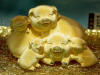 Year of the Pig - February 18, 2007
  Listen to MP3 “Business Beyond the Reef” to discuss
the problems with imports from China, telling all sides of the story and then
expand the discussion to revitalizing Chinatown -
Special Guest: Johnson Choi, MBA, RFC. President - Hong Kong.China.Hawaii
Chamber of Commerce (HKCHcc) and Danny Au, Manager, Bo Wah Trading
Listen to MP3 “Business Beyond the Reef” to discuss
the problems with imports from China, telling all sides of the story and then
expand the discussion to revitalizing Chinatown -
Special Guest: Johnson Choi, MBA, RFC. President - Hong Kong.China.Hawaii
Chamber of Commerce (HKCHcc) and Danny Au, Manager, Bo Wah Trading
November 30, 2007
 Hong Kong:
The frenzy for initial public offerings has likely faded as Sinotruk (3808), the
mainland's largest truck manufacturer, may follow Sinotrans Shipping (0368),
which fell below the offer price on its trading debut. Hong Kong:
The frenzy for initial public offerings has likely faded as Sinotruk (3808), the
mainland's largest truck manufacturer, may follow Sinotrans Shipping (0368),
which fell below the offer price on its trading debut.
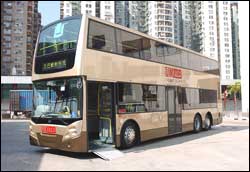 Kowloon Motor Bus yesterday announced a fare concession strategy which it says
is not aimed at the merger of Kowloon Canton Railway and the Mass Transit
Railway corporations. KMB's strategy comprises fare concession for seven
connecting trips covering 21 routes which are in areas served by KCRC and MTR
Corp. The bus company will introduce the scheme from Sunday - the same day the
merged railways will begin their fare concessions. KMB operations director Tim
Ip denied the company is trying to counter the fare reduction of the railways.
"We've been studying the implementation of the scheme and time is needed to take
steps and make preparation. So it is just a coincidence that we start our
interchange schemes on December 2. "It has no direct relationship between our
decision and the merger of the two railways," Ip said. He said the new schemes
are provided according to passengers' travel patterns and service demand. The
passengers will have to use Octopus cards for the specified bus routes and
interchange within two hours and 30 minutes. They will enjoy a discount of
HK$3.50 for airconditioned buses or HK$2.70 for non-airconditioned buses. There
will be discounts of 30 percent to 50 percent on 60 percent of the routes on the
second-leg journeys - a saving of 70 percent because of the free ride for the
rest of the routes. KMB's offer will cover West Kowloon, Tsuen Wan, Sha Tin,
Yuen Long, Tuen Mun, Tin Shui Wai and North District. In most cases, the fare
after the concession will be lower than the same route using the MTR. One of the
fare concessions is between Tsuen Wan West and Tsim Sha Tsui. Route 234A costs
HK$4.90 from Tsuen Wan to the Tai Chung Road bus stop, and if the passenger
takes a second- leg journey by using route 234X to Tsim Sha Tsui, they will save
HK$3.50 from the original fare of HK$7.50 for the second journey. The total cost
will be HK$8.90. For a journey by MTR on its single-journey fare rate, it will
be HK$9, or HK$8.20 with an Octopus card. Ip pointed out the concession will not
affect KMB's September decision to apply for a 9 percent fare rise, as the
company is still under pressure from surging operating costs such as fuel and
salary increases. He said KMB had taken into account the latest concession
scheme before making that application.
Kowloon Motor Bus yesterday announced a fare concession strategy which it says
is not aimed at the merger of Kowloon Canton Railway and the Mass Transit
Railway corporations. KMB's strategy comprises fare concession for seven
connecting trips covering 21 routes which are in areas served by KCRC and MTR
Corp. The bus company will introduce the scheme from Sunday - the same day the
merged railways will begin their fare concessions. KMB operations director Tim
Ip denied the company is trying to counter the fare reduction of the railways.
"We've been studying the implementation of the scheme and time is needed to take
steps and make preparation. So it is just a coincidence that we start our
interchange schemes on December 2. "It has no direct relationship between our
decision and the merger of the two railways," Ip said. He said the new schemes
are provided according to passengers' travel patterns and service demand. The
passengers will have to use Octopus cards for the specified bus routes and
interchange within two hours and 30 minutes. They will enjoy a discount of
HK$3.50 for airconditioned buses or HK$2.70 for non-airconditioned buses. There
will be discounts of 30 percent to 50 percent on 60 percent of the routes on the
second-leg journeys - a saving of 70 percent because of the free ride for the
rest of the routes. KMB's offer will cover West Kowloon, Tsuen Wan, Sha Tin,
Yuen Long, Tuen Mun, Tin Shui Wai and North District. In most cases, the fare
after the concession will be lower than the same route using the MTR. One of the
fare concessions is between Tsuen Wan West and Tsim Sha Tsui. Route 234A costs
HK$4.90 from Tsuen Wan to the Tai Chung Road bus stop, and if the passenger
takes a second- leg journey by using route 234X to Tsim Sha Tsui, they will save
HK$3.50 from the original fare of HK$7.50 for the second journey. The total cost
will be HK$8.90. For a journey by MTR on its single-journey fare rate, it will
be HK$9, or HK$8.20 with an Octopus card. Ip pointed out the concession will not
affect KMB's September decision to apply for a 9 percent fare rise, as the
company is still under pressure from surging operating costs such as fuel and
salary increases. He said KMB had taken into account the latest concession
scheme before making that application.
Macau property industry
professionals received a pay rise this year that was double that of their Hong
Kong counterparts, topping the list of a salary and benefits survey of seven
Asia-Pacific regions.
The green light for relaunching
Lantau's problem-plagued cable car depends on a final reliability test scheduled
within two weeks' time, Ngong Ping 360's deputy head of operations Raymond Leung
Wai-man said yesterday.
 Tony Leung
(R) and Tang Wei are seen in this post of "Lust, Caution". They have been
nominated for best leading actor and actress in the 2008 Film Independent's
Spirit Awards. Tony Leung
(R) and Tang Wei are seen in this post of "Lust, Caution". They have been
nominated for best leading actor and actress in the 2008 Film Independent's
Spirit Awards.
 Chinese star Gong Li
and John Cusack are set to feature in a new period drama set in Shanghai during
World War II, entertainment industry press reported on Tuesday. Gong, whose
recent movies include "Curse of the Golden Flower," "Miami Vice" and "Memoirs of
a Geisha," has already signed to star in the film, "Shanghai," Daily Variety
reported. Veteran actor Cusack, who has earned glowing reviews for his
performance in recent films "Grace is Gone" and thriller "1408," is still in
negotiations with studio bosses from The Weinstein Co., the report added. Cusack
is being lined up to play an American who returns to Japanese-occupied Shanghai
four months before Pearl Harbor to discover that a friend has been killed. The
film follows Cusack as he unravels the mystery of the death and gradually
uncovers a cover-up, Variety reported. The film is to be directed by Mikael
Hafstrom with filming scheduled to begin in 2008. Chinese star Gong Li
and John Cusack are set to feature in a new period drama set in Shanghai during
World War II, entertainment industry press reported on Tuesday. Gong, whose
recent movies include "Curse of the Golden Flower," "Miami Vice" and "Memoirs of
a Geisha," has already signed to star in the film, "Shanghai," Daily Variety
reported. Veteran actor Cusack, who has earned glowing reviews for his
performance in recent films "Grace is Gone" and thriller "1408," is still in
negotiations with studio bosses from The Weinstein Co., the report added. Cusack
is being lined up to play an American who returns to Japanese-occupied Shanghai
four months before Pearl Harbor to discover that a friend has been killed. The
film follows Cusack as he unravels the mystery of the death and gradually
uncovers a cover-up, Variety reported. The film is to be directed by Mikael
Hafstrom with filming scheduled to begin in 2008.
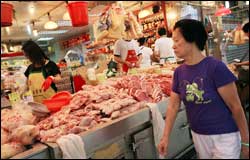  Pork lovers will have to dig deeper into their pockets
following another price rise - the third in six months. They will have to pay
HK$38 for a catty of fresh pork, up HK$2, after Ng Fung Hong - one of the
territory's three suppliers of live pigs from the mainland - raised the
wholesale price of pork by a hefty 8 percent yesterday. The company said the
adjustment is aimed at stabilizing local supply amid continued price increases
in fresh pork in the mainland. The latest increase represents a 25 percent jump
in the wholesale price to more than HK$1,300 per 100 catties and a rise of HK$8
per catty in the retail price since May. The Fresh Meat Alliance - a union of
live-pig buyers and truck drivers - has warned that high pork prices are here to
stay for some time. Alliance spokesman Ling Wai-yip said he is not optimistic
about any price cuts in the near future as prices of live pigs in the mainland
have continued to soar for the seventh week.
Pork lovers will have to dig deeper into their pockets
following another price rise - the third in six months. They will have to pay
HK$38 for a catty of fresh pork, up HK$2, after Ng Fung Hong - one of the
territory's three suppliers of live pigs from the mainland - raised the
wholesale price of pork by a hefty 8 percent yesterday. The company said the
adjustment is aimed at stabilizing local supply amid continued price increases
in fresh pork in the mainland. The latest increase represents a 25 percent jump
in the wholesale price to more than HK$1,300 per 100 catties and a rise of HK$8
per catty in the retail price since May. The Fresh Meat Alliance - a union of
live-pig buyers and truck drivers - has warned that high pork prices are here to
stay for some time. Alliance spokesman Ling Wai-yip said he is not optimistic
about any price cuts in the near future as prices of live pigs in the mainland
have continued to soar for the seventh week.
Hong Kong stocks fell Wednesday in volatile trade,
tracking a broad sell-off in global equity markets amid widening losses linked
to the subprime mortgage market. But stocks bounced back in the afternoon
recouping some of the early losses.
Shares in HSBC (0005) fell as much
as 3.1 percent yesterday, after the bank announced it would provide US$35
billion (HK$273 billion) in funding to save its two structured investment
vehicles, and JPMorgan said Standard Chartered (2888) may "need to follow suit,"
and move US$13 billion of SIV assets onto its balance sheet.
 China:
China on Tuesday got its first judge on the World Trade Organization (WTO)'s
highest court, six years after the country joined the Geneva-based body. Chinese
lawyer Zhang Yuejiao was formally appointed by the WTO Dispute Settlement Body (DSB)
as a member of the seven-person Appellate Body, which issues final rulings in
trade disputes, WTO sources said. Jennifer Hillman of the United States, Lilia
Bautista of the Philippines and Shotaro Oshima of Japan were also appointed as
new members of the top court at a DSB meeting on Tuesday. The appointments were
made according to the Dispute Settlement Understanding which stipulates that the
Appellate Body shall "comprise persons of recognized authority, with
demonstrated expertise in law, international trade and the subject matter of the
WTO agreements generally," a WTO statement said. The WTO said Hillman and
Bautista would formally join the top court next month, while Zhang and Oshima
would join in June. They can serve up to two four-year terms. Zhang, 63, is
professor of law at Shantou University in China. She is also an arbitrator on
China's International Trade and Economic Arbitration Commission and practises
law as a private attorney. Zhang once held positions at the Chinese Ministry of
Commerce as well as at the Asian Development Bank.
China:
China on Tuesday got its first judge on the World Trade Organization (WTO)'s
highest court, six years after the country joined the Geneva-based body. Chinese
lawyer Zhang Yuejiao was formally appointed by the WTO Dispute Settlement Body (DSB)
as a member of the seven-person Appellate Body, which issues final rulings in
trade disputes, WTO sources said. Jennifer Hillman of the United States, Lilia
Bautista of the Philippines and Shotaro Oshima of Japan were also appointed as
new members of the top court at a DSB meeting on Tuesday. The appointments were
made according to the Dispute Settlement Understanding which stipulates that the
Appellate Body shall "comprise persons of recognized authority, with
demonstrated expertise in law, international trade and the subject matter of the
WTO agreements generally," a WTO statement said. The WTO said Hillman and
Bautista would formally join the top court next month, while Zhang and Oshima
would join in June. They can serve up to two four-year terms. Zhang, 63, is
professor of law at Shantou University in China. She is also an arbitrator on
China's International Trade and Economic Arbitration Commission and practises
law as a private attorney. Zhang once held positions at the Chinese Ministry of
Commerce as well as at the Asian Development Bank.
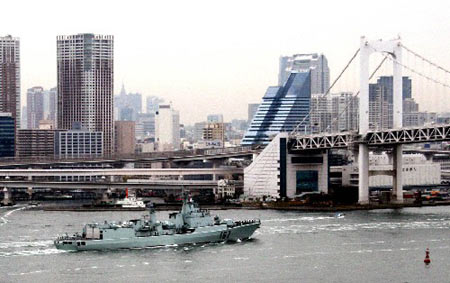 The
Chinese People's Liberation Army(PLA) Naval missile destroyer "Shenzhen" arrived
in Tokyo on Wednesday morning for a four-day visit. "Shenzhen," with 345
officials and soldiers onboard headed by Rear Admiral Xiao Xinnian, vice chief
of staff of the South China Sea Fleet of the PLA Navy, entered into the Tokyo
Bay earlier in the morning and was led to the port by the Japanese Maritime
Self-Defense Force (MSDF)'s frigate "Thunder". The 9:55 a.m. port call at Harumi
wharf, which is close to central Tokyo, is the first of its kind in the history
of PLA's navy. The
Chinese People's Liberation Army(PLA) Naval missile destroyer "Shenzhen" arrived
in Tokyo on Wednesday morning for a four-day visit. "Shenzhen," with 345
officials and soldiers onboard headed by Rear Admiral Xiao Xinnian, vice chief
of staff of the South China Sea Fleet of the PLA Navy, entered into the Tokyo
Bay earlier in the morning and was led to the port by the Japanese Maritime
Self-Defense Force (MSDF)'s frigate "Thunder". The 9:55 a.m. port call at Harumi
wharf, which is close to central Tokyo, is the first of its kind in the history
of PLA's navy.
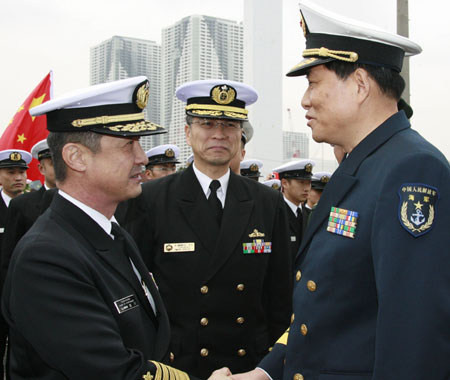 Rear
Admiral Xiao Xinnian(R), vice chief of staff of the South China Sea Fleet of the
Chinese PLA (People's Liberation Army) Navy, shakes hands with Eiji Yoshikawa,
chief of staff of the Japanese Maritime Self-Defense Force (MSDF), after
arriving in Tokyo on Nov. 28, 2007. The Chinese People's Liberation Army (PLA)'s
navy missile destroyer "Shenzhen" arrives in Tokyo Wednesday morning for a 4-day
goodwill visit to Japan, Nov. 28, 2007. It's the first time for PLA vessels to
visit Japan. Rear
Admiral Xiao Xinnian(R), vice chief of staff of the South China Sea Fleet of the
Chinese PLA (People's Liberation Army) Navy, shakes hands with Eiji Yoshikawa,
chief of staff of the Japanese Maritime Self-Defense Force (MSDF), after
arriving in Tokyo on Nov. 28, 2007. The Chinese People's Liberation Army (PLA)'s
navy missile destroyer "Shenzhen" arrives in Tokyo Wednesday morning for a 4-day
goodwill visit to Japan, Nov. 28, 2007. It's the first time for PLA vessels to
visit Japan.
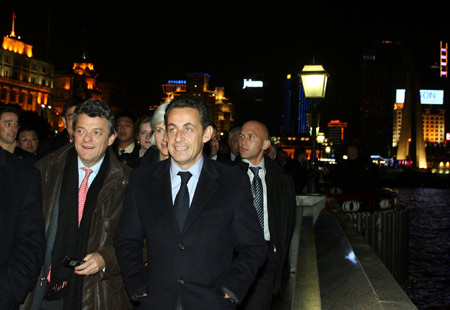 French
President Nicolas Sarkozy (R Front) visits the Bund Area in Shanghai, east
China, on Nov. 27, 2007. Sarkozy left here Tuesday, concluding his three-day
state visit to China. French
President Nicolas Sarkozy (R Front) visits the Bund Area in Shanghai, east
China, on Nov. 27, 2007. Sarkozy left here Tuesday, concluding his three-day
state visit to China.
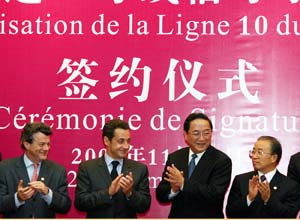 A signing ceremony
between Shanghai Shentong Metro. Co., Ltd and French Alstom company was held on
purchasing signal equipment for Shanghai metro line 10 in Shanghai, east China,
on Nov. 27, 2007. A signing ceremony
between Shanghai Shentong Metro. Co., Ltd and French Alstom company was held on
purchasing signal equipment for Shanghai metro line 10 in Shanghai, east China,
on Nov. 27, 2007.
Chinese toys export rebounds despite recalls - Customs
authorities in Guangdong Province, a major base for the toy-making industry in
southern China, said demand for exported toys has rebounded despite a spate of
recall dramas earlier this year. Latest statistics obtained from the Huangpu
Customs show the value of toys exported by Guangdong slipped by 5.4 percent in
September compared to the same period last year, but it regained strength to
register a year-on-year increase of 27.6 percent in October. Customs analysts
said the rebound was spurred by rising demands in the Christmas retail season,
and it also shows that toy recalls, staged by the US toy maker, Mattel Inc,
since summer over lead-contaminated surface paint, proved to have had limited
impact on the province's toy exports. Mattel apologized to China in September
that 87 percent of the recalled toys were found to have loose magnets -- a
design defect from Mattel itself -- and 13 percent of which contained excessive
lead. In the first ten months, Guangdong exported toys with a total value of
US$4.94 billion, up 22.9 percent over the same period last year. About US$3.92
billion, or 79 percent of the total were exported to the United States and the
European Union. Exports to the US alone were US$2.31 billion, up 15.4 percent
over the same period last year, while a 53.6 percent hike was seen in exports to
Latin American countries. Guangdong alone manufactures about 70 percent of the
total Chinese toys made for export and about half of the world's toys. In order
to address the customer uproars over toy safety, the province launched a
month-long safety inspection in September over its toy manufacturers. The
provincial Quarantine and Inspection Bureau announced at the end of October it
did discover problems like substandard paint and loose parts in toys. The bureau
withdrew production licenses from 423 toy makers, suspended licenses of 341 toy
companies, and ordered 690 others to improve their working practices.
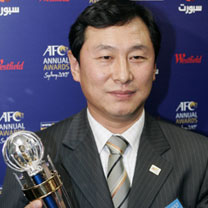 China Football
Association Vice President Nan Yong poses after China won the Asian Football
Federation (AFC) Association of the Year at the AFC Annual Awards in Sydney
November 28, 2007. China Football
Association Vice President Nan Yong poses after China won the Asian Football
Federation (AFC) Association of the Year at the AFC Annual Awards in Sydney
November 28, 2007.
China Post to auction hotels to shed non-core assets -
China Post Group, operator of the country's postal system, will auction off 60
hotels, an asset exchange said, as the government urges state companies to shed
non-core businesses. The China Beijing Equity Exchange, a site for trade in
unlisted assets, said on its Web site that China Post would sell the hotels
through an auction at the exchange. An exchange official said the hotels,
located in 24 provinces across China, would be subject to further valuation but
would be worth a total of at least four billion yuan (US$541 million). China
Post put 30 hotels up for sale in June in an auction in Shanghai and aims to
sell all 400 of its hotels by the end of 2008. China's state asset watchdog, the
State-owned Assets Supervision and Administration Commission, has urged major
state-run companies to focus on their main businesses and sell unrelated
operations to improve efficiency and competitiveness. Sinopec Corp, Asia's top
refiner, plans to sell its hotel businesses to China Travel Service Ltd. China
Post Group was created in January in a restructuring aimed at improving
efficiency in the country's postal system, which was previously operated by the
government itself. Some hotel operators see the auction as an opportunity to
expand. Home Inns & Hotel Management Inc, China's biggest budget hotel chain,
said in July it was in talks with China Post on the purchase of some properties
as it aims to quadruple the number of its hotels to 1,000 in the next few years.
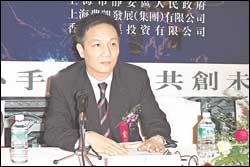 Disgraced
Shanghai property tycoon Chau Ching-ngai could face the death penalty or be
sentenced to life imprisonment if he is convicted on charges of bribery,
embezzlement and tax fraud. The Shanghai No 2 Intermediate People's Court posted
a notice yesterday saying it will hand down its verdict on Friday. Chau, 46,
also known as Zhou Zhengyi, has been on trial on three charges related to his
Shanghai-based property company, Nongkai Development Group. The counts include
offering bribes and forging value-added tax invoices. Chau has also been charged
with two other counts of bribery and embezzlement. Disgraced
Shanghai property tycoon Chau Ching-ngai could face the death penalty or be
sentenced to life imprisonment if he is convicted on charges of bribery,
embezzlement and tax fraud. The Shanghai No 2 Intermediate People's Court posted
a notice yesterday saying it will hand down its verdict on Friday. Chau, 46,
also known as Zhou Zhengyi, has been on trial on three charges related to his
Shanghai-based property company, Nongkai Development Group. The counts include
offering bribes and forging value-added tax invoices. Chau has also been charged
with two other counts of bribery and embezzlement.
November 29, 2007
Hong Kong:
China aluminum foil maker Xiashun Holdings Ltd, plans to raise up to US$272.4
million from its Hong Kong initial public offering, according to its term sheet.
The company, which kicks off a marketing roadshow for its IPO on Tuesday, is
offering 500 million new shares, or 25 percent of its enlarged share capital,
with a price range of HK$3.10-HK$4.25 each, the term sheet said. The indicative
price range represents a price-to-earnings multiple of 15 to 20.7 times the
sponsors' earnings forecast for 2008. By comparison, Aluminum Corp of China Ltd
now trades at 17 times 2008 earnings forecast. China-based packaging material
producers Nine Dragons and Lee & Man Paper trade at between 17 times and 19
times. Xiashun provides light-gauge aluminium foil, which is used in packaging
in the food and beverage and cigarette industries, for Sweden's Tetra Pak, a
packager for Mengniu Dairy and Huiyuan Juice. The sponsors, UBS and JP Morgan
expect the company could increase net profit about 20 percent to near HK$260
million in 2007. For 2008, they project a further increase to HK$375 million and
HK$445 million, respectively. The firm also has three cornerstone investors --
including New World Development Chairman Zheng Yu Tong, BOCI Financial Products
Ltd and Chinese Estates Holdings Chairman Lau Luen Hung -- would take a combined
US$45 million worth of shares, with a six-month lock-up period. Xiashun starts
its marketing roadshow on Monday, and the Hong Kong public offering will start
on December 5, with a trading debut scheduled for December 18. The company plans
to use 60 percent of the proceeds to purchase equipment and for a future
upstream expansion program, while 30 percent is to be used for acquisitions and
joint ventures.
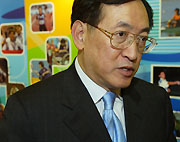 HK official calls for e-certificate food system - Hong Kong Secretary for Food
and Health York Chow said in Beijing on Tuesday that a common international
platform for an electronic health-certificate system should be developed to
enable food tracing with laser precision. According to a press release from the
Information Services Department of Hong Kong Special Administrative Region
(HKSAR) government, Chow said at the international food safety forum that with
the platform authorities can predict food issues before they occur and food
incidents can be resolved within hours rather than days. Hong Kong is heading
towards this direction and devising a set of food standards and making the best
use of an electronic food-tracing system, he added. Chow said a common format
and platform for electronic health and food safety certification could greatly
minimize economic, political and health damage caused by food-safety incidents.
He said the HKSAR government is drawing up a new law to manage food safety, is
learning from the best international practice and is more than willing to
contribute to the strengthening of international co-operation on the issue,
according to the press release. Chow said the goal is to ensure a comprehensive
and up-to-date set of food-safety standards complying with international
standards, yet suited to Hong Kong's circumstances. The HKSAR government is
planning a central poultry abattoir to avoid a human avian-influenza outbreak.
Although the proposal has been hotly debated, Chow said he is confident the
public will support it.
HK official calls for e-certificate food system - Hong Kong Secretary for Food
and Health York Chow said in Beijing on Tuesday that a common international
platform for an electronic health-certificate system should be developed to
enable food tracing with laser precision. According to a press release from the
Information Services Department of Hong Kong Special Administrative Region
(HKSAR) government, Chow said at the international food safety forum that with
the platform authorities can predict food issues before they occur and food
incidents can be resolved within hours rather than days. Hong Kong is heading
towards this direction and devising a set of food standards and making the best
use of an electronic food-tracing system, he added. Chow said a common format
and platform for electronic health and food safety certification could greatly
minimize economic, political and health damage caused by food-safety incidents.
He said the HKSAR government is drawing up a new law to manage food safety, is
learning from the best international practice and is more than willing to
contribute to the strengthening of international co-operation on the issue,
according to the press release. Chow said the goal is to ensure a comprehensive
and up-to-date set of food-safety standards complying with international
standards, yet suited to Hong Kong's circumstances. The HKSAR government is
planning a central poultry abattoir to avoid a human avian-influenza outbreak.
Although the proposal has been hotly debated, Chow said he is confident the
public will support it.
 New
Year's Eve will herald Hong Kong's two free television stations entering the
digital age. From 7pm on December 31, half the territory will witness a new era
of broadcasting. Viewers with an analogue TV set will have to purchase a digital
set-top box or buy a set with built-in decoder to access the channels. Asia
Television and Television Broadcasts announced their decision at a joint press
conference yesterday with the Commerce and Economic Development Bureau. The
government said preparations for introducing free digital television are
proceeding as planned. These will initially cover Kowloon Peninsula, north Hong
Kong Island, part of Sha Tin and the east of Lantau Island. Secretary for
Commerce and Economic Development Frederick Ma Si- hang said the two stations
will accelerate construction on transmission stations to target 75 percent
population coverage between the end of this year and early August. In an initial
phase of digital development, ATV will roll out seven channels and TVB five.
Each will have several standard (SDTV) channels and a high definition channel
(HDTV). ATV senior vice president of program Kwong Hoi-ying said news and
finance broadcasts will have trial runs as early as 7am on December 2. The
government will assist the Housing Department in upgrading cable systems for
public estates and liaise with property management companies to provide
technical assistance on communal aerial systems. Receivers costing several
hundred dollars eliminate common reception problems, while expensive and
sophisticated receivers costing thousands of dollars offer access to HDTV.
"Digital terrestrial television will enable both standard and high definition
formats," said Citi analyst Jason Brueschke. HDTV offers a clearer image and
uses a wider, 16:9 aspect, ratio. "The main benefits of digital TV are
significantly clearer and sharper images and enhanced sound quality," Brueschke
explained. ATV vice president of engineering Choi Chung-hong said no set-top
boxes currently available have yet been approved under the Office of the
Telecommunications Authority's voluntary labeling scheme. TVB spokeswoman
Stephanie Wong Hoi-ki said it has no detailed information on which set-top boxes
people should buy and does not recommend any particular models. "At this point,
the quality is not assured," said Wong, referring to the set- top boxes being
sold. New
Year's Eve will herald Hong Kong's two free television stations entering the
digital age. From 7pm on December 31, half the territory will witness a new era
of broadcasting. Viewers with an analogue TV set will have to purchase a digital
set-top box or buy a set with built-in decoder to access the channels. Asia
Television and Television Broadcasts announced their decision at a joint press
conference yesterday with the Commerce and Economic Development Bureau. The
government said preparations for introducing free digital television are
proceeding as planned. These will initially cover Kowloon Peninsula, north Hong
Kong Island, part of Sha Tin and the east of Lantau Island. Secretary for
Commerce and Economic Development Frederick Ma Si- hang said the two stations
will accelerate construction on transmission stations to target 75 percent
population coverage between the end of this year and early August. In an initial
phase of digital development, ATV will roll out seven channels and TVB five.
Each will have several standard (SDTV) channels and a high definition channel
(HDTV). ATV senior vice president of program Kwong Hoi-ying said news and
finance broadcasts will have trial runs as early as 7am on December 2. The
government will assist the Housing Department in upgrading cable systems for
public estates and liaise with property management companies to provide
technical assistance on communal aerial systems. Receivers costing several
hundred dollars eliminate common reception problems, while expensive and
sophisticated receivers costing thousands of dollars offer access to HDTV.
"Digital terrestrial television will enable both standard and high definition
formats," said Citi analyst Jason Brueschke. HDTV offers a clearer image and
uses a wider, 16:9 aspect, ratio. "The main benefits of digital TV are
significantly clearer and sharper images and enhanced sound quality," Brueschke
explained. ATV vice president of engineering Choi Chung-hong said no set-top
boxes currently available have yet been approved under the Office of the
Telecommunications Authority's voluntary labeling scheme. TVB spokeswoman
Stephanie Wong Hoi-ki said it has no detailed information on which set-top boxes
people should buy and does not recommend any particular models. "At this point,
the quality is not assured," said Wong, referring to the set- top boxes being
sold.
HSBC (0005) will bring US$45
billion (HK$351 billion) of assets from two structured investment vehicles (SIVs)
onto its balance sheet to mitigate the impact of funding shortages facing the
credit market, the London-based lender said yesterday.
Hong Kong's exports grew stronger
than expected last month as robust growth in shipments to the mainland and other
Asian markets helped offset slowing demand in the United States. But economists
warned of a less supportive external environment in coming months as the US
economy slows.
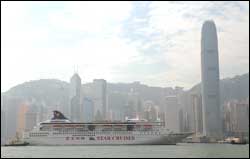 Race for new hot spots as cruise
industry grows - Tourists made a total of 450,000 visits to Hong Kong aboard
cruise liners in the first nine months of this year - an increase of 150 percent
over the same period last year. The boom has led tourism bodies to explore new
cruise destinations in the Greater China region and Asia Pacific, helped by the
expected opening of the territory's second cruise terminal at Kai Tak in 2012.
Speaking at a ceremony yesterday to mark the arrival of Star Cruises' redeployed
vessel, SuperStar Libra, Hong Kong Tourism Board executive director Anthony Lau
Chun-hon said the cruise industry is now the fastest- growing tourism sector
worldwide, and the Asia Pacific region will be the hot spot for growth. Among
the 450,000 cruise visits, more than half were made by tourists who flew here
first and toured Hong Kong before boarding cruise liners. Lau said Hong Kong
needs to step up the game amid stiff competition from neighbors to become a
regional cruise hub. Star Cruises - the world's third- largest cruise operator
owned by Malaysia's Genting Group - is one of the leading bidders for the Kai
Tak cruise terminal project announced on November 9. William Ng Ko-yin,
executive director of Star Cruises, said the company is interested in bidding
for the project with partners, and hopes to submit its proposals soon. Tenders
will close on March 7 next year. Tourism commissioner Au King-chi recently met
with representatives from Guangdong, Guangxi, Fujian and Hainan provinces in
Kunming to discuss the possibility of opening up more destinations for cruise
tourists. Cruise operators are also positioning themselves as Hong Kong steps up
efforts to become the region's cruise hub. The 42,000-tonne SuperStar Libra,
which can carry 1,480 passengers, will operate out of Hong Kong until March next
year. At present, Star Cruises is the only cruise operator to have three vessels
based in Hong Kong. The other two are SuperStar Aquarius and Star Pisces, while
another liner, Virgo, will join the fleet next year. SuperStar Libra will soon
begin cruises to Zhanjiang, Haikou and Sanya in the mainland, Halong Bay in
Vietnam and Kaohsiung in Taiwan. Ng said exploring new destinations in the Asia
Pacific and the Greater China region will help the group meet its future
targets. "The cruise business must have good connections with nearby countries -
having a terminal is not enough," he said. The Tourism Commission said having
more cruise vessels based in Hong Kong will strengthen the territory's position
as a regional cruise hub. Race for new hot spots as cruise
industry grows - Tourists made a total of 450,000 visits to Hong Kong aboard
cruise liners in the first nine months of this year - an increase of 150 percent
over the same period last year. The boom has led tourism bodies to explore new
cruise destinations in the Greater China region and Asia Pacific, helped by the
expected opening of the territory's second cruise terminal at Kai Tak in 2012.
Speaking at a ceremony yesterday to mark the arrival of Star Cruises' redeployed
vessel, SuperStar Libra, Hong Kong Tourism Board executive director Anthony Lau
Chun-hon said the cruise industry is now the fastest- growing tourism sector
worldwide, and the Asia Pacific region will be the hot spot for growth. Among
the 450,000 cruise visits, more than half were made by tourists who flew here
first and toured Hong Kong before boarding cruise liners. Lau said Hong Kong
needs to step up the game amid stiff competition from neighbors to become a
regional cruise hub. Star Cruises - the world's third- largest cruise operator
owned by Malaysia's Genting Group - is one of the leading bidders for the Kai
Tak cruise terminal project announced on November 9. William Ng Ko-yin,
executive director of Star Cruises, said the company is interested in bidding
for the project with partners, and hopes to submit its proposals soon. Tenders
will close on March 7 next year. Tourism commissioner Au King-chi recently met
with representatives from Guangdong, Guangxi, Fujian and Hainan provinces in
Kunming to discuss the possibility of opening up more destinations for cruise
tourists. Cruise operators are also positioning themselves as Hong Kong steps up
efforts to become the region's cruise hub. The 42,000-tonne SuperStar Libra,
which can carry 1,480 passengers, will operate out of Hong Kong until March next
year. At present, Star Cruises is the only cruise operator to have three vessels
based in Hong Kong. The other two are SuperStar Aquarius and Star Pisces, while
another liner, Virgo, will join the fleet next year. SuperStar Libra will soon
begin cruises to Zhanjiang, Haikou and Sanya in the mainland, Halong Bay in
Vietnam and Kaohsiung in Taiwan. Ng said exploring new destinations in the Asia
Pacific and the Greater China region will help the group meet its future
targets. "The cruise business must have good connections with nearby countries -
having a terminal is not enough," he said. The Tourism Commission said having
more cruise vessels based in Hong Kong will strengthen the territory's position
as a regional cruise hub.
 The
speed limits on Hong Kong's information superhighway are rising, with some of
the city's big telecommunications players rolling out faster networks and more
services linked to optical fibre cables. PCCW (SEHK: 0008), the city's largest
broadband provider, aims to offer various high-speed bandwidth applications,
including high-definition television, following the launch of its
1,000-megabits-per-second residential service. With PCCW's aggressive move to
faster broadband services, rival i-Cable Communications (SEHK: 1097) is studying
plans to further upgrade its cable network infrastructure. PCCW last week
unveiled Netvigator Fibre Direct, an optical fibre broadband service, to
residential customers with transmission speeds of between 100 and 1,000 megabits
per second. It will charge users between HK$588 and HK$2,188 per month. PCCW
offers a slower broadband service over existing copper telephone lines, based on
a technology called asymmetrical digital subscribers line (ADSL). The new
optical fibre service will be bundled with free high-definition television
subscriptions, waiving the monthly set-top-box rental and subscription tariff
for VOOM, its high-definition television channel. "We have invested in the
optical fibre network for 25 years in Hong Kong and it is the right time now to
launch the fibre direct service," said PCCW group managing director Alex Arena.
"We have so many optical fibres in Hong Kong and are ready to offer the service
to most of our users." PCCW is bringing so-called passive optical network
technology or xPON to the residential market after offering it to commercial
customers previously. Sources said ZTE (SEHK: 0763), Huawei Technologies and
UTStacom are helping PCCW roll out the service in Hong Kong. Users require a
single box, including an optical-fibre convertor and high-definition TV set-top
box, for the high-speed broadband service. The convertor turns the optical
signal into an electrical signal to deliver the broadband signal to computers
and other devices. "Since launching Now TV in 2003, we have connected many
residential buildings," a company source said, adding that over two-thirds of
households in the city already have the service. "In recent years, PCCW has also
installed optical fibres in newly-built residential buildings instead of
traditional copper wire." PCCW is conducting trials on a
1,250-megabits-per-second broadband service and laboratory testd on a
2,500-megabits-per-second service. Its efforts to develop high-speed broadband
services had not been given a high priority in previous years as the company
focused on offering services based on ADSL technology. However, when Hong Kong
Broadband Network, the fixed-line arm of City Telecom, this month launched a new
marketing campaign criticising ADSL technology as too slow, the pressure to act
was on. Ben Tong, executive director of i-Cable Communications, said the company
was looking into upgrading its broadband services to support transmission speeds
of 25 to 100 megabits per second, from 10 at present. However, Mr Tong said it
was not all about speed. "Speed is not the unique edge for broadband services.
We need content," he said. The
speed limits on Hong Kong's information superhighway are rising, with some of
the city's big telecommunications players rolling out faster networks and more
services linked to optical fibre cables. PCCW (SEHK: 0008), the city's largest
broadband provider, aims to offer various high-speed bandwidth applications,
including high-definition television, following the launch of its
1,000-megabits-per-second residential service. With PCCW's aggressive move to
faster broadband services, rival i-Cable Communications (SEHK: 1097) is studying
plans to further upgrade its cable network infrastructure. PCCW last week
unveiled Netvigator Fibre Direct, an optical fibre broadband service, to
residential customers with transmission speeds of between 100 and 1,000 megabits
per second. It will charge users between HK$588 and HK$2,188 per month. PCCW
offers a slower broadband service over existing copper telephone lines, based on
a technology called asymmetrical digital subscribers line (ADSL). The new
optical fibre service will be bundled with free high-definition television
subscriptions, waiving the monthly set-top-box rental and subscription tariff
for VOOM, its high-definition television channel. "We have invested in the
optical fibre network for 25 years in Hong Kong and it is the right time now to
launch the fibre direct service," said PCCW group managing director Alex Arena.
"We have so many optical fibres in Hong Kong and are ready to offer the service
to most of our users." PCCW is bringing so-called passive optical network
technology or xPON to the residential market after offering it to commercial
customers previously. Sources said ZTE (SEHK: 0763), Huawei Technologies and
UTStacom are helping PCCW roll out the service in Hong Kong. Users require a
single box, including an optical-fibre convertor and high-definition TV set-top
box, for the high-speed broadband service. The convertor turns the optical
signal into an electrical signal to deliver the broadband signal to computers
and other devices. "Since launching Now TV in 2003, we have connected many
residential buildings," a company source said, adding that over two-thirds of
households in the city already have the service. "In recent years, PCCW has also
installed optical fibres in newly-built residential buildings instead of
traditional copper wire." PCCW is conducting trials on a
1,250-megabits-per-second broadband service and laboratory testd on a
2,500-megabits-per-second service. Its efforts to develop high-speed broadband
services had not been given a high priority in previous years as the company
focused on offering services based on ADSL technology. However, when Hong Kong
Broadband Network, the fixed-line arm of City Telecom, this month launched a new
marketing campaign criticising ADSL technology as too slow, the pressure to act
was on. Ben Tong, executive director of i-Cable Communications, said the company
was looking into upgrading its broadband services to support transmission speeds
of 25 to 100 megabits per second, from 10 at present. However, Mr Tong said it
was not all about speed. "Speed is not the unique edge for broadband services.
We need content," he said.
China:
DHL, the world's leading express and logistics company, inked a deal with the
Shanghai Airport Authority on Monday to invest 175 million U.S. dollars on a new
north Asia cargo hub at the Shanghai Pudong International Airport. The move
followed the announcement UPS to establish an international cargo hub at the
airport on April 12 this year. Pudong airport is to be the first airport in the
world with two international cargo hubs, said sources with the airport. "The
investment of DHL signals that Shanghai has become an international center for
cargo transportation," said Wu Nianzu, board chairman of the Shanghai Airport
Authority. "After both hubs go into operation, the Pudong airport might become
the world's top three in terms of cargo transportation," he said. Freight volume
handled at the airport stood at 2.16 million tons last year, making the airport
world's sixth biggest cargo transporter, according to an earlier report by China
News Service. The north Asia cargo hub increased DHL's total investment in the
Asia-Pacific region to 2.2 billion U.S. dollars, and would improve DHL's network
in the region, where it has 50 ports and gateways. The first stage of the
project is due to be finished by 2010, when an express service center covering
88,000 square meters will come into use. Owned by Germany's Deutsche Post, DHL
provides express service, air parcel, ocean shipping, inter-continental
transportation, logistics and international postal service to more than 220
countries and regions. Its revenue in 2006 exceeded 60 billion euro.
 Wu Yi slams EU trade chief over
product safety - China' top trade official, Vice Premier Wu Yi, has strongly
rejected European Union Trade Commissioner Peter Mandelson's speech in Beijing
on the mainland's food safety, saying she was "extremely dissatisfied" that he
had politicized the issue. Wu Yi slams EU trade chief over
product safety - China' top trade official, Vice Premier Wu Yi, has strongly
rejected European Union Trade Commissioner Peter Mandelson's speech in Beijing
on the mainland's food safety, saying she was "extremely dissatisfied" that he
had politicized the issue.
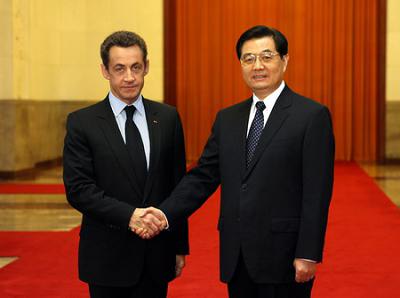 Chinese President Hu Jintao
(R) welcomes his French counterpart Nicolas Sarkozy in Beijing on November 26,
2007.Sarkozy arrived in Beijing on Sunday for his first state visit to China
since taking office in May. Chinese President Hu Jintao
(R) welcomes his French counterpart Nicolas Sarkozy in Beijing on November 26,
2007.Sarkozy arrived in Beijing on Sunday for his first state visit to China
since taking office in May.
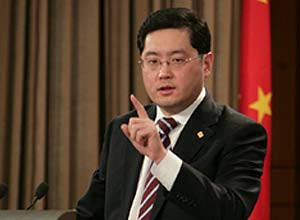 China attaches importance to food safety - Chinese Foreign Ministry Spokesman
Qin Gang said in Beijing on Tuesday that China attached great importance to food
safety and had taken effective measures in legislation, administration and media
supervision. Chinese Foreign Ministry Spokesman Qin Gang said in Beijing on
Tuesday that China attached great importance to food safety and had taken
effective measures in legislation, administration and media supervision. Qin
said obvious achievements have been made since China recently tightened
supervising on food safety. The rate of unqualified products in the export of
food from the European Union (EU) to China stood at 0.84 percent in the first
nine months of this year, while that from China to EU stood only at 0.2 percent,
Qin said. "We would make 100 percent efforts to resolve the 0.2 percent problem
(unqualified food)," Qin added. Citing Japanese official statistics released
last July, Qin said, 99.42 percent of the food exported from China to Japan were
qualified, which was higher than the United States' rate of 98.69 percent in its
exported food to Japan and the EU's rate of 99.38 percent. Qin admitted that
there is certain problems in Chinese food production, but such problems were
very few, and China has taken responsible attitude in dealing with the problems
so as to continuously raise the qualification rate of food and other products.
Noting that food safety was a challenge for the international community, Qin
said all countries should join hands to maintain people's health. Qin also
called on media to make objective, true, just and responsible reports about
Chinese food safety, saying China would not only enhance product quality, but
also protect legitimate rights and interests of Chinese manufacturers and
consumers.
China attaches importance to food safety - Chinese Foreign Ministry Spokesman
Qin Gang said in Beijing on Tuesday that China attached great importance to food
safety and had taken effective measures in legislation, administration and media
supervision. Chinese Foreign Ministry Spokesman Qin Gang said in Beijing on
Tuesday that China attached great importance to food safety and had taken
effective measures in legislation, administration and media supervision. Qin
said obvious achievements have been made since China recently tightened
supervising on food safety. The rate of unqualified products in the export of
food from the European Union (EU) to China stood at 0.84 percent in the first
nine months of this year, while that from China to EU stood only at 0.2 percent,
Qin said. "We would make 100 percent efforts to resolve the 0.2 percent problem
(unqualified food)," Qin added. Citing Japanese official statistics released
last July, Qin said, 99.42 percent of the food exported from China to Japan were
qualified, which was higher than the United States' rate of 98.69 percent in its
exported food to Japan and the EU's rate of 99.38 percent. Qin admitted that
there is certain problems in Chinese food production, but such problems were
very few, and China has taken responsible attitude in dealing with the problems
so as to continuously raise the qualification rate of food and other products.
Noting that food safety was a challenge for the international community, Qin
said all countries should join hands to maintain people's health. Qin also
called on media to make objective, true, just and responsible reports about
Chinese food safety, saying China would not only enhance product quality, but
also protect legitimate rights and interests of Chinese manufacturers and
consumers.
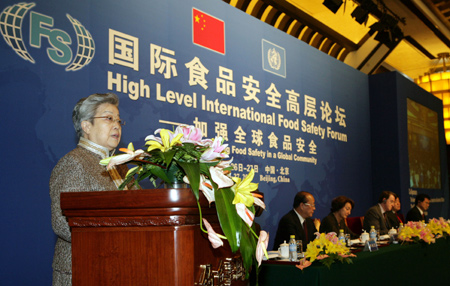 Chinese Vice Premier Wu Yi delivers a speech at the High Level International
Food Safety Forum in Beijing Nov. 26, 2007. The forum opened in Beijing on
Monday. Chinese Vice Premier Wu Yi said here on Monday that international food
safety issues should be settled through friendly consultation, instead of finger
pointing and groundless blames.
Chinese Vice Premier Wu Yi delivers a speech at the High Level International
Food Safety Forum in Beijing Nov. 26, 2007. The forum opened in Beijing on
Monday. Chinese Vice Premier Wu Yi said here on Monday that international food
safety issues should be settled through friendly consultation, instead of finger
pointing and groundless blames.
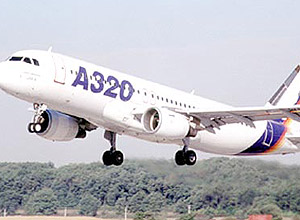 China has signed an
agreement worth 17.4 billion U.S. dollars to buy 160 planes from French company
Airbus. The deal, inked in Beijing, is composed of 110 A320 planes and 50 A330
planes, according to Airbus China. China has signed an
agreement worth 17.4 billion U.S. dollars to buy 160 planes from French company
Airbus. The deal, inked in Beijing, is composed of 110 A320 planes and 50 A330
planes, according to Airbus China.
 Chinese mainland actress Gong Li is making another push into Hollywood, by
taking the leading role in new film "Shanghai." Chinese mainland actress Gong Li
is making another push into Hollywood, by taking the leading role in new film
"Shanghai." Chinese mainland actress Gong Li is making another push into
Hollywood, by taking the leading role in new film "Shanghai." In the new film,
the 41-year-old veteran actress will play a mysterious woman who deals with the
underworld and a journalist from the US, starred by American actor John Cusack.
She picked the role for the possible breakthroughs in her performing skills
required for the new role, portal website sina.com reported on Friday. Gong Li
is now busy with preparations for the shooting, scheduled to kick off next
February in Shanghai, Los Angeles and Canada. Over the past few years Gong Li
has become a bigwig among Asian actresses in Hollywood, engaged in blockbusters
such as Memories of a Geisha (2005), Miami Vice (2006) and Hannibal Rising
(2007).
Chinese mainland actress Gong Li is making another push into Hollywood, by
taking the leading role in new film "Shanghai." Chinese mainland actress Gong Li
is making another push into Hollywood, by taking the leading role in new film
"Shanghai." Chinese mainland actress Gong Li is making another push into
Hollywood, by taking the leading role in new film "Shanghai." In the new film,
the 41-year-old veteran actress will play a mysterious woman who deals with the
underworld and a journalist from the US, starred by American actor John Cusack.
She picked the role for the possible breakthroughs in her performing skills
required for the new role, portal website sina.com reported on Friday. Gong Li
is now busy with preparations for the shooting, scheduled to kick off next
February in Shanghai, Los Angeles and Canada. Over the past few years Gong Li
has become a bigwig among Asian actresses in Hollywood, engaged in blockbusters
such as Memories of a Geisha (2005), Miami Vice (2006) and Hannibal Rising
(2007).
November 28, 2007
Hong Kong:
Citic Securities eyes HK listing -
Citic Securities Co Ltd, China's largest securities firm by market value, is
considering listing in Hong Kong in the wake of its pioneering joint venture
agreement with US investment bank Bear Stearns Co Inc, the Financial Times
reported on Monday. The newspaper quoted Citic Securities Chairman Wang Dongming
as saying an offshore listing for Citic, the securities arm of Citic Group,
would help to make it a truly global firm. "It would help us internationalize
our mindset," he said. "If you list in Hong Kong, you become real." Wang said
there were still several serious issues to be considered before a final decision
on a Hong Kong listing could be made. These include the Hong Kong Stock
Exchange's requirement that listings in the territory must cover a minimum of 15
percent of issued share capital, the report said. In addition, the Chinese
government requires all companies listing outside the Chinese mainland to hand
over 10 percent of the proceeds to the national social security fund, the
newspaper said, adding this would cost Citic Securities about five billion yuan
(US$675.54 million), based on its current share price in Shanghai. Citic
Securities has been increasing its earnings rapidly and expects to continue
growing fast."Everyone is over-enjoying their market capitalization," he said.
"We know these high multiples can't last forever." Wang said he had studied the
bubble years of the late 1980s in Japan and was determined to avoid what he saw
as the missed opportunities of the big Japanese securities firms. "We pay
attention because the Japanese used to be so important in the world," he said.
"So many of them were in the top tier and today, none of them are. We ask why
they are no longer first tier?" Wang attributed this Japanese decline to a
failure to invest in information technology, and a domestic focus that created
reluctance to recruit enough non-Japanese staff to become global players.
 One of Hong Kong’s most famous and
distinguished citizens – Sir Run Run Shaw – turned 100 on November 26 2007. Born
Rein Sha in Ningbo, Zhejiang on the mainland, Sir Run Run is famous as a
businessman, philanthropist, and film-maker. He was one of six sons born to a
Shanghai textile merchant in 1907 and received his education in American-run
schools. His impact on the film industry in Asia has been extraordinary. As Time
magazine said: “Shaw is the name that dominates the movie business of Southeast
Asia. Shaw Brothers’ films, produced at Shaw’s Movietown, shot in Shawscope
colour and shown in 143 Shaw-owned theatres, attract 250,000 people a day from
Hong Kong to Jakarta, plus thousands more in Chinatowns around the world.” Sir
Run Run one explained his success this way: “A small screen can never compare
with a big screen. Movie houses will carry on. People like to go out, they like
to be in a crowd. I am very fortunate. Our organisation owns so many theatres in
this part of the world that there’s no competition.” Sir Run Run travelled to
Singapore with his brother Dr Run Me Shaw at 19 to establish a film market. It
was then that he developed an interest in the film business. Their trip to
Singapore saw the brothers establishing a film company in 1930 called South Seas
Film Studio which later on became Shaw Studios. It went on to produce famous
Chinese films such as The Five Deadly Venoms and made many virtual unknowns into
household names. By 1967, Sir Run Run came to Hong Kong and eventually launched
TVB (SEHK: 0511) – one of Hong Kong’s biggest broadcasters. The broadcasting
channel is now a million dollar enterprise and hosts the annual pageant Miss
Hong Kong which has produced many stars such as Anita Yuen and Bernice Liu. He
received his knighthood in 1977 for his contributions to Hong Kong. Shaw
Studios, on the other hand, stopped productions in 1987. After his wife died, he
remarried in 1997 to Mona Fong Yat-wah, the current deputy chairwoman of TVB. In
May Ms Fong told reporters after the annual shareholders’ meeting that Sir Run
Run “is considering to retire” this year. Sir Run Run also delved into other
businesses such as real estate. He owns the 23-story Shaw Tower at Cathedral
Place located in Vancouver, Canada and few other prime estates around the world.
He is also well known for his philanthropy. Over the years, Sir Run Run has
donated billions of dollars to schools, charities and hospitals. In 2004, he
created the international Shaw Prize or the Nobel Prize of the east – awarded to
scientists in three areas of research such as astronomy, mathematics and life
and medical science – with a prize value of HK$1 million. One of Hong Kong’s most famous and
distinguished citizens – Sir Run Run Shaw – turned 100 on November 26 2007. Born
Rein Sha in Ningbo, Zhejiang on the mainland, Sir Run Run is famous as a
businessman, philanthropist, and film-maker. He was one of six sons born to a
Shanghai textile merchant in 1907 and received his education in American-run
schools. His impact on the film industry in Asia has been extraordinary. As Time
magazine said: “Shaw is the name that dominates the movie business of Southeast
Asia. Shaw Brothers’ films, produced at Shaw’s Movietown, shot in Shawscope
colour and shown in 143 Shaw-owned theatres, attract 250,000 people a day from
Hong Kong to Jakarta, plus thousands more in Chinatowns around the world.” Sir
Run Run one explained his success this way: “A small screen can never compare
with a big screen. Movie houses will carry on. People like to go out, they like
to be in a crowd. I am very fortunate. Our organisation owns so many theatres in
this part of the world that there’s no competition.” Sir Run Run travelled to
Singapore with his brother Dr Run Me Shaw at 19 to establish a film market. It
was then that he developed an interest in the film business. Their trip to
Singapore saw the brothers establishing a film company in 1930 called South Seas
Film Studio which later on became Shaw Studios. It went on to produce famous
Chinese films such as The Five Deadly Venoms and made many virtual unknowns into
household names. By 1967, Sir Run Run came to Hong Kong and eventually launched
TVB (SEHK: 0511) – one of Hong Kong’s biggest broadcasters. The broadcasting
channel is now a million dollar enterprise and hosts the annual pageant Miss
Hong Kong which has produced many stars such as Anita Yuen and Bernice Liu. He
received his knighthood in 1977 for his contributions to Hong Kong. Shaw
Studios, on the other hand, stopped productions in 1987. After his wife died, he
remarried in 1997 to Mona Fong Yat-wah, the current deputy chairwoman of TVB. In
May Ms Fong told reporters after the annual shareholders’ meeting that Sir Run
Run “is considering to retire” this year. Sir Run Run also delved into other
businesses such as real estate. He owns the 23-story Shaw Tower at Cathedral
Place located in Vancouver, Canada and few other prime estates around the world.
He is also well known for his philanthropy. Over the years, Sir Run Run has
donated billions of dollars to schools, charities and hospitals. In 2004, he
created the international Shaw Prize or the Nobel Prize of the east – awarded to
scientists in three areas of research such as astronomy, mathematics and life
and medical science – with a prize value of HK$1 million.
 HK official visits Shanghai to promote HK's shipping and maritime services -
Hong Kong Secretary for Transport and Housing Eva Cheng began a four-day visit
to Shanghai and Ningbo of Zhejiang province on Monday, according to a news
release from the Information Services Department of Hong Kong Special
Administrative Region government. The mission, organized by the Maritime
Industry Council and the Marine Department, serves as a platform for industry
leaders to meet potential customers and partners and keep pace with the latest
developments in Shanghai and Ningbo, the news release said. According to the
released schedule, the 29-member mission will on Tuesday visit Marintec China
2007, a prominent international shipping and maritime trade fair with 1,100
exhibitors from 30 countries and regions, including Hong Kong. Cheng will open
the Hong Kong Pavilion at Marintec China, which will showcase Hong Kong's
strengths in maritime services such as ocean transport, ship management, ship
register, maritime communications and navigation equipment. Cheng will on
Wednesday open a seminar on Hong Kong maritime services in Ningbo, where
speakers from the mission will update the Chinese mainland audience on Hong
Kong's professional services in shipping finance, insurance, maritime law,
taxation, ship management and shipping register, the news release said.
HK official visits Shanghai to promote HK's shipping and maritime services -
Hong Kong Secretary for Transport and Housing Eva Cheng began a four-day visit
to Shanghai and Ningbo of Zhejiang province on Monday, according to a news
release from the Information Services Department of Hong Kong Special
Administrative Region government. The mission, organized by the Maritime
Industry Council and the Marine Department, serves as a platform for industry
leaders to meet potential customers and partners and keep pace with the latest
developments in Shanghai and Ningbo, the news release said. According to the
released schedule, the 29-member mission will on Tuesday visit Marintec China
2007, a prominent international shipping and maritime trade fair with 1,100
exhibitors from 30 countries and regions, including Hong Kong. Cheng will open
the Hong Kong Pavilion at Marintec China, which will showcase Hong Kong's
strengths in maritime services such as ocean transport, ship management, ship
register, maritime communications and navigation equipment. Cheng will on
Wednesday open a seminar on Hong Kong maritime services in Ningbo, where
speakers from the mission will update the Chinese mainland audience on Hong
Kong's professional services in shipping finance, insurance, maritime law,
taxation, ship management and shipping register, the news release said.
 Chinese action star Jet Li could get
100 million yuan (about 13.3 million U.S. dollars) for starring in the battle
epic "The Warlords," breaking the record for an actor in a Chinese-language
film, according to the movie's director. Nearly half the budget for the 40
million U.S.-dollar Chinese epic went to the cast, with 100 million yuan to Jet
Li, 16 million yuan to Hong Kong star Andy Lau, 12 million yuan to Takeshi
Kaneshiro, and 2 million yuan to mainland actress Xu Jinglei. "Without Jet Li,
we would not dare to invest 40 million U.S. dollars in a Chinese-language film,"
said director Peter Chan. Chan stressed that Li was the "guarantee" for global
sales. According to Chan, Li can command the equivalent of 120 million yuan in
contemporary Hollywood blockbusters, but he agreed to accept less because of his
friendship with Chan. But the 100-million-yuan payday still broke the record for
a star in a Chinese film -- one that was held by Li himself, Chan said. Li
previously got 70 million yuan for starring in Chinese director Zhang Yimou's
"Hero." Chan earlier spoke highly of Li's ability to handle dramatic scenes when
he was promoting "The Warlords," calling him "the biggest surprise." "I haven't
seen Li handle so much drama in a movie. You can see from clips of the movie
that he portrays many emotional scenes very seriously, very effectively," Chan
was quoted in media reports as saying. Li, 44, a former national kung fu
champion on the Chinese mainland, made his name in Hong Kong films in the 1990s
with movies such as "The Legend of Fong Sai-Yuk" series before moving on to
Hollywood. He recently shot the third installment of the successful "Mummy"
films, titled "The Mummy: Tomb of the Dragon Emperor," and played a resurrected
ancient Chinese emperor. "The Warlords" is an epic about three blood brothers
and their struggle amid war and political upheaval. It is based on "The
Assassination of Ma," a Qing Dynasty (1644-1911) story about the killing of
General Ma Xinyi. The story was previously filmed under the title of "The Blood
Brothers" by Zhang Che in 1973. A release of the new film on Dec. 13, 2007 is
listed for the Chinese mainland, Hong Kong and southeast Asia. It is scheduled
to be released from next March in North America. Chinese action star Jet Li could get
100 million yuan (about 13.3 million U.S. dollars) for starring in the battle
epic "The Warlords," breaking the record for an actor in a Chinese-language
film, according to the movie's director. Nearly half the budget for the 40
million U.S.-dollar Chinese epic went to the cast, with 100 million yuan to Jet
Li, 16 million yuan to Hong Kong star Andy Lau, 12 million yuan to Takeshi
Kaneshiro, and 2 million yuan to mainland actress Xu Jinglei. "Without Jet Li,
we would not dare to invest 40 million U.S. dollars in a Chinese-language film,"
said director Peter Chan. Chan stressed that Li was the "guarantee" for global
sales. According to Chan, Li can command the equivalent of 120 million yuan in
contemporary Hollywood blockbusters, but he agreed to accept less because of his
friendship with Chan. But the 100-million-yuan payday still broke the record for
a star in a Chinese film -- one that was held by Li himself, Chan said. Li
previously got 70 million yuan for starring in Chinese director Zhang Yimou's
"Hero." Chan earlier spoke highly of Li's ability to handle dramatic scenes when
he was promoting "The Warlords," calling him "the biggest surprise." "I haven't
seen Li handle so much drama in a movie. You can see from clips of the movie
that he portrays many emotional scenes very seriously, very effectively," Chan
was quoted in media reports as saying. Li, 44, a former national kung fu
champion on the Chinese mainland, made his name in Hong Kong films in the 1990s
with movies such as "The Legend of Fong Sai-Yuk" series before moving on to
Hollywood. He recently shot the third installment of the successful "Mummy"
films, titled "The Mummy: Tomb of the Dragon Emperor," and played a resurrected
ancient Chinese emperor. "The Warlords" is an epic about three blood brothers
and their struggle amid war and political upheaval. It is based on "The
Assassination of Ma," a Qing Dynasty (1644-1911) story about the killing of
General Ma Xinyi. The story was previously filmed under the title of "The Blood
Brothers" by Zhang Che in 1973. A release of the new film on Dec. 13, 2007 is
listed for the Chinese mainland, Hong Kong and southeast Asia. It is scheduled
to be released from next March in North America.
 Hong Kong is likely to face a cut in the supply of water from the mainland,
which plans to limit the amount of water that cities, including Hong Kong, can
draw from the Dongjiang River.
Hong Kong is likely to face a cut in the supply of water from the mainland,
which plans to limit the amount of water that cities, including Hong Kong, can
draw from the Dongjiang River.
 Hong Kong's export traders may turn out to
be the losers from weak holiday sales in the United States this season, with
fourth-quarter numbers worsening, analysts say. Hong Kong's export traders may turn out to
be the losers from weak holiday sales in the United States this season, with
fourth-quarter numbers worsening, analysts say.
 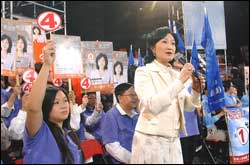 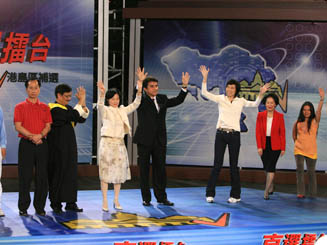 Former chief secretary for administration Anson Chan Fang On-sang and former
security chief Regina Ip Lau Suk-yee yesterday clashed over their respective
proposals for introducing universal suffrage in 2012, questioning each other if
they are sincere in pushing for democracy.
Former chief secretary for administration Anson Chan Fang On-sang and former
security chief Regina Ip Lau Suk-yee yesterday clashed over their respective
proposals for introducing universal suffrage in 2012, questioning each other if
they are sincere in pushing for democracy.
China:
China's homegrown private automobile manufacturer Geely Automobile said it was
planning to set up a joint venture in Russia amid its efforts of going global.
Representatives from nearly 130 Chinese food enterprises, which are here for an
international food security forum scheduled for Nov. 26-27, vowed on Sunday to
improve quality control.
 China publishes its first pictureof the moon captured by Chang’e-1, the
country’s first lunar probe, marking the full success of its lunar probe project
on November 26, 2007.
China publishes its first pictureof the moon captured by Chang’e-1, the
country’s first lunar probe, marking the full success of its lunar probe project
on November 26, 2007.
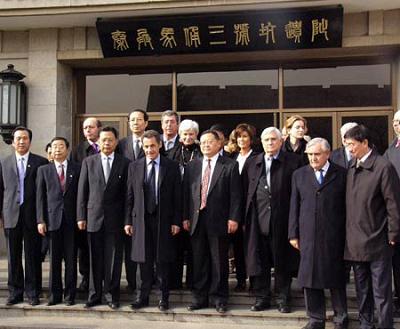 French President Nicolas Sarkozy (4L,
Front) and his entourage pose for a group photo with local people at the Museum
of Terracotta Horses and Armored Warriors of the First Emperor of the Qin
Dynasty in Xi’an, capital of Northwest China’s Shaanxi Province, Nov. 25, 2007.
According to the nuclear energy cooperation deal signed on Monday, Areva of
France will help build two reactors in Guangdong Province. French President Nicolas Sarkozy (4L,
Front) and his entourage pose for a group photo with local people at the Museum
of Terracotta Horses and Armored Warriors of the First Emperor of the Qin
Dynasty in Xi’an, capital of Northwest China’s Shaanxi Province, Nov. 25, 2007.
According to the nuclear energy cooperation deal signed on Monday, Areva of
France will help build two reactors in Guangdong Province.
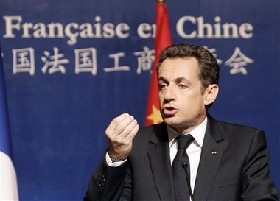 France's President Nicolas Sarkozy
delivers a speech to businessmen at the Franco-Chinese Chamber of Commerce in
Beijing, November 25, 2007, on the first day of a three-day official visit in
China. Airbus said it signed contracts Monday to sell 160 commercial passenger
jets to China in a deal worth around US$14.8 billion. The order includes 110 of
the European company's A320 jets and 50 of the slightly larger A330 planes,
Airbus officials said in Beijing, where they were accompanying French President
Nicolas Sarkozy on his first state visit to China. Airbus and Chinese partners
this summer signed an agreement to produce A320s in China in anticipation of
large Chinese orders for the popular single aisle jet that seats 150 or more
passengers. Size-wise, the plane is well suited for Chinese domestic routes
expected to show strong growth in the years ahead as the economy continues to
expand. Airbus and its American archrival Boeing Co. predict China will become
the world's second-biggest aircraft market after the United States, with
airlines buying 1,900 to 2,600 planes over the next two decades. The order
stands to push Airbus past Chicago-based Boeing in total orders for commercial
aircraft this year. Boeing said last week it had received 1,047 commercial
airplane orders this year, already beating its 2006 record-setting total of
1,044 orders with more than a month to go. Airbus had logged 1,021 commercial
jet orders as of the end of October, the most recent data available on the
company's website. The exact price tag for the purchase was not immediately
clear. Louis Gallois, chief executive of European Aeronautic Defence & Space Co.
NV, the owner of Airbus, said he "had not calculated it." French officials
speaking on condition of anonymity said the deal totaled about 10 billion euros,
or US$14.8 billion. Other Airbus officials said the list price of the planes
came to about US$17 billion. The deal is welcome news to Airbus, which has
struggled with a decline in the US dollar and delays with its A400M military
transport aircraft and the A380 superjumbo that has wiped billions of euros off
EADS' profit. Earlier this month, Gallois said the company needed to find an
extra 1 billion euros (US$1.46 billion) in cost savings after the planemaker and
its parent company announced third-quarter losses. The dollar's drop to record
lows against the euro also makes it harder for Airbus to compete against Boeing
Co., because while it sells its planes in dollars, many of its costs are in
euros. Airbus' agreement to assemble planes in China was seen as part of a
long-term strategy to win a greater share of the Chinese market. Its final
assembly line in the Chinese city of Tianjian is due to deliver its first
aircraft in early 2009. The plant is expected to be able to produce four A320s a
month by 2011 and a total of about 300 A320 planes by 2016. France's President Nicolas Sarkozy
delivers a speech to businessmen at the Franco-Chinese Chamber of Commerce in
Beijing, November 25, 2007, on the first day of a three-day official visit in
China. Airbus said it signed contracts Monday to sell 160 commercial passenger
jets to China in a deal worth around US$14.8 billion. The order includes 110 of
the European company's A320 jets and 50 of the slightly larger A330 planes,
Airbus officials said in Beijing, where they were accompanying French President
Nicolas Sarkozy on his first state visit to China. Airbus and Chinese partners
this summer signed an agreement to produce A320s in China in anticipation of
large Chinese orders for the popular single aisle jet that seats 150 or more
passengers. Size-wise, the plane is well suited for Chinese domestic routes
expected to show strong growth in the years ahead as the economy continues to
expand. Airbus and its American archrival Boeing Co. predict China will become
the world's second-biggest aircraft market after the United States, with
airlines buying 1,900 to 2,600 planes over the next two decades. The order
stands to push Airbus past Chicago-based Boeing in total orders for commercial
aircraft this year. Boeing said last week it had received 1,047 commercial
airplane orders this year, already beating its 2006 record-setting total of
1,044 orders with more than a month to go. Airbus had logged 1,021 commercial
jet orders as of the end of October, the most recent data available on the
company's website. The exact price tag for the purchase was not immediately
clear. Louis Gallois, chief executive of European Aeronautic Defence & Space Co.
NV, the owner of Airbus, said he "had not calculated it." French officials
speaking on condition of anonymity said the deal totaled about 10 billion euros,
or US$14.8 billion. Other Airbus officials said the list price of the planes
came to about US$17 billion. The deal is welcome news to Airbus, which has
struggled with a decline in the US dollar and delays with its A400M military
transport aircraft and the A380 superjumbo that has wiped billions of euros off
EADS' profit. Earlier this month, Gallois said the company needed to find an
extra 1 billion euros (US$1.46 billion) in cost savings after the planemaker and
its parent company announced third-quarter losses. The dollar's drop to record
lows against the euro also makes it harder for Airbus to compete against Boeing
Co., because while it sells its planes in dollars, many of its costs are in
euros. Airbus' agreement to assemble planes in China was seen as part of a
long-term strategy to win a greater share of the Chinese market. Its final
assembly line in the Chinese city of Tianjian is due to deliver its first
aircraft in early 2009. The plant is expected to be able to produce four A320s a
month by 2011 and a total of about 300 A320 planes by 2016.
 Miss China Zhang Zilin performs during the
57th Miss World Competition in Sanya of south China’s Hainan Province, Nov. 24,
2007. Zhang is honored the title of best model. Miss China Zhang Zilin performs during the
57th Miss World Competition in Sanya of south China’s Hainan Province, Nov. 24,
2007. Zhang is honored the title of best model.
 China drives the
global digital TV growth and will account for a quarter of all digital TV
households by 2012, according to Informa Telecoms and Media's Global Digital TV
report. China drives the
global digital TV growth and will account for a quarter of all digital TV
households by 2012, according to Informa Telecoms and Media's Global Digital TV
report.
 The European Union is facing a huge trade deficit with China but its own
companies are partly to blame for the imbalance, analysts said, ahead of the
annual Sino-EU summit in Beijing. The EU ran a trade deficit of 128 billion
euros (HK$1.47 trillion) with China last year and this is likely to balloon to
170 billion euros this year on current trends, according to EU statistics.
Economists point out that European companies with operations in China are a
crucial part of the mainland export juggernaut and profit immensely. "China's
trade surplus looks very big, but it has little to do with Chinese companies and
much more to do with multinationals," said Zhang Yansheng, head of the
Beijing-based Institute for International Economic Research. EU policymakers
have vowed to push the trade deficit issue to the top of the agenda when they
meet with their mainland counterparts this week. "During the six days that I
spend in China, the trade deficit will grow by over 2 billion euros, or 15
million euros an hour," EU trade chief Peter Mandelson has said. "That is what I
call unsustainable." But among the 15 million euros of hourly net exports, a
sizeable amount eventually winds up in the coffers of European companies,
including some of its most prestigious brands. For example, Swedish wireless
networks maker Ericsson exports 25 percent of its production in China back to
Europe. Factories in China account for 46 percent of German sportswear maker
adidas' global footwear production. These are not isolated cases. Of the US$878
billion (HK$6.85 trillion) in products exported in the first nine months of the
year, 56.6 percent belonged to foreign enterprises, according to Ministry of
Commerce figures. For 19 percent of European companies in China, exports home
form a "sizeable" part of their output, while 22 percent see Asia as their main
target market, according to the European Chamber of Commerce.
The European Union is facing a huge trade deficit with China but its own
companies are partly to blame for the imbalance, analysts said, ahead of the
annual Sino-EU summit in Beijing. The EU ran a trade deficit of 128 billion
euros (HK$1.47 trillion) with China last year and this is likely to balloon to
170 billion euros this year on current trends, according to EU statistics.
Economists point out that European companies with operations in China are a
crucial part of the mainland export juggernaut and profit immensely. "China's
trade surplus looks very big, but it has little to do with Chinese companies and
much more to do with multinationals," said Zhang Yansheng, head of the
Beijing-based Institute for International Economic Research. EU policymakers
have vowed to push the trade deficit issue to the top of the agenda when they
meet with their mainland counterparts this week. "During the six days that I
spend in China, the trade deficit will grow by over 2 billion euros, or 15
million euros an hour," EU trade chief Peter Mandelson has said. "That is what I
call unsustainable." But among the 15 million euros of hourly net exports, a
sizeable amount eventually winds up in the coffers of European companies,
including some of its most prestigious brands. For example, Swedish wireless
networks maker Ericsson exports 25 percent of its production in China back to
Europe. Factories in China account for 46 percent of German sportswear maker
adidas' global footwear production. These are not isolated cases. Of the US$878
billion (HK$6.85 trillion) in products exported in the first nine months of the
year, 56.6 percent belonged to foreign enterprises, according to Ministry of
Commerce figures. For 19 percent of European companies in China, exports home
form a "sizeable" part of their output, while 22 percent see Asia as their main
target market, according to the European Chamber of Commerce.
 China has urged local governments
to set up an early-warning system to ensure sufficient oil supplies at filling
stations, which face shortages across the nation. China has urged local governments
to set up an early-warning system to ensure sufficient oil supplies at filling
stations, which face shortages across the nation.
November 27, 2007
Hong Kong:
Alibaba.com (1688) founder and chairman Jack Ma Yun, left, has bought a luxury
duplex penthouse, with the price tag of HK$42,325 per square foot setting
another record in Asia's luxury property market.
 Kevin Rudd won the election as new Australian Prime Minister amongst the
long-heard voices for the change of government, when voters complained on
Howard's reforms in industrial relations and rising interest rates.
Kevin Rudd won the election as new Australian Prime Minister amongst the
long-heard voices for the change of government, when voters complained on
Howard's reforms in industrial relations and rising interest rates.
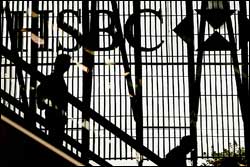 Hong Kong banks are
facing pressure to raise salaries or lose employees. Hongkong Bank says salaries
need to be adjusted and the Hong Kong Association of Banks agrees that salaries
should be raised. Hang Seng Bank (0011) vice chairman and chief executive
Raymond Or Ching-fai said on Friday the staff turnover rate of the bank is
predicted to be 12 percent this year - a decrease from 13 percent to 14 percent
last year, but an increase over the past average of 8-9 percent. "The turnover
rate pressure is likely to continue next year and salaries have to be adjusted
to retain talent," said Or, though he was unable to say by what percentage
salaries were likely to increase. Salaries at HSBC and Hang Seng Bank have
already been adjusted twice this year. They have also lifted the upper limit of
bonuses from the equivalent of four months' salary to five months. Hong Kong
Association of Banks chairman Peter Sullivan said there is "upside room" for
salaries. Hongkong and Shanghai Banking Corp chief executive Sandy Flockhart
said there is inflationary pressure, and that salary adjustments would be
necessary. The pressure to recruit and retain the right staff in the financial
services industry is more acute in Hong Kong than anywhere else in the world,
except for Japan, according to a survey by Robert Half International, a
recruitment agency specializing in financial services. The survey showed that 74
percent are worried about losing their top performers to other job opportunities
in the coming year. "There has been a bit of a war for financial talent," said
Andrew Brushfield, director of the Hong Kong office of Robert Half. Hong Kong banks are
facing pressure to raise salaries or lose employees. Hongkong Bank says salaries
need to be adjusted and the Hong Kong Association of Banks agrees that salaries
should be raised. Hang Seng Bank (0011) vice chairman and chief executive
Raymond Or Ching-fai said on Friday the staff turnover rate of the bank is
predicted to be 12 percent this year - a decrease from 13 percent to 14 percent
last year, but an increase over the past average of 8-9 percent. "The turnover
rate pressure is likely to continue next year and salaries have to be adjusted
to retain talent," said Or, though he was unable to say by what percentage
salaries were likely to increase. Salaries at HSBC and Hang Seng Bank have
already been adjusted twice this year. They have also lifted the upper limit of
bonuses from the equivalent of four months' salary to five months. Hong Kong
Association of Banks chairman Peter Sullivan said there is "upside room" for
salaries. Hongkong and Shanghai Banking Corp chief executive Sandy Flockhart
said there is inflationary pressure, and that salary adjustments would be
necessary. The pressure to recruit and retain the right staff in the financial
services industry is more acute in Hong Kong than anywhere else in the world,
except for Japan, according to a survey by Robert Half International, a
recruitment agency specializing in financial services. The survey showed that 74
percent are worried about losing their top performers to other job opportunities
in the coming year. "There has been a bit of a war for financial talent," said
Andrew Brushfield, director of the Hong Kong office of Robert Half.
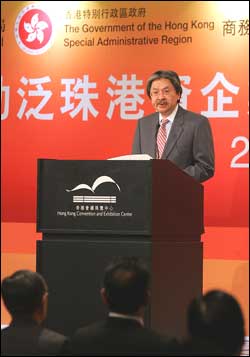 Financial Secretary
John Tsang Chun- wah said the government is concerned about accelerating
inflation and will take measures to ease problems faced by people who are not
well off. The consumer price index hit a nine- year high at 3.2 percent last
month compared to September's 1.6 percent. "The economy is exposed to many
external factors," Tsang said. "With a weakening US dollar, stronger yuan,
rising global food prices and surging international crude prices, the city's
inflation rate will ... rise." Tsang's views were echoed by Hang Seng Bank
(0011) chief executive Raymond Or Ching- fai. But Or added, "I don't think
people have to worry that much as wages will increase at the same time." With
the currency peg system, he said, it is inevitable banks will follow US rate
cuts. But SAR decisions also depend on capital inflows - especially from the
mainland through the QDII and through-train schemes. Asked whether Hong Kong is
already experiencing negative real interest rates and an asset bubble, Or said
most investors have bought bonds and opened fixed deposit accounts, which offer
higher rates. Still, he added, there is the risk of an asset bubble forming.
Merrill Lynch expects inflation pressure to continue. "The Hong Kong dollar will
depreciate further against the yuan," economist Ting Lu wrote in a report on
Thursday. "This, together with a rapid rise in food prices in China, will
continue to pose an upside risk to the city's inflation in the near term." He
said the low interest rate in Hong Kong will boost asset markets, adding to the
inflation problem. Because higher inflation affects the low-income group more,
especially when buying food, Tsang said the government has been working on
measures to help those affected. On that, Baptist University finance professor
Billy Mak Sui-choi said the fastest way to lower the CPI is by extending
property rates concessions next year. "As rentals account for the largest
weighting in the CPI, waiving rates can result in a more obvious decrease," he
said. But Mak said public housing tenants will not benefit unless rents are cut.
He believes regulating food prices will be more effective. "I don't mean the
government should intervene," Mak said. "Instead, it can discuss with mainland
authorities the possibility of introducing more food suppliers. With more
competition, food prices are likely to fall." Financial Secretary
John Tsang Chun- wah said the government is concerned about accelerating
inflation and will take measures to ease problems faced by people who are not
well off. The consumer price index hit a nine- year high at 3.2 percent last
month compared to September's 1.6 percent. "The economy is exposed to many
external factors," Tsang said. "With a weakening US dollar, stronger yuan,
rising global food prices and surging international crude prices, the city's
inflation rate will ... rise." Tsang's views were echoed by Hang Seng Bank
(0011) chief executive Raymond Or Ching- fai. But Or added, "I don't think
people have to worry that much as wages will increase at the same time." With
the currency peg system, he said, it is inevitable banks will follow US rate
cuts. But SAR decisions also depend on capital inflows - especially from the
mainland through the QDII and through-train schemes. Asked whether Hong Kong is
already experiencing negative real interest rates and an asset bubble, Or said
most investors have bought bonds and opened fixed deposit accounts, which offer
higher rates. Still, he added, there is the risk of an asset bubble forming.
Merrill Lynch expects inflation pressure to continue. "The Hong Kong dollar will
depreciate further against the yuan," economist Ting Lu wrote in a report on
Thursday. "This, together with a rapid rise in food prices in China, will
continue to pose an upside risk to the city's inflation in the near term." He
said the low interest rate in Hong Kong will boost asset markets, adding to the
inflation problem. Because higher inflation affects the low-income group more,
especially when buying food, Tsang said the government has been working on
measures to help those affected. On that, Baptist University finance professor
Billy Mak Sui-choi said the fastest way to lower the CPI is by extending
property rates concessions next year. "As rentals account for the largest
weighting in the CPI, waiving rates can result in a more obvious decrease," he
said. But Mak said public housing tenants will not benefit unless rents are cut.
He believes regulating food prices will be more effective. "I don't mean the
government should intervene," Mak said. "Instead, it can discuss with mainland
authorities the possibility of introducing more food suppliers. With more
competition, food prices are likely to fall."
 Teenagers now
know more about sex, and they are having more sex, according to the Family
Planning Association's latest findings. The number of Secondary 3 to Secondary 7
students who were reported to have had sex more than doubled - from 5.6 percent
in 1996 to 13.2 percent last year. The number of girls in the group who had sex
nearly doubled during the period - from 4.5 percent to 8.2 percent. And the
number of schoolboys who were reported to have had sex for the first time at 15
or younger reached 6.8 percent last year, compared with 3.2 percent 10 years
before that. For teenage girls it was 4.7 percent against 2.3 percent in 1996.
The survey took in 4,400 respondents aged between 12 and 27 from last November
to this February. The poll has been carried out every five years since 1981. The
survey showed that the young are becoming more knowledgeable about safe sex and
pregnancy. More than 70 percent said they knew about pregnancy risks and that
having more sexual partners would increase the risk of contracting venereal
disease. But Professor Lam Tai-hing of Hong Kong University, who chairs the
Family Planning Association's research subcommittee, said students today appear
to know less about AIDS than those questioned in 1991. Fewer than 80 percent of
secondary students were aware that AIDS could be transmitted through sharing
needles, compared with more than 90 percent in 1991. Lam attributed the drop to
the community shifting its focus from disease transmission 20 years ago to
anti-discrimination and caring for AIDS patients. The poll also showed the young
have become more liberal towards sex. About 70 percent of the Secondary 3 to
Secondary 7 students said they found the idea of cohabitation acceptable while
about half found pre-marital sex acceptable. They were also more open to
homosexuality: 54 percent of the girls and 35 percent of the boys said they
accepted lesbians, compared with 10 percent in 1991; while about one-third said
they would accept gays, against less than 10 percent previously. For young
adults between 18 and 27, 33 percent of men and 23 percent of women opted for
cohabitation before they got married, compared with only 13 percent among men
and 3 percent among women in 1991. However, 40 percent of men and 35 percent of
women said that they did not follow any family-planning methods. Dating has also
become more common among teenagers - with 46 percent of Secondary 1 and
Secondary 2 students saying they have dated before, compared with only 30
percent in 1996. The rate among students in Secondary 3 and Secondary 7 was 60
percent - up by six to eight percentage points from 1991. More teenagers
reported having intimate behavior while dating, like hugging and having sex.
Association executive director Susan Fan Yun-sun appealed to schools and parents
to offer more guidance for their children as more and more teenagers start
dating. "These young people may not be mature enough in handling a breakup in
relationships or unexpected pregnancies," she warned. Teenagers now
know more about sex, and they are having more sex, according to the Family
Planning Association's latest findings. The number of Secondary 3 to Secondary 7
students who were reported to have had sex more than doubled - from 5.6 percent
in 1996 to 13.2 percent last year. The number of girls in the group who had sex
nearly doubled during the period - from 4.5 percent to 8.2 percent. And the
number of schoolboys who were reported to have had sex for the first time at 15
or younger reached 6.8 percent last year, compared with 3.2 percent 10 years
before that. For teenage girls it was 4.7 percent against 2.3 percent in 1996.
The survey took in 4,400 respondents aged between 12 and 27 from last November
to this February. The poll has been carried out every five years since 1981. The
survey showed that the young are becoming more knowledgeable about safe sex and
pregnancy. More than 70 percent said they knew about pregnancy risks and that
having more sexual partners would increase the risk of contracting venereal
disease. But Professor Lam Tai-hing of Hong Kong University, who chairs the
Family Planning Association's research subcommittee, said students today appear
to know less about AIDS than those questioned in 1991. Fewer than 80 percent of
secondary students were aware that AIDS could be transmitted through sharing
needles, compared with more than 90 percent in 1991. Lam attributed the drop to
the community shifting its focus from disease transmission 20 years ago to
anti-discrimination and caring for AIDS patients. The poll also showed the young
have become more liberal towards sex. About 70 percent of the Secondary 3 to
Secondary 7 students said they found the idea of cohabitation acceptable while
about half found pre-marital sex acceptable. They were also more open to
homosexuality: 54 percent of the girls and 35 percent of the boys said they
accepted lesbians, compared with 10 percent in 1991; while about one-third said
they would accept gays, against less than 10 percent previously. For young
adults between 18 and 27, 33 percent of men and 23 percent of women opted for
cohabitation before they got married, compared with only 13 percent among men
and 3 percent among women in 1991. However, 40 percent of men and 35 percent of
women said that they did not follow any family-planning methods. Dating has also
become more common among teenagers - with 46 percent of Secondary 1 and
Secondary 2 students saying they have dated before, compared with only 30
percent in 1996. The rate among students in Secondary 3 and Secondary 7 was 60
percent - up by six to eight percentage points from 1991. More teenagers
reported having intimate behavior while dating, like hugging and having sex.
Association executive director Susan Fan Yun-sun appealed to schools and parents
to offer more guidance for their children as more and more teenagers start
dating. "These young people may not be mature enough in handling a breakup in
relationships or unexpected pregnancies," she warned.
 The central
government in Beijing on Thursday gave approval to the USS Kitty Hawk and
accompanying ships to enter the port of Hong Kong for the Thanksgiving holiday.
A spokesman for the mainland’s Foreign Ministry told a news conference on
Thursday the visit would be allowed to go ahead, but he didn’t explain why it
had been blocked in the first place, local radio reported. This comes after the
US asked the central government to reconsider its initial decision. Beijing had
earlier on Wednesday denied the aircraft carrier entry into the territory’s port
for undisclosed reasons – leading the 8,000 strong crew to believe they would
spend the holiday on board the vessel. Thanksgiving – which is on Thursday – is
an important celebration for Americans, who give thanks at the end of the
harvest season. In recent years, relations between the US and the mainland have
soured due to disagreements over Iran’s nuclear enrichment programme and over
the growing US trade deficit. But ties between the two powers were thought to
have improved after a visit from US Defence Secretary Robert Gates to the
mainland in an effort to calm tensions, Agence-France Presse reported. The USS
Kitty Hawk is a super-carrier and the second naval ship named after the site if
the Wright brothers’ first powered flight. She became the last active ship in
her class after the decommissioning of the USS Constellation in 2003 – making
her the oldest vessel in her class. At present, the USS Kitty Hawk is the only
permanently forward-deployed US naval ship in with the Yokosuka naval base in
Japan as her home port. She is scheduled to return to the US to be
decommissioned next year, and will be replaced by the USS George Washington. The central
government in Beijing on Thursday gave approval to the USS Kitty Hawk and
accompanying ships to enter the port of Hong Kong for the Thanksgiving holiday.
A spokesman for the mainland’s Foreign Ministry told a news conference on
Thursday the visit would be allowed to go ahead, but he didn’t explain why it
had been blocked in the first place, local radio reported. This comes after the
US asked the central government to reconsider its initial decision. Beijing had
earlier on Wednesday denied the aircraft carrier entry into the territory’s port
for undisclosed reasons – leading the 8,000 strong crew to believe they would
spend the holiday on board the vessel. Thanksgiving – which is on Thursday – is
an important celebration for Americans, who give thanks at the end of the
harvest season. In recent years, relations between the US and the mainland have
soured due to disagreements over Iran’s nuclear enrichment programme and over
the growing US trade deficit. But ties between the two powers were thought to
have improved after a visit from US Defence Secretary Robert Gates to the
mainland in an effort to calm tensions, Agence-France Presse reported. The USS
Kitty Hawk is a super-carrier and the second naval ship named after the site if
the Wright brothers’ first powered flight. She became the last active ship in
her class after the decommissioning of the USS Constellation in 2003 – making
her the oldest vessel in her class. At present, the USS Kitty Hawk is the only
permanently forward-deployed US naval ship in with the Yokosuka naval base in
Japan as her home port. She is scheduled to return to the US to be
decommissioned next year, and will be replaced by the USS George Washington.
Hong Kong police and colleagues in six countries and
regions have arrested 423 people in a crackdown on illegal soccer gambling
networks thought to have taken bets worth US$680 million.
 The KCRC is scrapping
subsidies for bus passengers introduced two years ago to boost patronage of its
West Rail line. As a result, Citybus will raise fares on three routes from next
month. The announcement came a day after the MTR Corporation (SEHK: 0066)
revealed the fare discounts most passengers will enjoy when the two rail
companies' operations merge next month. A spokesman for the Kowloon-Canton
Railway Corporation would not say whether the scrapping of subsidies was linked
to the merger. Passengers on the 701, 702, and 971 routes enjoy a HK$1.50
discount when they take a West Rail train to or from Nam Cheong station in West
Kowloon. The 701, 702, and 971 routes run between Nam Cheong and Mong Kok, Sham
Shui Po and Aberdeen, respectively. The discount will cease to apply from next
Saturday. A Citybus spokeswoman said the fare concession was being scrapped
because it had largely been funded by the KCRC's subsidy. KMB offers similar
discounts on some routes to passengers who interchange with KCR services. A
Kowloon Motor Bus spokesman said it had no plans to cancel these concessions. A
KCRC spokesman said it had taken many factors into account in deciding whether
or not to continue the promotional fare, including the benefits to passengers
and the company. With the KCRC days away from ending its role as a train
operator, it yesterday launched a book, A Century of Commitment - the KCRC
Story. Speaking at its launch, KCRC chief executive officer James Blake said:
"The book gives a fascinating account of the history of the KCR over nearly a
century, detailing the successes it has achieved, the network it has expanded
and the historic moments it has participated in." A selection of pictures from
the book is on display at East Tsim Sha Tsui station. The government-owned
corporation has also donated more than 70 items of historical interest to the
Railway Museum at Tai Po. They include a sketch of the steel bridge at Lo Wu
drawn in 1909; a plaque from the KCR British Section head office, which hung in
the old Tsim Sha Tsui terminus from 1916 to 1975; and staff rule books from 1946
and 1977. It is also selling souvenirs, with proceeds to go to the Community
Chest charity. The sale will take place at East Tsim Sha Tsui station today and
tomorrow from midday to 6pm. The KCRC is scrapping
subsidies for bus passengers introduced two years ago to boost patronage of its
West Rail line. As a result, Citybus will raise fares on three routes from next
month. The announcement came a day after the MTR Corporation (SEHK: 0066)
revealed the fare discounts most passengers will enjoy when the two rail
companies' operations merge next month. A spokesman for the Kowloon-Canton
Railway Corporation would not say whether the scrapping of subsidies was linked
to the merger. Passengers on the 701, 702, and 971 routes enjoy a HK$1.50
discount when they take a West Rail train to or from Nam Cheong station in West
Kowloon. The 701, 702, and 971 routes run between Nam Cheong and Mong Kok, Sham
Shui Po and Aberdeen, respectively. The discount will cease to apply from next
Saturday. A Citybus spokeswoman said the fare concession was being scrapped
because it had largely been funded by the KCRC's subsidy. KMB offers similar
discounts on some routes to passengers who interchange with KCR services. A
Kowloon Motor Bus spokesman said it had no plans to cancel these concessions. A
KCRC spokesman said it had taken many factors into account in deciding whether
or not to continue the promotional fare, including the benefits to passengers
and the company. With the KCRC days away from ending its role as a train
operator, it yesterday launched a book, A Century of Commitment - the KCRC
Story. Speaking at its launch, KCRC chief executive officer James Blake said:
"The book gives a fascinating account of the history of the KCR over nearly a
century, detailing the successes it has achieved, the network it has expanded
and the historic moments it has participated in." A selection of pictures from
the book is on display at East Tsim Sha Tsui station. The government-owned
corporation has also donated more than 70 items of historical interest to the
Railway Museum at Tai Po. They include a sketch of the steel bridge at Lo Wu
drawn in 1909; a plaque from the KCR British Section head office, which hung in
the old Tsim Sha Tsui terminus from 1916 to 1975; and staff rule books from 1946
and 1977. It is also selling souvenirs, with proceeds to go to the Community
Chest charity. The sale will take place at East Tsim Sha Tsui station today and
tomorrow from midday to 6pm.
 The man who would be president of City University met staff and students for the
first time yesterday, and vowed to strive to turn the institution into a
"world-class university". Way Kuo, dean of the engineering department of the
University of Tennessee, Knoxville, spent about two hours setting out his vision
to the 130-odd invited representatives. "We had a very warm discussion,"
Professor Kuo said. "We have a common goal: to make City University a
world-class university." The Taiwan-born professor was named this week as the
only candidate shortlisted for the post by a search committee. The university's
22-member ruling council is expected to discuss his appointment at a meeting on
Monday afternoon. The university's governance rules require a three-quarters
vote in favour to ratify the appointment. Speaking after yesterday's meeting,
council chairman Chung Shui-ming said Professor Kuo had the administrative and
teaching experience necessary to lead the university. Student representative
Sixtus Leung Chung-hang said the meeting was "very brief" and had dealt with
general issues, but was short on details of what direction Professor Kuo would
set for the university. "I hope he will be able to foster more co-operation
within the university," he said, adding he found the professor "very
presentable". However, council member and university staff association
vice-chairman Fung Wai-wah said he was concerned about Professor Kuo's ability
to attract fund-raising donations because of his lack of a local social network.
"He seems to be a stranger to Hong Kong," Dr Fung said. "And he is not very
familiar with City University." Acting president Richard Ho Yan-ki has been
running the university since former president Chang Hsin-kang retired in April.
His term will expire at the end of next month.
The man who would be president of City University met staff and students for the
first time yesterday, and vowed to strive to turn the institution into a
"world-class university". Way Kuo, dean of the engineering department of the
University of Tennessee, Knoxville, spent about two hours setting out his vision
to the 130-odd invited representatives. "We had a very warm discussion,"
Professor Kuo said. "We have a common goal: to make City University a
world-class university." The Taiwan-born professor was named this week as the
only candidate shortlisted for the post by a search committee. The university's
22-member ruling council is expected to discuss his appointment at a meeting on
Monday afternoon. The university's governance rules require a three-quarters
vote in favour to ratify the appointment. Speaking after yesterday's meeting,
council chairman Chung Shui-ming said Professor Kuo had the administrative and
teaching experience necessary to lead the university. Student representative
Sixtus Leung Chung-hang said the meeting was "very brief" and had dealt with
general issues, but was short on details of what direction Professor Kuo would
set for the university. "I hope he will be able to foster more co-operation
within the university," he said, adding he found the professor "very
presentable". However, council member and university staff association
vice-chairman Fung Wai-wah said he was concerned about Professor Kuo's ability
to attract fund-raising donations because of his lack of a local social network.
"He seems to be a stranger to Hong Kong," Dr Fung said. "And he is not very
familiar with City University." Acting president Richard Ho Yan-ki has been
running the university since former president Chang Hsin-kang retired in April.
His term will expire at the end of next month.
AC/InterActiveCorp, one of the world's largest internet
conglomerates, plans to invest US$100 million to set up a company on the
mainland.
China:
China started on Friday to build two new railway lines in Fujian Province on the
southeastern coast, which will slash travel times between the coastal and inland
areas.
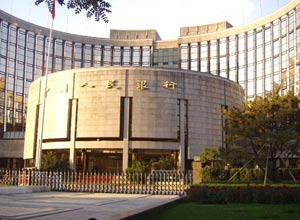 "These ratings actions reflect the
Standard & Poor's assessment that the banks' efforts to build up their financial
positions, corporate risk cultures, risk management capabilities, and business
profiles are starting to pay off, albeit to slightly different degrees," said
Liao Qiang, a Standard & Poor's credit analyst. "These ratings actions reflect the
Standard & Poor's assessment that the banks' efforts to build up their financial
positions, corporate risk cultures, risk management capabilities, and business
profiles are starting to pay off, albeit to slightly different degrees," said
Liao Qiang, a Standard & Poor's credit analyst.
 The 2007 MTV Style
Gala hit the Shanghai Grand Stage on Friday, gathering together some of the
biggest names in entertainment, including American socialite Paris Hilton, Vicky
Zhao, Li Bingbing and Nicholas Tse. The 2007 MTV Style
Gala hit the Shanghai Grand Stage on Friday, gathering together some of the
biggest names in entertainment, including American socialite Paris Hilton, Vicky
Zhao, Li Bingbing and Nicholas Tse.
China's State Council, or cabinet,
has ordered all central organs to use "economic, energy-saving,
environment-friendly and domestic-brand" automobiles.
China bought from abroad US$3.14
billion worth of textile machinery in the first eight months of this year, a
growth of 25.5 percent year on year.
 Casinos in Taiwan may generate US$3
billion (HK$23.4 billion) in total annual revenue should the island legislate to
legalize the industry, according to Las Vegas-based industry magnate Larry
Woolf, who manages 13 casinos in North America. Casinos in Taiwan may generate US$3
billion (HK$23.4 billion) in total annual revenue should the island legislate to
legalize the industry, according to Las Vegas-based industry magnate Larry
Woolf, who manages 13 casinos in North America.
French President Nicolas Sarkozy
begins a three- day state visit to China on Sunday, with business deals and the
environment at the top of his agenda.
November 26, 2007
Hong Kong:
President Hu Jintao and Premier Wen Jiabao on Friday met with chief executives
of Hong Kong and Macao Special Administrative Regions (SAR) and pledged "all-out
support" to them and their governments.
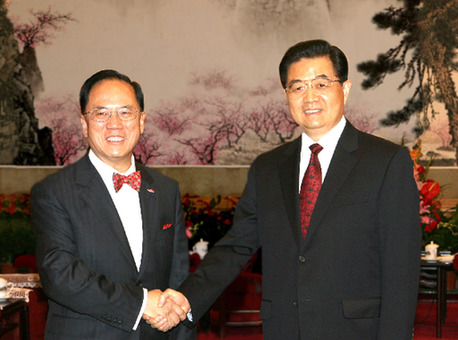 Chinese President Hu Jintao (R) meets with Chief Executive Donald Tsang of Hong
Kong Special Administrative Region (HKSAR) in Beijing, Nov. 23, 2007. The
central government will continue to unswervingly uphold the principles of "one
country, two systems" and the Basic Law of the HKSAR, and "give all-out support"
for the HKSAR Chief Executive and the HKSAR government in governance according
to law.
Chinese President Hu Jintao (R) meets with Chief Executive Donald Tsang of Hong
Kong Special Administrative Region (HKSAR) in Beijing, Nov. 23, 2007. The
central government will continue to unswervingly uphold the principles of "one
country, two systems" and the Basic Law of the HKSAR, and "give all-out support"
for the HKSAR Chief Executive and the HKSAR government in governance according
to law.
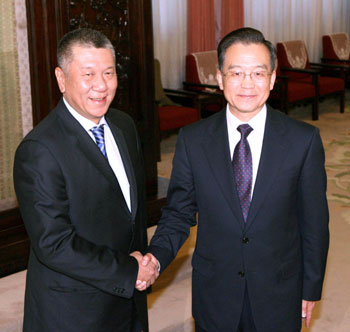 Chinese Premier Wen Jiabao (R) meets with Edmund Ho Hau Wah, chief executive of
the Macao Special Administrative Region (MSAR), in Beijing, Nov. 23, 2007. "The
central government will fully support the Macao SAR government and its chief
executive to administer the region in line with the law and to realize the
greater development of Macao," said Wen at the meeting.
Chinese Premier Wen Jiabao (R) meets with Edmund Ho Hau Wah, chief executive of
the Macao Special Administrative Region (MSAR), in Beijing, Nov. 23, 2007. "The
central government will fully support the Macao SAR government and its chief
executive to administer the region in line with the law and to realize the
greater development of Macao," said Wen at the meeting.
 Disney
characters Mickey and Minnie Mouses wave during a parade at HK Disneyland, Nov.
22, 2007. The Disney's Sparkling Christmas kicked off on Thursday. Disney
characters Mickey and Minnie Mouses wave during a parade at HK Disneyland, Nov.
22, 2007. The Disney's Sparkling Christmas kicked off on Thursday.
Hong Kong stocks extended their
losses Friday in choppy trade after the mainland markets plunged 4.5 percent on
renewed concerns the US subprime mortgage crisis could slow the Chinese
economy's breakneck pace of growth.
China:
China's currency, the yuan, Friday hit a new high against the U.S. dollar for
the second consecutive day, smashing the 7.4-yuan mark, according to the Chinese
Foreign Exchange Trading System.
 A section of
a covered road that crosses over the Beijing Zoo is illuminated at night in
Beijing, November 21, 2007. One thousand meters long, it is the first enclosed
stretch of road in the capital, and was built with insulating materials to
minimize traffic noise to the zoo animals. A section of
a covered road that crosses over the Beijing Zoo is illuminated at night in
Beijing, November 21, 2007. One thousand meters long, it is the first enclosed
stretch of road in the capital, and was built with insulating materials to
minimize traffic noise to the zoo animals.
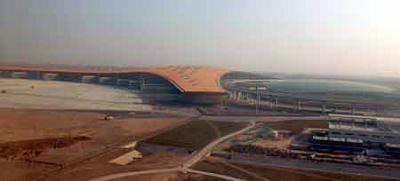 Photo
taken on Nov. 21, 2007, shows the exterior of the main building of the third
terminal of Beijing Capital International Airport. The building, which covers a
building area of around 580,000 square meters and passed a four-party acceptance
check on Wednesday, is aimed at meeting rapidly increasing air demands for the
coming Olympics in 2008. Photo
taken on Nov. 21, 2007, shows the exterior of the main building of the third
terminal of Beijing Capital International Airport. The building, which covers a
building area of around 580,000 square meters and passed a four-party acceptance
check on Wednesday, is aimed at meeting rapidly increasing air demands for the
coming Olympics in 2008.
The value of China's trade with Latin America was 63.97
billion U.S. dollars in the first nine months of this year, up 43.5 percent
year-on-year, said Fu Ziying, assistant minister of the Ministry of Commerce of
China (MOFCOM).
China's consumer price index (CPI) will rise 4.5 percent
to 4.6 percent for the whole of the current year, which will indicate a moderate
and tolerable inflation, the country's top statistician Xie Fuzhan said Thursday
at Tsinghua University.
The first picture of the moon captured by China's first
lunar orbiter is expected to be ready for publication within three days, the
country's space administration said Friday.


 Paris Hilton visits the Bund on the bank of the Huangpu
River in Shanghai November 22, 2007. Hilton is in Shanghai to attend 2007 MTV
Awards on Friday.
Paris Hilton visits the Bund on the bank of the Huangpu
River in Shanghai November 22, 2007. Hilton is in Shanghai to attend 2007 MTV
Awards on Friday.
 Beijing's hutongs are
known for their winding narrow paths and houses. With their delicately carved
tiles, big red doors and stone lions, these unique buildings contain stories of
many generations. But there's also some wonderful smells emanating from these
hutongs. You can find some cozy eateries that may not be luxurious, but the food
is irresistible. Some of them offer tasty vegetarian dishes, others feature
delicious household dishes. Beijing's hutongs are
known for their winding narrow paths and houses. With their delicately carved
tiles, big red doors and stone lions, these unique buildings contain stories of
many generations. But there's also some wonderful smells emanating from these
hutongs. You can find some cozy eateries that may not be luxurious, but the food
is irresistible. Some of them offer tasty vegetarian dishes, others feature
delicious household dishes.
November 25, 2007
Hong Kong:
Hong Kong took its first baby steps
on the road to developing an Islamic finance market in the city yesterday when
Hang Seng Bank (0011) officially launched an inaugural Islamic equity fund.
Flats in Aberdeen sold for between
3 and 7 percent more after the better-than- expected land sales last Monday, but
transaction volume fell 40 to 50 percent. One week after the sales, the average
selling price of 12- to 15-year-old flats at South Horizons rose 3 percent to
HK$4,858 per square foot, while that of three-year-old Sham Wan Towers and
28-year-old Aberdeen Centre climbed to HK$5,128 and HK$3,603, respectively, both
up 7 percent. Real estate experts say Hong Kong's thriving luxury property
market is reminiscent of the situation around 1996 - only this time they expect
the boom to sustain.
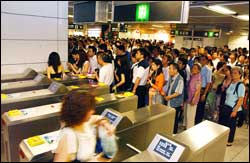 Commuters will save up to HK$8.20 a trip
from Sunday week when the MTRC and KCRC officially merge. Under the
fare-reduction scheme announced yesterday, some commuters will enjoy half fare
travel due to the removal of second-charge gates at the interchange stations in
Tsim Sha Tsui and Kowloon Tong. MTR marketing and station business general
manager Jeny Yeung Mei- chun said an estimated 2.8 million passengers will pay
less every day, with half of these enjoying fare cuts of at least 5 percent.
About 130,000 passengers will enjoy fare cuts of 10 percent or more. Commuters will save up to HK$8.20 a trip
from Sunday week when the MTRC and KCRC officially merge. Under the
fare-reduction scheme announced yesterday, some commuters will enjoy half fare
travel due to the removal of second-charge gates at the interchange stations in
Tsim Sha Tsui and Kowloon Tong. MTR marketing and station business general
manager Jeny Yeung Mei- chun said an estimated 2.8 million passengers will pay
less every day, with half of these enjoying fare cuts of at least 5 percent.
About 130,000 passengers will enjoy fare cuts of 10 percent or more.
 It's time to bet on, says Hong Kong's stock guru Lee
Shau-kee, who is ready to throw HK$10 billion into the market when everything
has cleared up. Lee, dubbed "Asia's Warren Buffett," said he sees the silver
lining in the gloomy sentiment. "I'll split the lump of money into two shots,
that is HK$5 billion each," he told a media conference announcing his donation
of HK$500 million to the University of Hong Kong. The first half, he said, will
be used in a couple of days, "I already spent between HK$1 billion and HK$2
billion to buy stocks in the market today [Thursday], and will splash out the
rest tomorrow [Friday]." He said he still has to see when to spend the other
HK$5 billion. Lee recalled he pulled the siren last week that the market may go
very volatile; it did, as the Hang Seng Index dropped some 3,000 points this
week. "But today it's not at all the same," Asia's second richest man said. The
negative news, he explained, has at least been partly exposed, like the huge
losses brought about by the subprime crisis in Europe and North America, and the
mainland's cooling measures to contain an overheating economy. "Now seize your
chance to buy low," he said. A self-proclaimed analyst, Lee said all stocks have
their elemental - metal, water, wood, fire and earth. "I always have a
preference over the metal or gold, which represents the financial sector such as
insurance companies and banks," he said. The 79-year-old new age geomancist
recommended Hong Kong Exchange and Clearing (0388) and Chinese Merchants Bank
(3968), "but I currently hold just a little of HKEx." While having "little
feeling" over water and wood elements, Lee also liked fire, the energy industry.
"That means something burnable." He endorsed CNOOC (0883) for the first time as
a good choice of investment. Earth element, representing real estate, is a
little complicated, according to Lee. "They are also good in the long term, but
as I said last month, we should be cautious about those stocks."
It's time to bet on, says Hong Kong's stock guru Lee
Shau-kee, who is ready to throw HK$10 billion into the market when everything
has cleared up. Lee, dubbed "Asia's Warren Buffett," said he sees the silver
lining in the gloomy sentiment. "I'll split the lump of money into two shots,
that is HK$5 billion each," he told a media conference announcing his donation
of HK$500 million to the University of Hong Kong. The first half, he said, will
be used in a couple of days, "I already spent between HK$1 billion and HK$2
billion to buy stocks in the market today [Thursday], and will splash out the
rest tomorrow [Friday]." He said he still has to see when to spend the other
HK$5 billion. Lee recalled he pulled the siren last week that the market may go
very volatile; it did, as the Hang Seng Index dropped some 3,000 points this
week. "But today it's not at all the same," Asia's second richest man said. The
negative news, he explained, has at least been partly exposed, like the huge
losses brought about by the subprime crisis in Europe and North America, and the
mainland's cooling measures to contain an overheating economy. "Now seize your
chance to buy low," he said. A self-proclaimed analyst, Lee said all stocks have
their elemental - metal, water, wood, fire and earth. "I always have a
preference over the metal or gold, which represents the financial sector such as
insurance companies and banks," he said. The 79-year-old new age geomancist
recommended Hong Kong Exchange and Clearing (0388) and Chinese Merchants Bank
(3968), "but I currently hold just a little of HKEx." While having "little
feeling" over water and wood elements, Lee also liked fire, the energy industry.
"That means something burnable." He endorsed CNOOC (0883) for the first time as
a good choice of investment. Earth element, representing real estate, is a
little complicated, according to Lee. "They are also good in the long term, but
as I said last month, we should be cautious about those stocks."
Tycoon Lee Shau-kee is donating HK$500 million (US$66
million) to the University of Hong Kong. The donation will be split into two,
with half for scholarships and the rest for campus development. A ceremony
attended by Mr Lee, chairman and managing director of Henderson Land Development
(SEHK: 0012), and Tsui Lap-chee, vice-chancellor of the university, will be held
today. In March, Mr Lee gave HK$400 million to the Hong Kong University of
Science and Technology. At that time, he likened donations to investments, which
he said should be made with regard to the potential for growth and their
contribution to society. HKU started its endowment fund in 1996 but did not
begin focusing on fund-raising until 1999. Significant inflows began in 2003 and
2004 when the government introduced a matching scheme. In May 2005, tycoon Li
Ka-shing donated HK$1 billion to the university. This led to criticism when the
university renamed its medical school after him.
  Anson Chan could face probe after complaint filed with ICAC -A district council
member yesterday lodged a formal complaint with the Independent Commission
Against Corruption, alleging that former chief secretary Anson Chan Fang On-sang
had used her position to obtain 100 percent financing to purchase a flat in
1993. Chan Wan-sang, of the Tuen Mun District Council, said he had done so as
the Department for Justice had said an investigation could not be conducted
unless a formal complaint was received. "I have not forgotten about this case
which was first unveiled by the local media in 1995. I believe Anson Chan owes
the Hong Kong people an explanation," Chan said. "My complaint will give
Secretary for Justice Wong Yan-lung the opportunity to ensure justice is done."
The council member said he was not happy with the selective approach adopted by
Director of Prosecution Ian Grenville Cross when handling complaints against
public figures. "For instance, Cross gave more weight to the complaint of Martin
Lee Chu-ming than he did to that of Alex Tsui Ka-kit. Seemingly, the former
chief secretary enjoyed better treatment and more benevolence and leniency than
did others," he claimed. Chan said he decided to file a complaint after reading
a report in Sing Tao Daily alleging one of the two properties Anson Chan said
she had mortgaged to get the home loan was a car park. According to a document
in the Land Registry, Anson Chan, under Richer Ltd, received a HK$7.8 million
loan from Hang Seng Bank to buy a flat and parking space in Villa Monte Rosa.
Her campaign media manager Lucy Chan Wai-yee insisted the former civil servant
had mortgaged two properties, though the second property was not registered with
the Land Registry.
Anson Chan could face probe after complaint filed with ICAC -A district council
member yesterday lodged a formal complaint with the Independent Commission
Against Corruption, alleging that former chief secretary Anson Chan Fang On-sang
had used her position to obtain 100 percent financing to purchase a flat in
1993. Chan Wan-sang, of the Tuen Mun District Council, said he had done so as
the Department for Justice had said an investigation could not be conducted
unless a formal complaint was received. "I have not forgotten about this case
which was first unveiled by the local media in 1995. I believe Anson Chan owes
the Hong Kong people an explanation," Chan said. "My complaint will give
Secretary for Justice Wong Yan-lung the opportunity to ensure justice is done."
The council member said he was not happy with the selective approach adopted by
Director of Prosecution Ian Grenville Cross when handling complaints against
public figures. "For instance, Cross gave more weight to the complaint of Martin
Lee Chu-ming than he did to that of Alex Tsui Ka-kit. Seemingly, the former
chief secretary enjoyed better treatment and more benevolence and leniency than
did others," he claimed. Chan said he decided to file a complaint after reading
a report in Sing Tao Daily alleging one of the two properties Anson Chan said
she had mortgaged to get the home loan was a car park. According to a document
in the Land Registry, Anson Chan, under Richer Ltd, received a HK$7.8 million
loan from Hang Seng Bank to buy a flat and parking space in Villa Monte Rosa.
Her campaign media manager Lucy Chan Wai-yee insisted the former civil servant
had mortgaged two properties, though the second property was not registered with
the Land Registry.
Popularity ratings between Legco by-election candidate
Anson Chan Fang On-sang and her main rival Regina Ip Lau Suk-yee have narrowed
to a single-digit difference after the district council elections on Sunday, a
survey has found.
The central government in Beijing on Thursday gave
approval to the USS Kitty Hawk and accompanying ships to enter the port of Hong
Kong for the Thanksgiving holiday.
 Mainland officials got land premium cut - The abbot of Po Lin Monastery has
revealed that central government officials helped the monastery negotiate a
drastically reduced land premium for its Temple of Ten Thousand Buddhas project,
which saw construction begin yesterday. The five-storey, 60,000 sq ft exhibition
hall, which will include a multimedia hall, Buddhist exhibits, altars and
collections of teachings, is expected to open in 2010. In May of last year, the
monks were negotiating with the Hong Kong government to obtain a 50 per cent
discount on charges related to development of the land involved. At the time,
Sik Chi Wai said the premium could top HK$30 million. However, according to the
Land Registry, the premium paid in October was HK$11.98 million. The abbot
thanked the officials for their support yesterday.
Mainland officials got land premium cut - The abbot of Po Lin Monastery has
revealed that central government officials helped the monastery negotiate a
drastically reduced land premium for its Temple of Ten Thousand Buddhas project,
which saw construction begin yesterday. The five-storey, 60,000 sq ft exhibition
hall, which will include a multimedia hall, Buddhist exhibits, altars and
collections of teachings, is expected to open in 2010. In May of last year, the
monks were negotiating with the Hong Kong government to obtain a 50 per cent
discount on charges related to development of the land involved. At the time,
Sik Chi Wai said the premium could top HK$30 million. However, according to the
Land Registry, the premium paid in October was HK$11.98 million. The abbot
thanked the officials for their support yesterday.
Shares of City Telecom, a Hong Kong fixed-line telephone operator, sank as much
as 35.94 per cent yesterday after the firm unveiled a full-year profit from a
loss as investors doubted its growth prospects.
Laptop computer users will soon be able to enjoy full
internet browsing mobility while commuting, as more laptops become compatible
with the 3.5G mobile network, according to an industry association.
China:
China's third-quarter macro figures came out last week. The trade surplus in
October continued to surge, which for once is actually surprising. Expensive
commodities worldwide meant that the value of imports was up 25.5% from a year
ago, but export growth still outpaced it, leaving the month's trade surplus at
US$27.05, a record high. The central bank said GDP rose 11.5% in the first three
quarters, compared to a total increase last year of 11.1%. On the other hand,
inflation rose 4.1% in the first three quarters, compared to a 1.5% rise in
2006. Goldman Sachs analyst Hong Liang raised a warning about inflation again
(she did this a few months ago at the height of the pork shortage too), saying
that the monthly CPI could hit 7% this year. The central bank has done the only
thing it can do: raise interest rates. The reserve requirement rate will go up
for a ninth time this year, to 13.5%, effective November 26. Central bank
governor Zhou Xiaochuan has pledged to fight inflation, but how exactly he plans
to do this is anyone's guess. Goldman predicts two more rate hikes by year's
end. Remember all that talk about a gush of Chinese capital outflows? Well, it's
definitely in the works. China National Offshore Oil Corp, which reduces to the
rather cute acronym CNOOC, was linked to acquisitions in Australia and Nigeria
this week. There was a rumor that CNOOC wanted to take over Shell's stake in an
oil project in Australia's Northwest Shelf region for US$450 million, which was
later curtly denied by the Chinese company. Now, a new story has surfaced,
saying CNOOC wants to hand over US$900 million to Shell, again, but this time
for almost 50% in two Nigerian offshore blocks. No comment from CNOOC. But
commodities acquisitions aren't really news - banking buy-ins, however, are. The
FT broke the news - citing anonymous sources - that China's top three banks,
Bank of China, ICBC and China Construction Bank, approached Singapore's Temasek
Holdings to buy its 17% stake in Standard Chartered. The contacts were "informal
and discreet," which could mean anything, really. In any case, no deal is on the
cards - Temasek isn't selling, and Standard Chartered isn't keen on having its
independence questioned by having the Chinese as its largest stakeholder. An
ICBC official denied that any such offer to Temasek took place. Lastly, the
much-ballyhooed China Investment Corp revealed that it's a cornerstone investor
in China Railway Group's Hong Kong listing. The sovereign fund will take US$100
million, the biggest institutional stake, in the H-share offering. This is its
second move after buying into Blackstone months ago.
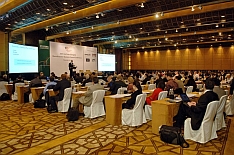 (AmCham Shanghai) Manufacturers Learn
How to Stay Competitive - With concerns looming that China is increasingly
becoming a less competitive manufacturing environment, nearly 200 participants
gathered to understand manufacturing competitiveness issues and solutions at the
2007 Manufacturers' Business Council Conference. China manufacturers need to
take steps to ensure their competitiveness against competition from countries
like Vietnam, India, Brazil and Thailand, said T.T. Chen, chair of the AmCham
Shanghai Manufacturers' Business Council, to open the conference. More than 20
speakers and panelists provided the audience with ideas and insights on
maintaining competitiveness, covering issues such as cost pressures, quality,
productivity, profitability, lean manufacturing, taxes, investment and 6-Sigma.
In the keynote speech, Christopher Bliss, principal at management consulting
firm Booz Allen Hamilton (BAH), reiterated the theme of the conference, noting
that many countries are ready to compete with China. ¡°We are seeing the end of
easy manufacturing in China,¡± he said. Citing the key results and findings from
a soon-to-be-released study jointly conducted by AmCham Shanghai and BAH, Bliss
encouraged manufacturers to first focus on understanding the role of China in a
company's global supply chain, then focusing on achieving operational excellence
in the areas of procurement, shop-floor operations, inbound and outbound
logistics, and systems and information flows. (AmCham Shanghai) Manufacturers Learn
How to Stay Competitive - With concerns looming that China is increasingly
becoming a less competitive manufacturing environment, nearly 200 participants
gathered to understand manufacturing competitiveness issues and solutions at the
2007 Manufacturers' Business Council Conference. China manufacturers need to
take steps to ensure their competitiveness against competition from countries
like Vietnam, India, Brazil and Thailand, said T.T. Chen, chair of the AmCham
Shanghai Manufacturers' Business Council, to open the conference. More than 20
speakers and panelists provided the audience with ideas and insights on
maintaining competitiveness, covering issues such as cost pressures, quality,
productivity, profitability, lean manufacturing, taxes, investment and 6-Sigma.
In the keynote speech, Christopher Bliss, principal at management consulting
firm Booz Allen Hamilton (BAH), reiterated the theme of the conference, noting
that many countries are ready to compete with China. ¡°We are seeing the end of
easy manufacturing in China,¡± he said. Citing the key results and findings from
a soon-to-be-released study jointly conducted by AmCham Shanghai and BAH, Bliss
encouraged manufacturers to first focus on understanding the role of China in a
company's global supply chain, then focusing on achieving operational excellence
in the areas of procurement, shop-floor operations, inbound and outbound
logistics, and systems and information flows.
China has made considerable progress
in taking actions to ensure safety of toys and other products exported to
Europe, said the European Union consumer chief.
The emergence of payment services
through mobile phones has put a virtual withdrawal machine in consumers' hands,
enabling 8 million mobile users in China to buy insurance or book tickets with a
flick of their fingers. Promising consumers "safe and convenient payment at any
place at any time," China UnionPay, a central bank arm that provides a
nationwide electronic payment network, developed this service, which connects
users' bank accounts with their mobile phone numbers. Nearly 8 billion yuan
worth of payments was transacted in this way in the first 10 months of the year
as the service gradually expanded to 21 provinces and cities across the country.
Consumers found they could save the trouble of queuing impatiently at the banks.
Instead, they can send instructions through text messages to pay for anything,
from phone services to insurance. Although only 8 million customers use the
service, a small number compared with the total number of mobile phone users in
China, UnionPay is confident that the service will "run in the fast lane" as
more Chinese who used to carry cash around embrace diversified payment methods.
On Monday, commercial banks started to offer cross-bank services. Chinese
customers can now make deposits and cash withdrawals at different banks,
regardless of where they keep their accounts. At the same time, more services
based on the ubiquity of mobile phones are being developed. China Mobile
recently joined with leading securities firms and financial newspapers to launch
a new service that provides key information on capital markets to subscribers.
(One U.S. dollar equals to 7.41 yuan).
 U.S. celebrity
Paris Hilton holds toy pandas while visiting Yu Yuan Garden in Shanghai November
21, 2007. Hilton is in Shanghai to attend 2007 MTV Awards on Friday U.S. celebrity
Paris Hilton holds toy pandas while visiting Yu Yuan Garden in Shanghai November
21, 2007. Hilton is in Shanghai to attend 2007 MTV Awards on Friday
 European businesses are still performing quite well in China despite
increasingly stiff competition and Beijing's failure to improve the regulatory
environment, a business group said yesterday. The European Chamber of Commerce
in China, releasing its annual business confidence survey, said 72 percent of
respondents were either making a profit or breaking even. But European firms
continue to face hurdles including a lack of government transparency,
insufficient protection of intellectual property rights and excessive red tape,
the organization said, reflecting some of the issues likely to be on the agenda
at a European Union-China summit in Beijing next week. "The investment climate
is unfortunately not changing much, not getting better. We see exactly the same
obstacles as in the last survey," said Joerg Wuttke, president of the chamber. A
host of EU officials will visit Beijing next week to discuss economic and trade
issues with their mainland counterparts, including the value of the yuan, which
they say is artificially weak against the euro. The EU, faced with a growing
trade deficit with China, has become increasingly tough in its stance. European
businesses want Beijing to improve its legal system, Wuttke said, for instance
by creating more professional courts to handle IPR cases. Firms had also
expressed concern that Beijing was actively trying to avoid some of its World
Trade Organization commitments and that it could use its recently adopted
anti-monopoly law to extend protection to state-owned monopolies, Wuttke said.
He singled out oil refining and distribution as sectors that were benefiting
from preferential treatment.
European businesses are still performing quite well in China despite
increasingly stiff competition and Beijing's failure to improve the regulatory
environment, a business group said yesterday. The European Chamber of Commerce
in China, releasing its annual business confidence survey, said 72 percent of
respondents were either making a profit or breaking even. But European firms
continue to face hurdles including a lack of government transparency,
insufficient protection of intellectual property rights and excessive red tape,
the organization said, reflecting some of the issues likely to be on the agenda
at a European Union-China summit in Beijing next week. "The investment climate
is unfortunately not changing much, not getting better. We see exactly the same
obstacles as in the last survey," said Joerg Wuttke, president of the chamber. A
host of EU officials will visit Beijing next week to discuss economic and trade
issues with their mainland counterparts, including the value of the yuan, which
they say is artificially weak against the euro. The EU, faced with a growing
trade deficit with China, has become increasingly tough in its stance. European
businesses want Beijing to improve its legal system, Wuttke said, for instance
by creating more professional courts to handle IPR cases. Firms had also
expressed concern that Beijing was actively trying to avoid some of its World
Trade Organization commitments and that it could use its recently adopted
anti-monopoly law to extend protection to state-owned monopolies, Wuttke said.
He singled out oil refining and distribution as sectors that were benefiting
from preferential treatment.
November 24, 2007
Hong Kong:
Airport Authority Hong Kong Wednesday announced unaudited revenue of 4,199
million HK dollars (about 540 million U.S. dollars) for the six months ended
Sept. 30, 2007, up 10.1 percent from the corresponding period in 2006. The
authority's profit attributable to equity shareholder of 1,136 million HK
dollars (about 146 million US dollars) witnessed an increase of 14.4 percent.
Total passenger throughput advanced 7.1 percent, to 24.3 million; cargo volumes
grew 5.8 percent, to 1.88 million tons; and air traffic movements increased 6.0
percent, to 149,030. Stanley Hui, Chief Executive Officer of the authority said,
" After a lackluster first quarter, we saw solid increases in cargo throughput
from April to September. "Strong and sustained economic growth on the Mainland
and in Hong Kong generated demand for aviation services. And with continued
steady growth in passenger volumes, Hong Kong International Airport will soon
serve more than 50 million passengers per year," he said. To meet this demand
and reinforce Hong Kong's position as a premier regional and international
aviation hub, the authority is investing 4.5 billion HK dollars (about 577
million US dollars) to expand and enhance the infrastructure and services at
Hong Kong International Airport.
Hong Kong stocks tumbled Thursday,
tracking other Asian markets, as investors grew cautious after the US Federal
Reserve lowered its growth outlook for the nation's economy, while also
displaying a hawkish stance in the minutes of its October policy meeting.
China should not allow the "through
train" to leave the station, as the government may not be able to stop huge
amounts of domestic capital from flowing overseas once the direct investment
scheme starts rolling full steam ahead, a former mainland central banker warns.
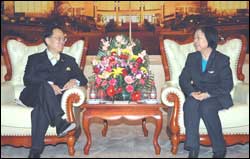 Chief
Executive Donald Tsang Yam- kuen yesterday sought more details on the investment
"through train" during a closed-door meeting with People's Bank of China deputy
governor Wu Xiaoling. According to a close aide to Tsang, Wu reiterated what
Premier Wen Jiabao had said in Singapore, about prudence and timing, without
elaborating. Tsang's meeting with Wu came only hours after the Hong Kong leader
had arrived in Beijing on a three-day visit, during which he is to make the
first report of his new term to central government leaders. According to the
aide, Tsang told Wu, that Hong Kong would fully comply with national policy with
regard to cross-border investment. Tsang also called on the China Insurance
Regulatory Commission chairman Wu Dingfu yesterday, during which he invited
mainland insurers to set up branches as Ping An Insurance had done. Tsang also
told the insurance regulator more talent nurturing exchange programs should be
initiated to groom young mainland and Hong Kong insurance professionals. The
newly appointed head of the Hong Kong and Macau Affairs Working Committee, and
sixth-ranked Politburo member, Xi Jinping will hold his first working meeting
and dinner with Tsang today. Tsang is scheduled to meet President Hu Jintao and
Premier Wen tomorrow. Accompanied by his wife Selina and Chief Executive Office
director Norman Chan Tak-lam, Tsang arrived in Beijing in the morning yesterday,
and was was received by Hong Kong and Macau Affairs Office deputy director Chen
Zuo'er at Beijing airport. In the afternoon, Tsang visited a warehouse which has
been turned into the "789 Creative Zone" in Beijing, to understand whether such
a concept is feasible in Hong Kong. Tsang also called on incumbent Beijing mayor
Wang Qishan, who is set to be named a vice premier in March. Wang said
Beijing-Hong Kong ties and cooperation could be further improved as Shanghai,
Beijing and, hopefully Guangzhou and Qingdao, could soon follow Hong Kong in
becoming international metropolitan cities. Wang praised the successful three-
day equestrian trials in Hong Kong in August, and said he was confident Hong
Kong was the right choice for the Olympic equestrian events. Tsang also asked
Wang to consider sending a second batch of national treasures to Hong Kong as
the first exhibition in the city proved a tremendous success. Tsang will today,
meet representatives of the National Development and Reform Commission, the
General Administration of Press and Publication and China Investment
Corporation, the sovereign wealth fund. Tomorrow, he will call on Minister for
Foreign Affairs Yang Jiechi in addition to the top leaders. After winding up his
trip to Beijing, Tsang will fly to Guangzhou on Friday night to meet with
Guangdong provincial party Secretary Zhang Dejiang and Guangdong provincial
governor Huang Huahua. Chief
Executive Donald Tsang Yam- kuen yesterday sought more details on the investment
"through train" during a closed-door meeting with People's Bank of China deputy
governor Wu Xiaoling. According to a close aide to Tsang, Wu reiterated what
Premier Wen Jiabao had said in Singapore, about prudence and timing, without
elaborating. Tsang's meeting with Wu came only hours after the Hong Kong leader
had arrived in Beijing on a three-day visit, during which he is to make the
first report of his new term to central government leaders. According to the
aide, Tsang told Wu, that Hong Kong would fully comply with national policy with
regard to cross-border investment. Tsang also called on the China Insurance
Regulatory Commission chairman Wu Dingfu yesterday, during which he invited
mainland insurers to set up branches as Ping An Insurance had done. Tsang also
told the insurance regulator more talent nurturing exchange programs should be
initiated to groom young mainland and Hong Kong insurance professionals. The
newly appointed head of the Hong Kong and Macau Affairs Working Committee, and
sixth-ranked Politburo member, Xi Jinping will hold his first working meeting
and dinner with Tsang today. Tsang is scheduled to meet President Hu Jintao and
Premier Wen tomorrow. Accompanied by his wife Selina and Chief Executive Office
director Norman Chan Tak-lam, Tsang arrived in Beijing in the morning yesterday,
and was was received by Hong Kong and Macau Affairs Office deputy director Chen
Zuo'er at Beijing airport. In the afternoon, Tsang visited a warehouse which has
been turned into the "789 Creative Zone" in Beijing, to understand whether such
a concept is feasible in Hong Kong. Tsang also called on incumbent Beijing mayor
Wang Qishan, who is set to be named a vice premier in March. Wang said
Beijing-Hong Kong ties and cooperation could be further improved as Shanghai,
Beijing and, hopefully Guangzhou and Qingdao, could soon follow Hong Kong in
becoming international metropolitan cities. Wang praised the successful three-
day equestrian trials in Hong Kong in August, and said he was confident Hong
Kong was the right choice for the Olympic equestrian events. Tsang also asked
Wang to consider sending a second batch of national treasures to Hong Kong as
the first exhibition in the city proved a tremendous success. Tsang will today,
meet representatives of the National Development and Reform Commission, the
General Administration of Press and Publication and China Investment
Corporation, the sovereign wealth fund. Tomorrow, he will call on Minister for
Foreign Affairs Yang Jiechi in addition to the top leaders. After winding up his
trip to Beijing, Tsang will fly to Guangzhou on Friday night to meet with
Guangdong provincial party Secretary Zhang Dejiang and Guangdong provincial
governor Huang Huahua.
China:
Chinese customers can now make deposits and cash withdrawals at different banks,
regardless of where they keep their accounts, thanks to a service launched by
the central bank on Monday.
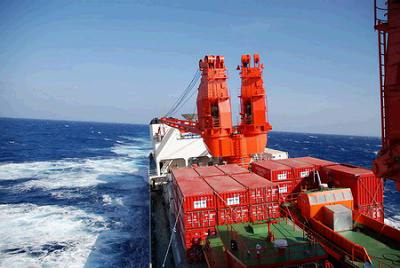 The main Chinese Antarctic support vessel, "Xue Long," enters the genesis region
of cyclones, in the northwestern Pacific, to the east of the Philippines, on
November 18. The vessel is expected to reach the Equator on November 18; and
then the Port of Fremantle, in Australia, on November 21.
The main Chinese Antarctic support vessel, "Xue Long," enters the genesis region
of cyclones, in the northwestern Pacific, to the east of the Philippines, on
November 18. The vessel is expected to reach the Equator on November 18; and
then the Port of Fremantle, in Australia, on November 21.
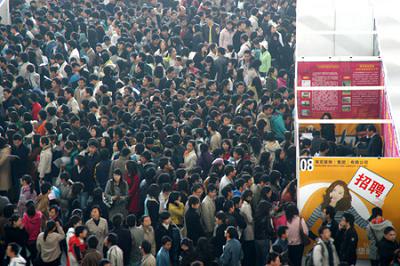 Crowds of job hunters flock to a job
fair in Nanjing, East China’s Jiangsu Province, November 20, 2007. Nearly 50,000
college graduates participated in the event. The job fair was the first of a
series of recruitment events for the 427,000 students who would graduate next
year in the province. Nearly 50,000 graduates participated in the event. Crowds of job hunters flock to a job
fair in Nanjing, East China’s Jiangsu Province, November 20, 2007. Nearly 50,000
college graduates participated in the event. The job fair was the first of a
series of recruitment events for the 427,000 students who would graduate next
year in the province. Nearly 50,000 graduates participated in the event.
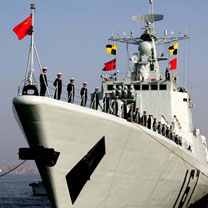 A Chinese naval ship left
Zhanjiang Wednesday for a port call to Japan, the first such visit in the
history of the naval forces of the Chinese People's Liberation Army. A Chinese naval ship left
Zhanjiang Wednesday for a port call to Japan, the first such visit in the
history of the naval forces of the Chinese People's Liberation Army.
 Actress Jiang Wenli poses with the Marco Aurelio award for best actress after
winning it at the Rome International Film Festival October 27, 2007. As a young
girl, Jiang Wenli dreamed of being a writer. The Best Actress at this October's
Rome Film Festival recalls that her engineer father, who was always at his
happiest in a bookstore, would buy her a classic novel for her birthday.
Although she grew up on Romain Rolland and Honore de Balzac, she barely knew
anyone who worked in the world of art, in small-town Bengbu, East China's Anhui
Province. She never thought she would end up as an actress. But, like many other
young, small-town Chinese, she was determined to make it to the big city. When
she failed her national college entrance examination in 1987, the best
opportunity that came up was a job at the local waterworks. Even so, Jiang kept
alive her hopes of a bigger stage. "There was a fire burning in my heart,
getting stronger every day, just like the heroine in the award-winning And the
Spring Comes, in which a small-town girl has dreams of art. I knew I wanted to
get out of town, but I didn't really know where to go. Leaving was the first
priority," Jiang says. Judges at the Rome Film Festival said her performance in
And the Spring Comes (Li Chun) vividly brought to life the character of a woman
who does not compromise. In real life, Jiang began her acting life by enrolling
at Beijing Film Academy's performance department in 1988, after seeing an advert
in a magazine. She persuaded her father, who was going to Beijing on a business
trip, to take her along and try out for an audition. There were thousands of
applicants, but just 20 would make the grade. Jiang, who was not a trained
actress, treated the trip as a fun outing. She says she was surprised to make it
through to the final rounds. The topic for the deciding acting piece was set out
as follows: When the Tangshan earthquake (in 1976, which killed about 240,000
people) occurred, you were out of town. You heard your hometown was destroyed
and all your family members had died - but you could not go back to the city for
a month. Later, you see the wreck that was your home. Now, act. While the other
applicants wailed, Jiang recalled French painter Eugene Delacroix's Orphan Girl
at the Cemetery. The painting moved her to tears as a young girl. She went into
a corner and thought of her grandmother, who had recently passed away. When her
tears started falling, she raised her head. All the judges were moved by her
"zero performance". Lin Hongtong, one of those judges and a professor at the
academy, says her performance revealed her understanding of human nature. For
four years at the academy, Jiang was a favored student and in demand from film
crews. Teacher Zhang Hua recalls she was a quiet student but would show amazing
energy when she acted. Her first film role, as a student, was memorable. In Chen
Kaige's Golden Palm Award-winning Farewell My Concubine (Bawang Bieji), she
played a prostitute. The 10-minute appearance was so impressive it is still
talked about by cinephiles today. In order to be authentic as possible, Jiang
talked to an old prostitute, who told her a typical "professional" would look
out of the corners of their eyes and shake their head slightly. The film was a
huge success, but Jiang was trapped by self-doubt. "I was a small-town girl who
could barely speak putonghua. Well, when I was thrown suddenly into film
academy, I was stunned. For a long time I thought actors should be extrovert,
vigorous people who could forget themselves in front of other people and become
the role they play. But I am quiet, educated to be modest, yet with a strong
ego. I often thought I was not suitable for the industry."
Actress Jiang Wenli poses with the Marco Aurelio award for best actress after
winning it at the Rome International Film Festival October 27, 2007. As a young
girl, Jiang Wenli dreamed of being a writer. The Best Actress at this October's
Rome Film Festival recalls that her engineer father, who was always at his
happiest in a bookstore, would buy her a classic novel for her birthday.
Although she grew up on Romain Rolland and Honore de Balzac, she barely knew
anyone who worked in the world of art, in small-town Bengbu, East China's Anhui
Province. She never thought she would end up as an actress. But, like many other
young, small-town Chinese, she was determined to make it to the big city. When
she failed her national college entrance examination in 1987, the best
opportunity that came up was a job at the local waterworks. Even so, Jiang kept
alive her hopes of a bigger stage. "There was a fire burning in my heart,
getting stronger every day, just like the heroine in the award-winning And the
Spring Comes, in which a small-town girl has dreams of art. I knew I wanted to
get out of town, but I didn't really know where to go. Leaving was the first
priority," Jiang says. Judges at the Rome Film Festival said her performance in
And the Spring Comes (Li Chun) vividly brought to life the character of a woman
who does not compromise. In real life, Jiang began her acting life by enrolling
at Beijing Film Academy's performance department in 1988, after seeing an advert
in a magazine. She persuaded her father, who was going to Beijing on a business
trip, to take her along and try out for an audition. There were thousands of
applicants, but just 20 would make the grade. Jiang, who was not a trained
actress, treated the trip as a fun outing. She says she was surprised to make it
through to the final rounds. The topic for the deciding acting piece was set out
as follows: When the Tangshan earthquake (in 1976, which killed about 240,000
people) occurred, you were out of town. You heard your hometown was destroyed
and all your family members had died - but you could not go back to the city for
a month. Later, you see the wreck that was your home. Now, act. While the other
applicants wailed, Jiang recalled French painter Eugene Delacroix's Orphan Girl
at the Cemetery. The painting moved her to tears as a young girl. She went into
a corner and thought of her grandmother, who had recently passed away. When her
tears started falling, she raised her head. All the judges were moved by her
"zero performance". Lin Hongtong, one of those judges and a professor at the
academy, says her performance revealed her understanding of human nature. For
four years at the academy, Jiang was a favored student and in demand from film
crews. Teacher Zhang Hua recalls she was a quiet student but would show amazing
energy when she acted. Her first film role, as a student, was memorable. In Chen
Kaige's Golden Palm Award-winning Farewell My Concubine (Bawang Bieji), she
played a prostitute. The 10-minute appearance was so impressive it is still
talked about by cinephiles today. In order to be authentic as possible, Jiang
talked to an old prostitute, who told her a typical "professional" would look
out of the corners of their eyes and shake their head slightly. The film was a
huge success, but Jiang was trapped by self-doubt. "I was a small-town girl who
could barely speak putonghua. Well, when I was thrown suddenly into film
academy, I was stunned. For a long time I thought actors should be extrovert,
vigorous people who could forget themselves in front of other people and become
the role they play. But I am quiet, educated to be modest, yet with a strong
ego. I often thought I was not suitable for the industry."
Major industrial polluters will be
barred from raising capital on the stock market, the top environment watchdog
said while pledging to step up efforts to reduce industrial waste.
China firm wins bid for Afghan
copper - China Metallurgical Group has won the right to develop a large copper
deposit in Afghanistan, Ibrahim Adel, the Afghan mines minister, announced
Tuesday. The copper mine, with an estimated copper reserve of 13 million tons,
is located to the east of Kabul, the capital of Afghanistan. The projected
investment in this copper deposit totaled US$3 billion. China Metallurgical
Group will spend five years in construction, and then pay an annual US$400
million to the Afghan government by operating the mine. Ibrahim Adel said: "It
is the largest foreign investment ever in Afghanistan's history, a total of
100,000 Afghans will find job in this mine." "We estimated that the copper
reserve totals 13 million tons, and it might increase to 20 million tons," he
added. The Chinese State-owned metallurgical group plans to yield 200,000 tons
copper annually from the mine. This copper mine was discovered in 1974 and
detected by soviet geologists in 1979. However, it has never been developed due
to years of civil wars. The Chinese offer beat other four bids, from Strikeforce,
part of Russia's Basic Element Group, the London-based Kazakhmys Consortium,
Hunter Dickinson of Canada and US copper mining firm, Phelps Dodge. The Chinese
group said it has already invested US$1 billion in overseas mining resources.
China and India, who went to war in
1962, will hold their first joint army exercise next month in a sign of warmer
ties between the two Asian powers.
 Tianjin property prices have been
escalating at a rate of 15 to 20 percent annually in the past two years. And
with President Hu Jintao endorsing the city's Binhai New Area as a special
economic zone, the upward trend is set to continue, said property consultants
and agents. In his 17th National Congress report, the Chinese President
announced that the special economic zones - where experimental reforms will be
carried out - would include Tianjin's Binhai New Area and Shanghai's Pudong New
Area. It was the first time that Binhai was mentioned. Binhai, which includes
Tanggu, Hangu and Dagang districts, will see a series of financial reforms in
the banking industry, fund-raising methods and foreign-exchange controls,
according to the State Council. Knight Frank head of research Xavier Wong said
more than 70 of the world's largest 500 enterprises, such as Motorola, IBM, HSBC
Holdings Plc (0005), Samsung and Exxon Mobil Corp, have already set up
operations in the area. In the first half of 2007, 14 such enterprises have
added more capital into their Tianjin projects. According to the Statistical
Bureau of Tianjin, foreign direct investment into the city in the same period
US$2.58 billion (HK$20 billion), up 27.5 percent from a year ago. "Seeing as
Binhai now has the blessing of the central government, Tianjin is likely to
become an increasingly important economic centre within the Bohai Rim Region,"
said Wong. Tianjin property prices have been
escalating at a rate of 15 to 20 percent annually in the past two years. And
with President Hu Jintao endorsing the city's Binhai New Area as a special
economic zone, the upward trend is set to continue, said property consultants
and agents. In his 17th National Congress report, the Chinese President
announced that the special economic zones - where experimental reforms will be
carried out - would include Tianjin's Binhai New Area and Shanghai's Pudong New
Area. It was the first time that Binhai was mentioned. Binhai, which includes
Tanggu, Hangu and Dagang districts, will see a series of financial reforms in
the banking industry, fund-raising methods and foreign-exchange controls,
according to the State Council. Knight Frank head of research Xavier Wong said
more than 70 of the world's largest 500 enterprises, such as Motorola, IBM, HSBC
Holdings Plc (0005), Samsung and Exxon Mobil Corp, have already set up
operations in the area. In the first half of 2007, 14 such enterprises have
added more capital into their Tianjin projects. According to the Statistical
Bureau of Tianjin, foreign direct investment into the city in the same period
US$2.58 billion (HK$20 billion), up 27.5 percent from a year ago. "Seeing as
Binhai now has the blessing of the central government, Tianjin is likely to
become an increasingly important economic centre within the Bohai Rim Region,"
said Wong.
November 23, 2007
Hong Kong:
The chairman
of the Association for Democracy and People's Livelihood, Frederick Fung Kin-kee,
resigned from his post yesterday in the aftermath of the party's disappointing
results in the district council elections.
 ParknShop is ditching its policy of
dishing out plastic bags, becoming the first supermarket in Hong Kong to adopt
the green move. By doing so, the supermarket chain will avoid dumping 50 million
plastic bags into shrinking landfills in 2008. The territory's landfills are
expected to be used up within six to 10 years. Instead shoppers will be offered
biodegradable plastic bags, an alternative which still did not please the Green
Council. The council is not convinced the biodegradable plastic will break down
in landfill conditions. Hong Kong's plastic pollution is a pressing concern for
green groups, with 23 million plastic bags dumped each day and 8.4 billion each
year. One-sixth comes from the three main supermarkets - ParknShop, Wellcome and
CRC, with the rest handed out by wet markets, neighborhood grocers and
convenience stores. Friends of the Earth welcomed the initiative, saying
ParknShop had taken the lead to encourage other supermarkets to do the same.
"Every day each person disposes five bags per day - this problem is serious.
They take one from the supermarket but do not reuse it. Plastic bags are not
biodegradable. If you continue to use them, the disposal volume will increase
and this will add pressure on the landfills," said Michelle Au Wing- tse, FoE's
environmental affairs officer. Although the Green Council praised the
supermarket's green move, chief executive Linda Ho Wai-ping said: "Our only
concern is will this type of plastic be biodegradable with no light, little
oxygen and without sunlight? Some biodegradable bags such as Totally Degradable
Plastic need sunlight to breakdown." The no-plastic bag campaign is part of a
raft of measures by the supermarket to save 160 million bags in the next five
years. It has already saved 30 million bags this year by encouraging shoppers to
bring their own bags. ParknShop is ditching its policy of
dishing out plastic bags, becoming the first supermarket in Hong Kong to adopt
the green move. By doing so, the supermarket chain will avoid dumping 50 million
plastic bags into shrinking landfills in 2008. The territory's landfills are
expected to be used up within six to 10 years. Instead shoppers will be offered
biodegradable plastic bags, an alternative which still did not please the Green
Council. The council is not convinced the biodegradable plastic will break down
in landfill conditions. Hong Kong's plastic pollution is a pressing concern for
green groups, with 23 million plastic bags dumped each day and 8.4 billion each
year. One-sixth comes from the three main supermarkets - ParknShop, Wellcome and
CRC, with the rest handed out by wet markets, neighborhood grocers and
convenience stores. Friends of the Earth welcomed the initiative, saying
ParknShop had taken the lead to encourage other supermarkets to do the same.
"Every day each person disposes five bags per day - this problem is serious.
They take one from the supermarket but do not reuse it. Plastic bags are not
biodegradable. If you continue to use them, the disposal volume will increase
and this will add pressure on the landfills," said Michelle Au Wing- tse, FoE's
environmental affairs officer. Although the Green Council praised the
supermarket's green move, chief executive Linda Ho Wai-ping said: "Our only
concern is will this type of plastic be biodegradable with no light, little
oxygen and without sunlight? Some biodegradable bags such as Totally Degradable
Plastic need sunlight to breakdown." The no-plastic bag campaign is part of a
raft of measures by the supermarket to save 160 million bags in the next five
years. It has already saved 30 million bags this year by encouraging shoppers to
bring their own bags.
For the first time a woman jockey
has been invited to compete in the annual International Jockeys' Championship
hosted by the Jockey Club as part of its Turf World Championships.
The Hong Kong Equestrian Federation
has bowed to pressure from the local Olympic Committee, with only those riders
who have an HKSAR passport getting financial help from the HK$20 million fund
provided by the Jockey Club.
China:
Premier Wen Jiabao said yesterday
the government and the private sector should join hands in sustaining China's
development and preventing "substantial inflation" caused by an overheating
economy and the booming stock and property markets.
China Mobile (0941) - already the
world's largest cellular phone operator by subscribers - added a record number
of new customers in October. The telecom giant reported signing up 6.6 million
new users last month, breaking its previous monthly mark of 6.1 million set in
September. As at October 31, it had a total of 356.3 million subscribers -
exceeding the entire population of the United States. Smaller rival China Unicom
(0762) said yesterday it added 1.49 million wireless users in October, bringing
its total to 157.5 million. Meanwhile, fixed-line operators China Netcom (0906)
and China Telecom (0728) both lost customers. China Telecom's total users fell
by 880,000 to 222.56 million, while China Netcom saw a drop of 370,400 customers
to 114.11 million. China Mobile and China Unicom had launched their one-way
billing packages offering free incoming calls in February and March,
respectively. China's Ministry of Information Industry said on Monday that the
government will speed up the granting of licenses to allow fixed-line operators
to offer mobile telecom services. "It has been a trend towards mobile [phone]
usage so the licensing will help raise their [fixed-line carriers']
competitiveness," said Victor Yip, an analyst at UOB Kay Hian. China Netcom
added 461,900 broadband subscribers last month, while China Telecom signed up
550,000 more. Despite the drop in fixed-line subscribers, shares of the two
fixed-line operators soared in Hong Kong. China Netcom jumped 11.1 percent to
close at HK$23.50, while China Telecom closed at HK$5.89, rising 8.07 percent.
China Mobile gained 1.97 percent to close at HK$134.40 and China Unicom climbed
3.13 percent to HK$15.80.
 Sinopec is planning to boost output
and imports amid efforts to stabilize the domestic oil supplies. The oil giant
has ordered subsidiaries to work on their full capacities to refine 42 million
tons of crude oil in the fourth quarter. Sinopec is planning to boost output
and imports amid efforts to stabilize the domestic oil supplies. The oil giant
has ordered subsidiaries to work on their full capacities to refine 42 million
tons of crude oil in the fourth quarter.
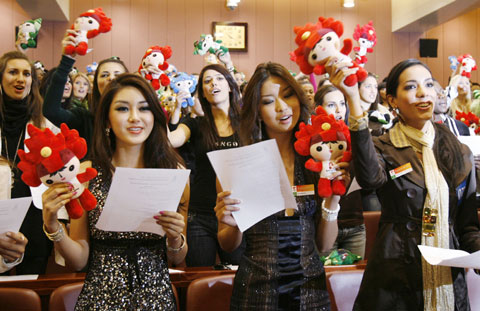 Miss World beauty contestants sing an
Olympic song "Light the Passion, Share the Dream" during a media event in
Beijing November 19, 2007. The 2007 Miss World Final will be held on the
December 1 in Sanya, southern China. Miss World beauty contestants sing an
Olympic song "Light the Passion, Share the Dream" during a media event in
Beijing November 19, 2007. The 2007 Miss World Final will be held on the
December 1 in Sanya, southern China.
 Vietnamese
rosewood craftworks are popular at the 4th China-ASEAN Expo opened in Guangxi
Zhuang Autonomous Region on October 28, 2007. ASEAN is stepping up talks on FTAs
with China. Vietnamese
rosewood craftworks are popular at the 4th China-ASEAN Expo opened in Guangxi
Zhuang Autonomous Region on October 28, 2007. ASEAN is stepping up talks on FTAs
with China.
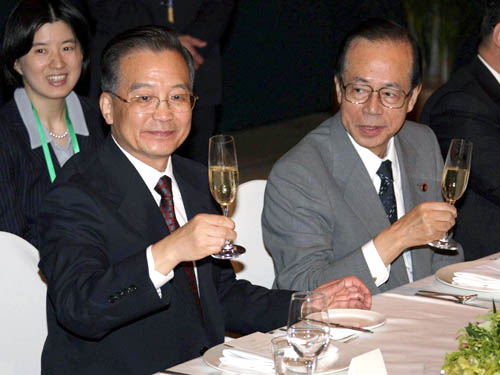 Premier
Wen Jiabao yesterday urged his new Japanese counterpart, Yasuo Fukuda, to seize
the opportunities presented by warming ties between the two nations, saying
relations were at an "important turning point". His comments came during the
first meeting between Mr Wen and Mr Fukuda, who replaced Shinzo Abe as prime
minister in late September. Mr Fukuda took office vowing to implement his
long-stated goal of improving Japan's relations with China, building on the work
of Mr Abe, who sought to thaw the freeze that developed under his predecessor,
Junichiro Koizumi. Officials on both sides said Mr Wen expressed hopes that an
upcoming visit by Mr Fukuda to Beijing and a visit to Tokyo by President Hu
Jintao next spring would boost the steady development of ties. "I hope we will
make concerted efforts and grasp this opportunity to push forward the continuous
development of bilateral ties," Mr Wen said. He remarked that Mr Fukuda had
telephoned him soon after becoming prime minister, saying this showed the
importance Mr Fukuda attached to Sino-Japanese relations. The pair spoke for
more than 90 minutes during a hectic day of East Asian diplomacy of the fringes
of the Asean leaders summit in Singapore. They met formally before heading
laughing and smiling to lunch to continue talks in what diplomats on both sides
said was an unusual move given the previously stiff relationship between
leaders. "Mr Fukuda made it clear that he was pleased Japan and China were now
working together," Japanese Foreign Ministry spokesman Matsuo Sakaba said. "He
welcomed the positive developments in recent times and made a commitment to
developing the relationship." Specifically, the two set the date of the first
Sino-Japanese Economic Dialogue, which will take place on December 1 and 2 in
Beijing and involve high ranking economic, finance and industrial officials on
both sides. "We expect much from this dialogue," Mr Sakaba said. Premier
Wen Jiabao yesterday urged his new Japanese counterpart, Yasuo Fukuda, to seize
the opportunities presented by warming ties between the two nations, saying
relations were at an "important turning point". His comments came during the
first meeting between Mr Wen and Mr Fukuda, who replaced Shinzo Abe as prime
minister in late September. Mr Fukuda took office vowing to implement his
long-stated goal of improving Japan's relations with China, building on the work
of Mr Abe, who sought to thaw the freeze that developed under his predecessor,
Junichiro Koizumi. Officials on both sides said Mr Wen expressed hopes that an
upcoming visit by Mr Fukuda to Beijing and a visit to Tokyo by President Hu
Jintao next spring would boost the steady development of ties. "I hope we will
make concerted efforts and grasp this opportunity to push forward the continuous
development of bilateral ties," Mr Wen said. He remarked that Mr Fukuda had
telephoned him soon after becoming prime minister, saying this showed the
importance Mr Fukuda attached to Sino-Japanese relations. The pair spoke for
more than 90 minutes during a hectic day of East Asian diplomacy of the fringes
of the Asean leaders summit in Singapore. They met formally before heading
laughing and smiling to lunch to continue talks in what diplomats on both sides
said was an unusual move given the previously stiff relationship between
leaders. "Mr Fukuda made it clear that he was pleased Japan and China were now
working together," Japanese Foreign Ministry spokesman Matsuo Sakaba said. "He
welcomed the positive developments in recent times and made a commitment to
developing the relationship." Specifically, the two set the date of the first
Sino-Japanese Economic Dialogue, which will take place on December 1 and 2 in
Beijing and involve high ranking economic, finance and industrial officials on
both sides. "We expect much from this dialogue," Mr Sakaba said.
November 22, 2007
Hong Kong:
Hong Kong's unemployment rate
unexpectedly fell to a fresh nine-year low in the August-October period, as
strong domestic consumption amid the booming stock and property markets helped
create more jobs.
 Geng Tianyuan from China's Hong Kong, the winner of best actor, poses with his
award certificate in the 3rd Traditional Chinese Opera Festival in Paris,
France, Nov. 18, 2007. The 3rd Traditional Chinese Opera Festival closed in
Paris on Sunday.
Geng Tianyuan from China's Hong Kong, the winner of best actor, poses with his
award certificate in the 3rd Traditional Chinese Opera Festival in Paris,
France, Nov. 18, 2007. The 3rd Traditional Chinese Opera Festival closed in
Paris on Sunday.
Bank of China (Hong Kong) (2388)
said yesterday it spent HK$3.95 billion to acquire a 4.94 percent stake in Bank
of East Asia (0023), and BEA chairman David Li Kwok-po said he believes it may
increase its stake in coming days.
 The 115-seat win by the Democratic Alliance for the
Betterment and Progress of Hong Kong in the district council elections came as a
surprise to the leadership of the territory's largest pro- Beijing party, and
helped erase the wounds it suffered four years ago amid a public outcry over the
party's support for the hated Article 23 legislation.
The 115-seat win by the Democratic Alliance for the
Betterment and Progress of Hong Kong in the district council elections came as a
surprise to the leadership of the territory's largest pro- Beijing party, and
helped erase the wounds it suffered four years ago amid a public outcry over the
party's support for the hated Article 23 legislation.
Chief Executive Donald Tsang Yam- kuen recently announced
plans for 10 large-scale infrastructure projects that will bring about huge
economic benefits. Most of them are transport- related: Sha Tin to Central Link,
Tuen Mun Western Bypass, Hong Kong- Zhuhai-Macau bridge, to name a few.
China:
The People's Bank of China launched a trans-bank system for small-amount payment
on Monday. The first batch of 14 banks in Beijing will apply this system in
succession, according to the Beijing Morning Post. After signing contracts with
account banks in advance, with a 12-digit payment bank code, clients can
deposit, withdraw or transfer small sums of money amongst outlets of banks
participating in this program. Clients also need to pay certain fees for
small-amount transactions. However, the charge varies among banks. For instance,
China Construction Bank (CCB) and Bank of China (BOC) will both charge the
clients one percent of the transacted amount of money, but the minimum charge
for a single transaction is 10 yuan in CCB and 1 yuan in BOC, and maximum is 200
yuan in CCB and 100 yuan in BOC. CCB also sets a limit of five million yuan for
a single deposit or withdraw, while BOC has no such a limit. Some 14 branches of
banks appear in the first branch in adopting the trans-bank payment system in
Beijing, including the Industrial and Commercial Bank of China, Agricultural
Bank of China, BOC, CCB, and Bank of Communications. The Beijing branch of China
Merchants Bank doesn't come up in the list.
Mobile phone ring-tone provider Hurray Holding yesterday
announced it would merge with China's largest private television program
producer Enlight Media.
Premier Wen Jiabao yesterday said he
did not agree with Shenzhen banks' recent move to impose a limit on withdrawals.
He said illegal fund flows should be tackled through legal means.
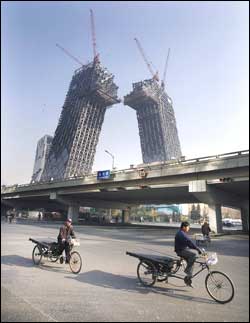 Building a skyscraper should be a
challenge enough. Ole Scheeren wants to reinvent the concept. The chief
architect behind the new headquarters for China's state broadcaster has created
a project that is both an engineering feat set to dominate Beijing's skyline and
a radical social statement. "We wanted to think of a skyscraper that would not
fall into the trap of racing for height, of trying to dominate the skyline by
being the tallest," Scheeren said. "We thought against the verticality of the
needle, against this very simple principle of hierarchy." What his firm, Rem
Koolhaas' Office for Metropolitan Architecture, created instead is what Scheeren
describes as a "loop folded in space" - two towers sloped together and joined by
a gravity-defying canopy equivalent to 80 storys in height. The building is
among several projects in Beijing as the city reinvents itself for next year's
Olympics. Scheeren said the Olympics "was really a catalyst that I think
propelled ambition and development in a very particular way." The project for
China Central Television will incorporate 475,000 square meters in a single
structure, making it the largest in the world after the Pentagon. The design is
so complex that, a decade ago, computational tools were not sophisticated enough
to support the engineering. For Scheeren, it is not the architectural tricks
that count. "It's easy to look at the building as an accomplishment of
engineering, but for me, what is more important than that is the social ambition
this project pursues in the way it brings people together," he said. The
building will incorporate all the elements of television-making in one structure
- from production studios and newsrooms to executive offices. A pathway open to
visitors will follow the loop of the building up to the canopy, where the
glass-floored overhang offers a view over the city from a dizzying 160 meters,
before looping back down through the second tower. Building a skyscraper should be a
challenge enough. Ole Scheeren wants to reinvent the concept. The chief
architect behind the new headquarters for China's state broadcaster has created
a project that is both an engineering feat set to dominate Beijing's skyline and
a radical social statement. "We wanted to think of a skyscraper that would not
fall into the trap of racing for height, of trying to dominate the skyline by
being the tallest," Scheeren said. "We thought against the verticality of the
needle, against this very simple principle of hierarchy." What his firm, Rem
Koolhaas' Office for Metropolitan Architecture, created instead is what Scheeren
describes as a "loop folded in space" - two towers sloped together and joined by
a gravity-defying canopy equivalent to 80 storys in height. The building is
among several projects in Beijing as the city reinvents itself for next year's
Olympics. Scheeren said the Olympics "was really a catalyst that I think
propelled ambition and development in a very particular way." The project for
China Central Television will incorporate 475,000 square meters in a single
structure, making it the largest in the world after the Pentagon. The design is
so complex that, a decade ago, computational tools were not sophisticated enough
to support the engineering. For Scheeren, it is not the architectural tricks
that count. "It's easy to look at the building as an accomplishment of
engineering, but for me, what is more important than that is the social ambition
this project pursues in the way it brings people together," he said. The
building will incorporate all the elements of television-making in one structure
- from production studios and newsrooms to executive offices. A pathway open to
visitors will follow the loop of the building up to the canopy, where the
glass-floored overhang offers a view over the city from a dizzying 160 meters,
before looping back down through the second tower.
Beijing supports a strong US dollar
because it would foster a healthy global economic system, People's Bank of China
(SEHK: 3988) governor Zhou Xiaochuan said yesterday. Mr Zhou said Beijing hoped
for an orderly solution following recent market turbulence stirred by defaults
on US mortgages. "So in this sense, actually we hope to see a strong dollar," he
said. Mr Zhou stressed China's support of the US dollar was made in an
international context and not with regard to its US$1.43 trillion in foreign
exchange reserves. Earlier this month, the euro hit a record high above US$1.47
after Cheng Siwei, a vice-chairman of the National People's Congress who has no
hand in drafting policy, made comments which pointed to the diversification of
the country's reserves. Asked in Cape Town if Beijing should or was already
investing in stronger currencies and if he agreed with Mr Cheng's comments, Mr
Zhou said: "He is not in government and not in administration, so it is his own
opinion. "Central banks always listen to all kind of opinions, but it doesn't
mean we do anything in line with what they talked [about] ... we have our own
analysis and have our own policy." Turning to the domestic economy, Mr Zhou said
Beijing did not need to raise interest rates too frequently because inflationary
pressures were coming mainly from rising food prices. But it could not rule out
further interest rate rises although none was on the cards "next week", he said.
A rise in food prices pushed the inflation rate to an 11-year high of 6.5 per
cent last month, up from 6.2 per cent in September. The central bank has raised
interest rates five times this year, partly to curb inflation and to prevent
real returns on bank deposits from sinking too far into negative territory.
China would continue to raise banks' reserve ratios, Mr Zhou said.
November 21, 2007
Hong Kong:
The pro-Beijing political party DAB was the big winner in this year’s District
Council elections. Polling day, when it came, was very much like the rest of the
campaign - quiet, understated and lacking in excitement. The district council
elections have, this time, failed to fire the public's imagination, this despite
the fact that fewer candidates have been returned unopposed and many
constituencies were hotly contested. The full results will not be known until
today. But it is at this stage possible to gauge the extent to which Hong Kong
people have used these grass-roots elections to exercise their democratic
rights. And the outcome is not as discouraging as it might first appear.
Yesterday's turnout, the key indicator as far as people's enthusiasm for voting
is concerned, at more than 38 per cent, was lower than the record 44 per cent
set at the last district council elections four years ago. That was widely
expected. And it is easy to understand why the figure is smaller this time. In
2003, Hong Kong had endured years of economic downturn and the traumatic Sars
outbreak. Government proposals for national security laws had raised fears that
our freedoms were about to be eroded. The elections took place a few months
after the mass demonstration by 500,000 people on July 1. In such circumstances,
it is not surprising that a record proportion of registered voters turned out to
make their feelings felt through the ballot box. The political climate this time
is very different. The economy is booming and Chief Executive Donald Tsang
Yam-kuen has been careful not to push ahead with any policy that is likely to
spark widespread opposition. At the time of the last district council polls,
there were strong hopes that democratic reforms were on the way. Little progress
has since been made. But much to the disappointment of the pan-democrats, even
this has failed to ignite public opinion. The question of democratic reforms may
well become the focus of the Legislative Council elections next year. But they
certainly did not prompt a high proportion of voters to flock to the polls
yesterday. This does not mean that Hong Kong people have lost their enthusiasm
for democracy, however. Indeed, there is another figure from yesterday's vote
that is worth considering. A record 1.149 million votes were cast - the highest
for any district council election. This is a reflection of the growing number of
registered voters, which was about half a million more than in 2003. Hong Kong
people are increasingly recognising the importance of at least registering to
vote, even if many choose not to exercise that right for the election of
district councillors who, after all, have a very limited role in policy-making.
We can also take some comfort from the rather uncontroversial nature of this
campaign. It would have been nice to have some higher-quality candidates and a
higher profile for election debates. But with the exception of one violent
attack on a campaign manager, which may or may not be related to the polls, this
has been a fair and orderly election. That is something of which Hong Kong can
be proud.
"Home Song" heads home with most -
"The Jammed," a self-distribbed contempo thriller about human trafficking that
until five months ago was set to go direct-to-DVD, capped a remarkable rise from
obscurity to collect the top trophy at the Inside Film Awards Nov. 17. The
indie-financed pic also won kudos for script (for scribe-producer-helmer Dee
McLachlan) and music (Grant McLachlan), but Tony Ayres' semi-autobiographical
immigrant family drama "The Home Song Stories" scooped the biggest booty, five
awards, including the director award for Ayres. The web-voted IF Awards, dubbed
the people's choice kudos in contrast to the AFI Awards held each December, were
presented at the Royal Pines Resort on Queensland's Gold Coast and broadcast on
fifth-ranked pubcaster SBS. "The Jammed," which stars Emma Lung as an Asian
immigrant forced into sex slavery in Melbourne, was bypassed for acting kudos
which went to "Home Song" leads 13-year-old Joel Lok and Joan Chen. Chen said
she was lured out of retirement to take the role and described the win as
"embroidery on silk." "Home Song" also collected awards for design (Melinda
Doring) and cinematography (Nigel Bluck). Tinnitus-drama "Noise" garnered awards
for sound (Emma Bortignon, Doron Kipen, Philippe Decrausaz) and editing (Geoff
Hitchins). "Unlikely Travellers" from helmer Michael Noonan won best doc and
"Darling! The Pieter-Dirk Uys Story" took the independent spirit award.
China's Hong Kong and Finland signed
an avoidance of double taxation agreement on income from aircraft operation here
on Monday. The pact, which covers income derived from the operation of aircraft
in international traffic, was signed by Eva Cheng, secretary for Transport and
Housing of the Hong Kong Special Administrative Region government, and Timo
Rajakangas, Finnish Consul-General in Hong Kong. Hong Kong has similar
arrangements with Bangladesh, Belgium, Canada, Croatia, Denmark, Estonia,
Ethiopia, Germany, Iceland, Israel, Jordan, Kenya, Kuwait, Mauritius, Mexico,
the Netherlands, New Zealand, Norway, Russia, South Korea, Sweden, Switzerland,
the UK, the China's mainland and China's Macao.
 Contestants
participate in the sedan chair race in Hong Kong, November 18, 2007. The annual
contest since 1975 is participated by local residents and organized to raise
funds for charity. Contestants
participate in the sedan chair race in Hong Kong, November 18, 2007. The annual
contest since 1975 is participated by local residents and organized to raise
funds for charity.
The presence of Hong Kong's leading
political figures and a number of key clashes in several constituencies failed
to excite voters, with just over 38 percent of the electorate turning up for
yesterday's district council elections.
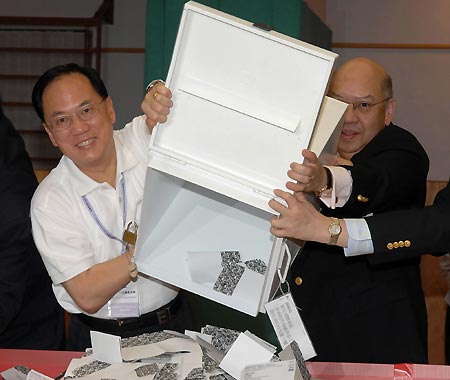 Hong Kong Special
Administrative Region (HKSAR) Chief Executive Donald Tsang (L) opens a ballot
box at a polling station in Hong Kong, China on Nov. 18, 2007. Voting to elect
the third-term district councils of the HKSAR ended Sunday night. The Hong Kong
Electoral Affairs Commission announced at predawn hours here Monday that the
counting of ballots in the third-term District Council election was completed as
364 candidates won in their contested constituencies. The announcement by the
Electoral Affairs Commission came at about 4:45 a.m. local time Monday (2045 GMT
Sunday) as it took more than five hours to complete the ballots-counting
process, which began at 22:30 (1430 GMT) Sunday immediately after the voting
ended. More than 1.14 million registered voters cast their votes in the election
for the third-term District Council in the Hong Kong Special Administrative
Region (HKSAR), about 70,000 more than those in the 2003 election, according to
the Electoral Affairs Commission. Hong Kong has 18 District Councils and the
third-term District Councils are composed of 534 members, including 405 elected
members, 102 appointed members and 27 ex-officio members. Candidates in 41 of
the 405 constituencies have been elected unopposed while the remaining 364 seats
in the 18 District Councils were contested by 866 candidates. The District
Council election adopts the first-past-the post voting system, under which the
candidate who receives the largest number of votes will be elected. All Hong
Kong permanent residents aged 18 or above who are ordinarily residing in Hong
Kong are eligible to register as electors. The functions of district councils
include advising the HKSAR government on matters affecting the well-being of the
people in the district and the use of public funds allocated to the district for
local public works and community activities. Where funds are made available, a
district council will also undertake environmental improvements and the
promotion of recreational and cultural activities as well as community
activities. Voting began from 7:30 a.m. (2330 GMT Saturday) and ended at 22:30
Sunday (1430 GMT Sunday) as 1.14 million voters, including HKSAR Chief Executive
Donald Tsang, flocked to 480 polling stations to cast their votes. "The polling
for our third-term District Council has come to a successful ending," said HKSAR
Chief Executive Donald Tsang after the voting ended, "it is a fair, open and
just election under the full-scale coverage by the press and the observation by
the public. "The election shows citizens in Hong Kong have good traditions and
the election system has been respected," Tsang said, "I hope the new elected
District Council members to try their best in their work to help the HKSAR
government build more harmonious and more beautiful communities." The ballot
counting started at 22:30 Sunday (1430 GMT Sunday) under the observation of
candidates and the public. Local televisions broadcast live the results of
ballots-counting for all the polling stations. The term of office for the third
term district councils will start from Jan. 1, 2008 and end on Dec. 31, 2011. Hong Kong Special
Administrative Region (HKSAR) Chief Executive Donald Tsang (L) opens a ballot
box at a polling station in Hong Kong, China on Nov. 18, 2007. Voting to elect
the third-term district councils of the HKSAR ended Sunday night. The Hong Kong
Electoral Affairs Commission announced at predawn hours here Monday that the
counting of ballots in the third-term District Council election was completed as
364 candidates won in their contested constituencies. The announcement by the
Electoral Affairs Commission came at about 4:45 a.m. local time Monday (2045 GMT
Sunday) as it took more than five hours to complete the ballots-counting
process, which began at 22:30 (1430 GMT) Sunday immediately after the voting
ended. More than 1.14 million registered voters cast their votes in the election
for the third-term District Council in the Hong Kong Special Administrative
Region (HKSAR), about 70,000 more than those in the 2003 election, according to
the Electoral Affairs Commission. Hong Kong has 18 District Councils and the
third-term District Councils are composed of 534 members, including 405 elected
members, 102 appointed members and 27 ex-officio members. Candidates in 41 of
the 405 constituencies have been elected unopposed while the remaining 364 seats
in the 18 District Councils were contested by 866 candidates. The District
Council election adopts the first-past-the post voting system, under which the
candidate who receives the largest number of votes will be elected. All Hong
Kong permanent residents aged 18 or above who are ordinarily residing in Hong
Kong are eligible to register as electors. The functions of district councils
include advising the HKSAR government on matters affecting the well-being of the
people in the district and the use of public funds allocated to the district for
local public works and community activities. Where funds are made available, a
district council will also undertake environmental improvements and the
promotion of recreational and cultural activities as well as community
activities. Voting began from 7:30 a.m. (2330 GMT Saturday) and ended at 22:30
Sunday (1430 GMT Sunday) as 1.14 million voters, including HKSAR Chief Executive
Donald Tsang, flocked to 480 polling stations to cast their votes. "The polling
for our third-term District Council has come to a successful ending," said HKSAR
Chief Executive Donald Tsang after the voting ended, "it is a fair, open and
just election under the full-scale coverage by the press and the observation by
the public. "The election shows citizens in Hong Kong have good traditions and
the election system has been respected," Tsang said, "I hope the new elected
District Council members to try their best in their work to help the HKSAR
government build more harmonious and more beautiful communities." The ballot
counting started at 22:30 Sunday (1430 GMT Sunday) under the observation of
candidates and the public. Local televisions broadcast live the results of
ballots-counting for all the polling stations. The term of office for the third
term district councils will start from Jan. 1, 2008 and end on Dec. 31, 2011.
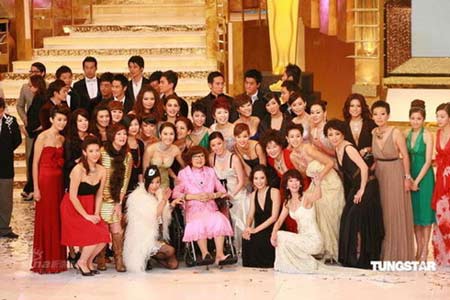 Hong Kong
TVB stars pose for a group photo at TVB's 40th anniversary awards on Saturday,
Nov. 17, 2007. Hong Kong's dominant television station TVB celebrated its 40th
anniversary with a star-studded awards gala on Saturday. Over the years, TVB has
helped a bevy of local acting talent achieve stardom with long-running TV dramas
produced and broadcast under its umbrella. Since 1997, TVB has been holding an
anniversary awards ceremony every November to honor its best stars of the year.
This year's show saw Moses Chan take the best leading actor award for his role
in "Heart of Greed," with the drama's Lee Sze Kei winning the best actress
award. Gigi Lai was voted as "my favorite TVB actress," and Raymond Lam was
crowned "my favorite TVB actor." Kate Tsui was named as "vastly-improved
actress," and her counterpart actor was Amigo Choi. Veteran comedian Lydia Shum
was honored with a lifetime achievement award. Shum, whose health problems have
long been the focus of local media, made it to the ceremony in a wheelchair to
accept the honor. Anniversary celebrations will continue with another ceremony
scheduled for November 19, the 40th birthday of TVB Pearl, a major channel of
TVB. Hong Kong
TVB stars pose for a group photo at TVB's 40th anniversary awards on Saturday,
Nov. 17, 2007. Hong Kong's dominant television station TVB celebrated its 40th
anniversary with a star-studded awards gala on Saturday. Over the years, TVB has
helped a bevy of local acting talent achieve stardom with long-running TV dramas
produced and broadcast under its umbrella. Since 1997, TVB has been holding an
anniversary awards ceremony every November to honor its best stars of the year.
This year's show saw Moses Chan take the best leading actor award for his role
in "Heart of Greed," with the drama's Lee Sze Kei winning the best actress
award. Gigi Lai was voted as "my favorite TVB actress," and Raymond Lam was
crowned "my favorite TVB actor." Kate Tsui was named as "vastly-improved
actress," and her counterpart actor was Amigo Choi. Veteran comedian Lydia Shum
was honored with a lifetime achievement award. Shum, whose health problems have
long been the focus of local media, made it to the ceremony in a wheelchair to
accept the honor. Anniversary celebrations will continue with another ceremony
scheduled for November 19, the 40th birthday of TVB Pearl, a major channel of
TVB.
 Henderson Land
Development (0012) chairman Lee Shau-kee turned cooler on the Hong Kong equity
market for the first time yesterday, warning that investors should be cautious.
In response to the tumble of Hong Kong shares at the end of last week, Lee said
the effects from the mainland's crackdown on underground channels pumping money
into Hong Kong have been factored in. "I am afraid other negative [news] will
come. It is so serious these few days. The index may see a further slide, but
the drop will only be temporary. "The [situation] will be stable after a while,"
Lee told reporters after casting his vote in the district council elections. He
added: "Anyway, investors should be careful and don't buy the shares if they are
too expensive; buy them when the prices are low. The stock market is very
volatile now and more tightening measures from the mainland may come. "Investors
need to be more careful before buying any stock. Buy more shares if [the index]
drops, buy even more when it drops further." Gaming magnate Stanley Ho Hung- sun
said on Saturday the benchmark Hang Seng Index will be able to reach 40,000
points by the end of this year, but Lee sees a less-than-rosy outlook for the
market. "It's impossible [to reach 40,000]. I believe it will probably reach
35,000, or about 30,000 points by the end of this year and expect the index to
hit 33,000 in two to three months after the New Year," he said. Yesterday was
the first time this year that Lee has expressed negative comments to the public. Henderson Land
Development (0012) chairman Lee Shau-kee turned cooler on the Hong Kong equity
market for the first time yesterday, warning that investors should be cautious.
In response to the tumble of Hong Kong shares at the end of last week, Lee said
the effects from the mainland's crackdown on underground channels pumping money
into Hong Kong have been factored in. "I am afraid other negative [news] will
come. It is so serious these few days. The index may see a further slide, but
the drop will only be temporary. "The [situation] will be stable after a while,"
Lee told reporters after casting his vote in the district council elections. He
added: "Anyway, investors should be careful and don't buy the shares if they are
too expensive; buy them when the prices are low. The stock market is very
volatile now and more tightening measures from the mainland may come. "Investors
need to be more careful before buying any stock. Buy more shares if [the index]
drops, buy even more when it drops further." Gaming magnate Stanley Ho Hung- sun
said on Saturday the benchmark Hang Seng Index will be able to reach 40,000
points by the end of this year, but Lee sees a less-than-rosy outlook for the
market. "It's impossible [to reach 40,000]. I believe it will probably reach
35,000, or about 30,000 points by the end of this year and expect the index to
hit 33,000 in two to three months after the New Year," he said. Yesterday was
the first time this year that Lee has expressed negative comments to the public.
China:
Chinese toon draws on Confucius - There's nothing looney about these toons. Two
Chinese media firms have signed a deal with the Confucius Foundation to make a
$5.3 million cartoon series on the legendary philosopher's life and teachings.
Shandong Radio and TV, based in the eastern Shandong Province; and Shenzhen
Phoenix Star, a subsidiary of the Hong Kong-listed Phoenix Satellite TV, will
jointly produce the cartoon on the philosopher's life and lectures. There will
be 100 episodes, each lasting 13 minutes. "The cartoon aims to make Confucius
and his philosophy well known and better understood in a form with popular
appeal," a spokesman for the Chinese Confucius Foundation told the Xinhua news
agency. Confucius, the respectful name for the great thinker, philosopher,
statesman and educator called Kongqiu, who lived from 551-479 BC, is undergoing
a major revival in China these days. Confucian philosophy, which dominated
Chinese society for centuries, and spread to the West in the late 16th century,
advocates achieving harmony through self-refinement in manners and taste. The
project is expected to be finalized by September, and the series is tapped to be
aired in 2009, the 2,560th anniversary of Confucius' birth, the spokesman says.
Scholars and, increasingly, the Communist Party, believe following sound
Confucian principles is conducive to building a "harmonious society," to which
President Hu Jintao constantly refers. Last year, in order to settle the debate
about what the ancient philosopher looked like, the China Confucius Foundation (CCF)
published a standard image of him -- as an old man with a long beard, broad
mouth and big ears, wearing a robe with his hands crossed on his chest. And for
anyone who thinks toons are too juvenile for the man known as the Master, you
just need to check out his views on youthful pursuits in the Analects of
Confucius: "A youth is to be regarded with respect. How do we know that his
future will not be equal to our present?"
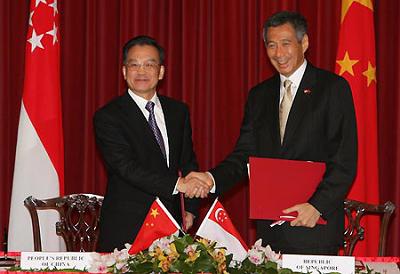 Chinese Premier Wen Jiabao
(L) shakes hands with his Singaporean counterpart Lee Hsien Loong after signing
the Framework Agreement for the Development of the Sino-Singapore Eco-city
Project in Singapore on Nov. 18, 2007. Wen Jiabao arrived in Singapore on Sunday
for an official visit and would attend a series of regional summit meetings to
be held in the country. Chinese Premier Wen Jiabao
(L) shakes hands with his Singaporean counterpart Lee Hsien Loong after signing
the Framework Agreement for the Development of the Sino-Singapore Eco-city
Project in Singapore on Nov. 18, 2007. Wen Jiabao arrived in Singapore on Sunday
for an official visit and would attend a series of regional summit meetings to
be held in the country.
China has started construction on 16
new express passenger rail projects and is expected to have 12,000 kilometers of
express rail lines by 2020, the Ministry of Railways said Sunday.
 A residential
building in Shanghai. Despite warnings of a slowdown and the central
government's efforts to forestall overheating, China's real estate market
remained brisk in the third quarter. A residential
building in Shanghai. Despite warnings of a slowdown and the central
government's efforts to forestall overheating, China's real estate market
remained brisk in the third quarter.
 Hongkonger Verna has
worked in Beijing for two years, but only recently became fastidious about
eating quality food after becoming pregnant. With occasional rumors of hygiene
problems with local food, Verna was worried about the possible effect on her
unborn baby. She called up a local friend and asked: "what do you think is safe
to eat?" Whether her concern was warranted or not, there is one certain answer
to Verna's question: organic foods. Hongkonger Verna has
worked in Beijing for two years, but only recently became fastidious about
eating quality food after becoming pregnant. With occasional rumors of hygiene
problems with local food, Verna was worried about the possible effect on her
unborn baby. She called up a local friend and asked: "what do you think is safe
to eat?" Whether her concern was warranted or not, there is one certain answer
to Verna's question: organic foods.
Premier Wen Jiabao and Singapore
Prime Minister Lee Hsien Loong agreed yesterday to jointly develop an
environmentally friendly city in northeastern China that will be used as a model
for sustainable development, a Singapore government statement said.

 Director Ang Lee (2, L) poses with
actors (L-R) Tony Leung, Tang Wei, Lee-hom Wang and Joan Chen at the premiere of
the film "Lust, Caution" during the 64th Venice Film Festival in Venice, Italy,
Aug. 30, 2007. "Lust, Caution" directed by Ang Lee is one of 22 films competing
in the official contest. As Oscar-winning director Ang Lee's spy thriller "Lust,
Caution" hits theaters around the world, Internet hackers have showed an
interest in the film by spreading a virus on websites related to the movie. As
of Friday, the virus had infected several hundreds of websites, online forums
and blogs about the film, according to a Beijing Daily report that quoted
Rising, a domestic company specializing in the research and production of
anti-virus software. The virus damages computers when users download the film
online or explore websites about the blockbuster. Once hit by the virus,
computers monitors will show abnormal blue screens. The virus can infect some
hardware, such as flash disks and mobile hard disks, when they are connected to
computers that carry the virus. Director Ang Lee (2, L) poses with
actors (L-R) Tony Leung, Tang Wei, Lee-hom Wang and Joan Chen at the premiere of
the film "Lust, Caution" during the 64th Venice Film Festival in Venice, Italy,
Aug. 30, 2007. "Lust, Caution" directed by Ang Lee is one of 22 films competing
in the official contest. As Oscar-winning director Ang Lee's spy thriller "Lust,
Caution" hits theaters around the world, Internet hackers have showed an
interest in the film by spreading a virus on websites related to the movie. As
of Friday, the virus had infected several hundreds of websites, online forums
and blogs about the film, according to a Beijing Daily report that quoted
Rising, a domestic company specializing in the research and production of
anti-virus software. The virus damages computers when users download the film
online or explore websites about the blockbuster. Once hit by the virus,
computers monitors will show abnormal blue screens. The virus can infect some
hardware, such as flash disks and mobile hard disks, when they are connected to
computers that carry the virus.
 Chinese actress Zhou
Xun promotes the fashion magazine Harper's Bazaar on Sunday, Nov. 11, 2007, in a
shopping mall in Beijing. Chinese actress Zhou Xun signed the 140th anniversary
special Chinese edition of the international fashion magazine Harper's Bazaar on
Sunday in a shopping mall in Beijing. Zhou Xun published 140 photos from her
daily life on the magazine upon the invitation of Bazaar's Chinese
editor-in-chief Su Mang, who is also a good friend of Zhou. Many of the photos
were shot by Zhou's boyfriend, Taiwan stylist Li Daqi. "These moments of my life
were just like a story or a film, in which I played the main part." Zhou Xun
said, "You will see the most candid and the most relaxed Zhou Xun before the
camera of Daqi." Chinese actress Zhou
Xun promotes the fashion magazine Harper's Bazaar on Sunday, Nov. 11, 2007, in a
shopping mall in Beijing. Chinese actress Zhou Xun signed the 140th anniversary
special Chinese edition of the international fashion magazine Harper's Bazaar on
Sunday in a shopping mall in Beijing. Zhou Xun published 140 photos from her
daily life on the magazine upon the invitation of Bazaar's Chinese
editor-in-chief Su Mang, who is also a good friend of Zhou. Many of the photos
were shot by Zhou's boyfriend, Taiwan stylist Li Daqi. "These moments of my life
were just like a story or a film, in which I played the main part." Zhou Xun
said, "You will see the most candid and the most relaxed Zhou Xun before the
camera of Daqi."
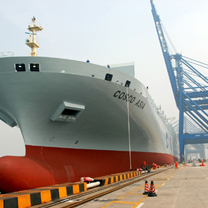 The 10,050-TEU
container vessel COSCO Asia, is docked at Tianjin Five Continents International
Container Terminal. COSCO Pacific Ltd said its throughput rose 20 percent in the
first 10 months. The 10,050-TEU
container vessel COSCO Asia, is docked at Tianjin Five Continents International
Container Terminal. COSCO Pacific Ltd said its throughput rose 20 percent in the
first 10 months.
November 20, 2007
Hong Kong:
After the strong surge in the second quarter, Hong Kong's economy cooled in the
third quarter on weaker US demand.
Gross domestic product for the three months to the end of September rose 6.2
percent from a year earlier, the government said yesterday, after gaining 6.6
percent in the second quarter. On a seasonally adjusted basis, the economy grew
1.7 percent from the previous quarter, after expanding 1.9 percent in the second
quarter. The government also altered its forecast for growth this year to 6
percent from 5 to 6 percent previously. "The economy remains robust with the
bullish market environment, increasing household income and strong private
consumption," said acting government economist Helen Chan. Bank of East Asia
economist Paul Tang said growth was due to private consumption, which was helped
by the buoyant equity market. Total exports of goods grew by 6.4 percent in the
third quarter, a slight decrease of 0.2 percent in quarter-to-quarter
comparison. Chan explained that is due to the 4 percent decline of exports to
the United States, which accounts for 14 percent of total exports. However, she
said exports to the mainland, which take up 49 percent of total exports, rose
12.9 percent in the last quarter. "Exports will continue to weaken in the few
quarters ahead," said Kelvin Lau, an economist at Standard Chartered Bank in
Hong Kong. "On the other hand, I see no reason for domestic consumption to slow
because wages and asset prices are still rising, so that should hold up the
economy." Household spending rose 9.7 percent in the third quarter from a year
earlier after gaining 5.7 percent in the previous three months. "Strengthened
domestic demand made up for softer exports," said Joe Lo, senior economist at
Citigroup in Hong Kong. "The economy is still growing pretty strongly." Hong
Kong's jobless rate was 4.1 percent in September, matching July's nine-year low.
The government has also raised the composite consumer CPI inflation for the
whole year from 1.5 percent to 2 percent. Inflation rate for the third quarter
is 1.6 percent, 0.3 percent up compared to the second quarter. If the effects of
rates concession is to be taken into consideration, the inflation rate will be
2.7 percent.
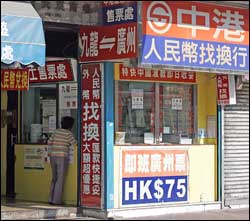 Police have smashed an
underground bank in Shenzhen that allegedly handled transactions totaling 4.3
billion yuan (HK$4.5 billion) between 2006 and May this year. The raid was
revealed by a state-run television station on Friday as mainland authorities
intensified their crackdown on illegal funds being poured into Hong Kong stocks
through underground channels ahead of China's delayed "through-train" scheme.
The scheme will eventually allow legitimate direct investment from the mainland
into Hong Kong. Arrested during the bust in June was To Ling, 43, a
money-exchange shop owner in Hong Kong. Five other suspects were also arrested.
Ninety bank cards, 40 internet bank passwords, 67 bank books and 11 identity
cards for account transfers were seized, as well as a large number of ledgers
and journals. Investigators allege the illegal network had operated for about
seven or eight years in Shenzhen, attracting investors from 31 provinces and
cities. Based in a residential area, its daily transactions reportedly averaged
eight million yuan, with transaction fees hitting more than 10 million yuan.
According to CCTV, mainlanders would deposit money with the underground
organization, which would then in-struct its Hong Kong agents to transfer the
funds into the clients' Hong Kong account to buy local stocks. Police believe
some 130 million yuan poured into the Hong Kong stock and property markets, and
100 million yuan into the capital markets. Last year, police smashed more than
70 underground financial organizations throughout the mainland that were
involved in US$3 billion (HK$23.4 billion) worth of transactions, CCTV reported.
"Many people have speculated on Hong Kong stocks through the underground
financial channels with just a phone call," an unnamed investor said. Another
source said most mainland brokerages were involved in "unlawful account openings
because of the fat profits involved." All mainland securities houses have
recently received warning letters, advising them not to participate in illegal
account openings. Some large brokerages have already been fined. Subsidiaries of
China National Petroleum Corp and Sinopec are among the clients of the Shenzhen
underground bank police shut down, a mainland newspaper revealed. Police have smashed an
underground bank in Shenzhen that allegedly handled transactions totaling 4.3
billion yuan (HK$4.5 billion) between 2006 and May this year. The raid was
revealed by a state-run television station on Friday as mainland authorities
intensified their crackdown on illegal funds being poured into Hong Kong stocks
through underground channels ahead of China's delayed "through-train" scheme.
The scheme will eventually allow legitimate direct investment from the mainland
into Hong Kong. Arrested during the bust in June was To Ling, 43, a
money-exchange shop owner in Hong Kong. Five other suspects were also arrested.
Ninety bank cards, 40 internet bank passwords, 67 bank books and 11 identity
cards for account transfers were seized, as well as a large number of ledgers
and journals. Investigators allege the illegal network had operated for about
seven or eight years in Shenzhen, attracting investors from 31 provinces and
cities. Based in a residential area, its daily transactions reportedly averaged
eight million yuan, with transaction fees hitting more than 10 million yuan.
According to CCTV, mainlanders would deposit money with the underground
organization, which would then in-struct its Hong Kong agents to transfer the
funds into the clients' Hong Kong account to buy local stocks. Police believe
some 130 million yuan poured into the Hong Kong stock and property markets, and
100 million yuan into the capital markets. Last year, police smashed more than
70 underground financial organizations throughout the mainland that were
involved in US$3 billion (HK$23.4 billion) worth of transactions, CCTV reported.
"Many people have speculated on Hong Kong stocks through the underground
financial channels with just a phone call," an unnamed investor said. Another
source said most mainland brokerages were involved in "unlawful account openings
because of the fat profits involved." All mainland securities houses have
recently received warning letters, advising them not to participate in illegal
account openings. Some large brokerages have already been fined. Subsidiaries of
China National Petroleum Corp and Sinopec are among the clients of the Shenzhen
underground bank police shut down, a mainland newspaper revealed.
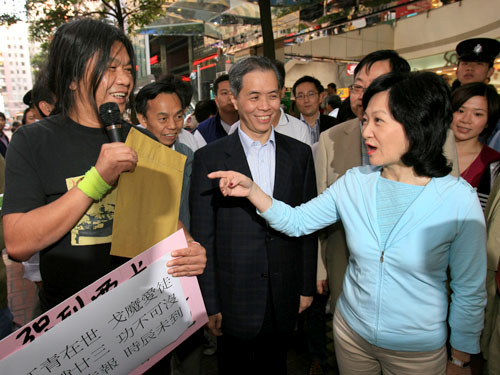 Former security secretary Regina Ip Lau Suk-yee yesterday met her online
supporters face to face - and one of her most persistent opponents. Mrs Ip, who
has made much of her entry on the Facebook internet social networking site since
entering the Legislative Council by-election race, attended a sharing session in
Paterson Street, Causeway Bay, organised by her online support group "Regina for
councillor". With more than 30 fans and dozens of passers-by stopping to watch,
the candidate answered questions about issues ranging from the 1999 right of
abode controversy to her love life. She not only exchanged views with her
supporters but also with maverick lawmaker "Long Hair" Leung Kwok-hung. Mr Leung
arrived with placards and handed a petition to the former security boss
demanding she apologise for her aggressive promotion of the national security
bill four years ago. "I have met you many times. You are quite nice," said Mrs
Ip, smiling as she listened to the protester's criticism of her past remarks
about democracy. Joining Mrs Ip on the campaign trail for the first time was her
daughter, Cynthia Ip Wing-yan, 18, who is studying in the United States. Miss Ip,
who is on holiday, said she hoped to help her mother with the campaign. Mrs Ip's
main opponent in the race for a Hong Kong Island Legco seat, former chief
secretary Anson Chan Fang On-sang, met 30 secondary school and university
students in a cafeteria in Causeway Bay. She said she encouraged young people to
express their opinions about public affairs and to persevere in overcoming the
difficulties they face. Both former government officials will canvass today for
candidates in the district council elections. Mrs Ip will be supporting
candidates from her Savantas Policy Institute, while Mrs Chan will visit
districts on Hong Kong Island to urge citizens to support those "sharing similar
ideas" with her. Six other candidates will contest the December 2 by-election,
which was necessitated by the death of DAB chairman Ma Lik.
Former security secretary Regina Ip Lau Suk-yee yesterday met her online
supporters face to face - and one of her most persistent opponents. Mrs Ip, who
has made much of her entry on the Facebook internet social networking site since
entering the Legislative Council by-election race, attended a sharing session in
Paterson Street, Causeway Bay, organised by her online support group "Regina for
councillor". With more than 30 fans and dozens of passers-by stopping to watch,
the candidate answered questions about issues ranging from the 1999 right of
abode controversy to her love life. She not only exchanged views with her
supporters but also with maverick lawmaker "Long Hair" Leung Kwok-hung. Mr Leung
arrived with placards and handed a petition to the former security boss
demanding she apologise for her aggressive promotion of the national security
bill four years ago. "I have met you many times. You are quite nice," said Mrs
Ip, smiling as she listened to the protester's criticism of her past remarks
about democracy. Joining Mrs Ip on the campaign trail for the first time was her
daughter, Cynthia Ip Wing-yan, 18, who is studying in the United States. Miss Ip,
who is on holiday, said she hoped to help her mother with the campaign. Mrs Ip's
main opponent in the race for a Hong Kong Island Legco seat, former chief
secretary Anson Chan Fang On-sang, met 30 secondary school and university
students in a cafeteria in Causeway Bay. She said she encouraged young people to
express their opinions about public affairs and to persevere in overcoming the
difficulties they face. Both former government officials will canvass today for
candidates in the district council elections. Mrs Ip will be supporting
candidates from her Savantas Policy Institute, while Mrs Chan will visit
districts on Hong Kong Island to urge citizens to support those "sharing similar
ideas" with her. Six other candidates will contest the December 2 by-election,
which was necessitated by the death of DAB chairman Ma Lik.
China:
Venture capital investment in Chinas urged 87.4 percent to 677 million U.S.
dollars in the third quarter, an industry report said. Service-oriented sectors
were the most appealing as they attracted a record 432 million U.S. dollars and
accounted for nearly half of the 59 deals, a report by Ernst and Young and Dow
Jones Venture One, a financial information provider, said. By comparison, the
sectors received investment worth 242 million U.S. dollars in the same period
last year. Money flowing into the information industry dropped 23 percent from a
year ago to 217 million U.S. dollars and accounted for 24 deals. "Globally, more
and more venture capitalists are pouring funds into service-oriented companies,"
said Robert Partridge, Managing Director of Transaction Advisory Services and
the VC Advisory Group of Ernst and Young. "These companies have a relatively low
capital threshold for investors and can attract a large group of customers
within a short time." Venture capitalism, also known as risk capital, refers to
money invested in start-up firms and small businesses that have both growth
potential and the possibility of loss.
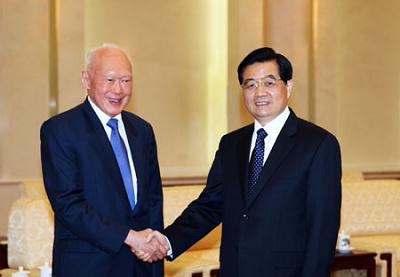 Chinese
President Hu Jintao meets with visiting Singaporean Minister Mentor Lee Kuan Yew
in Beijing Nov. 16, 2007. China would like to work with Singapore to promote the
relations to a new height to benefit the two peoples and the region, said
Chinese President Hu Jintao on Friday. Hu told visiting Singaporean Minister
Mentor Lee Kuan Yew that Sino-Singaporean relations had further developed since
the two countries forged diplomatic ties 17 years ago. The two countries had
increased political trust and economic and trade cooperation, and maintained
coordination in the international and regional affairs, he added. Hu expressed
gratitude for the adherence of Singapore to the one-China policy, and its
opposition to "Taiwan's Independence" as well as its support to China's
reunification cause. He said China was pursuing what the 17th CPC National
Congress had agreed to build a well-off society, and Singapore was taking the
strategy of rebuilding Singapore, thus the two countries faced the new
opportunity for cooperation. Lee Kuan Yew said China's development benefited
Asia and the world. Singapore would be committed to all-round cooperation with
China and would play a positive role in promoting cooperation between China and
the Association of Southeast Asian Nations (ASEAN), he added. Chinese
President Hu Jintao meets with visiting Singaporean Minister Mentor Lee Kuan Yew
in Beijing Nov. 16, 2007. China would like to work with Singapore to promote the
relations to a new height to benefit the two peoples and the region, said
Chinese President Hu Jintao on Friday. Hu told visiting Singaporean Minister
Mentor Lee Kuan Yew that Sino-Singaporean relations had further developed since
the two countries forged diplomatic ties 17 years ago. The two countries had
increased political trust and economic and trade cooperation, and maintained
coordination in the international and regional affairs, he added. Hu expressed
gratitude for the adherence of Singapore to the one-China policy, and its
opposition to "Taiwan's Independence" as well as its support to China's
reunification cause. He said China was pursuing what the 17th CPC National
Congress had agreed to build a well-off society, and Singapore was taking the
strategy of rebuilding Singapore, thus the two countries faced the new
opportunity for cooperation. Lee Kuan Yew said China's development benefited
Asia and the world. Singapore would be committed to all-round cooperation with
China and would play a positive role in promoting cooperation between China and
the Association of Southeast Asian Nations (ASEAN), he added.
 California
Governor Arnold Schwarzenegger Friday urged the Bush administration to promote
U.S. economic growth by expanding free trade. In a letter to President George W.
Bush, the governor said the federal government should counterbalance the
national economic slowdown by opening global markets and expanding free trade.
"Rapidly expanding U.S. exports are a growing source of employment and wage
gains and a well-timed counterbalance to the housing slowdown," Schwarzenegger
said. Citing California, which exports 25 percent of its annual output,
Schwarzenegger said the current trends indicate that it will grow quickly and
substantially, offering more and more job opportunities to fellow Californians.
"However, I am concerned Congress may be moving to end its past commitment to
opening markets and expanding trade by failing to act upon the Free Trade
Agreements you have concluded," he said. "We must recognize that global trade is
largely beneficial, but that its benefits can be uneven and can come with real
downsides for some of our workers. But the answer to those concerns isn't to
shut the door." Even if that protectionism were to assist some, it would do so
at the expense of the far greater number of American workers who benefit from
growing exports, the governor said. "Instead, the answer is to negotiate and
ratify fair treaties and to continue to improve our infrastructure, education
and training so that the United States can successfully compete, and American
workers can gain more employment and higher wages," he said. California
Governor Arnold Schwarzenegger Friday urged the Bush administration to promote
U.S. economic growth by expanding free trade. In a letter to President George W.
Bush, the governor said the federal government should counterbalance the
national economic slowdown by opening global markets and expanding free trade.
"Rapidly expanding U.S. exports are a growing source of employment and wage
gains and a well-timed counterbalance to the housing slowdown," Schwarzenegger
said. Citing California, which exports 25 percent of its annual output,
Schwarzenegger said the current trends indicate that it will grow quickly and
substantially, offering more and more job opportunities to fellow Californians.
"However, I am concerned Congress may be moving to end its past commitment to
opening markets and expanding trade by failing to act upon the Free Trade
Agreements you have concluded," he said. "We must recognize that global trade is
largely beneficial, but that its benefits can be uneven and can come with real
downsides for some of our workers. But the answer to those concerns isn't to
shut the door." Even if that protectionism were to assist some, it would do so
at the expense of the far greater number of American workers who benefit from
growing exports, the governor said. "Instead, the answer is to negotiate and
ratify fair treaties and to continue to improve our infrastructure, education
and training so that the United States can successfully compete, and American
workers can gain more employment and higher wages," he said.
 Wang Beixing of
China skates to a second place finish in the woman's 500m race during the 2007
ISU World Cup Speed Skating Championships at the Calgary Olympic Oval in
Calgary, Alberta, November 16, 2007. Wang Beixing of
China skates to a second place finish in the woman's 500m race during the 2007
ISU World Cup Speed Skating Championships at the Calgary Olympic Oval in
Calgary, Alberta, November 16, 2007.
China Pacific Insurance, the mainland's third largest
insurer, is set to raise up to US$6 billion by listing its shares in Shanghai
and Hong Kong, people familiar with the situation said. The initial public
offering (IPO) of mainland A shares is expected to occur as early as next month,
with an H-share listing targeted for March next year. People familiar with the
situation said that each listing would raise up to US$3 billion although the
A-share portion - representing about 12 percent of the group's enlarged share
capital - is tipped to be "slightly bigger" than that of the H share. The
estimated size of the capital raising, of a company launched just six years ago,
highlights the dramatic surge in the mainland's equity markets since the life
and general insurer first signalled its intention to list two years ago. People
close to the situation anticipated last year that a sole Hong Kong listing would
raise about US$1 billion. Over the past year, regulators have encouraged
companies to list on the domestic market instead of overseas, in an effort to
mop up investor liquidity which has propelled the flagship Shanghai index
sixfold since 2005. The listing of the state-owned insurer will deliver a
handsome paper profit for a consortium led by Carlyle Group, the US private
equity firm, which two years ago acquired a 25 per cent in the group's life
assurance arm for US$410 million. The consortium this year agreed to swap its
existing stake and invest an unspecified additional sum in return for a 19.9
percent holding at group level, a move which cleared the path for a listing. UBS
will help to arrange both the A and H-share listings, with Credit Suisse
involved in just the Hong Kong offering. Both investment banks declined to
comment. Founded in 2001, China Pacific's life assurance subsidiary has quickly
become the third biggest company in the sector, behind China Life and Ping An,
both of which have been listed in Hong Kong for several years. Shares in China
Life more than doubled on their first day of trading in Shanghai in January this
year, while the A shares of Ping An have almost quadrupled since it listed in
March raising US$5.2 billion.
Taxes on gains from shares and property may be round the
corner in the mainland in a move to clamp down on speculation and illegal
activities. According to a revised income declaration form posted on the tax
bureau's website, residents whose annual income exceeds 120,000 yuan
(HK$125,796) have to submit from January detailed information of their earnings
from equities and property investments. The major difference between the new
form and the one in use for a year is residents have to state gains on equities
and property separately. "The new rule only requires residents to report gains
through asset transfers. If they lose from the investment, there is no need for
them to report anything," a tax official said. Chinese University associate
economics professor Terrence Chong Tai-leung said: "The move might be aimed at
un-derstanding wealth accumulation in the middle- to high- income group in
preparation of a profits tax." He adding the new requirement could help Beijing
track bribery and other offenses. Other economists said the rule ena-bles closer
monitoring of fund flows. "It helps the government collect data on investment
activities," said an economist at a mainland brokerage. "The government may
eventually impose a capital gains tax on [equities and property] transfers
despite Beijing's denials this year." In the first half, there were rumors that
Beijing was considering a capital gains tax in the wake of the strong stock
market rally which saw the Shanghai Composite Index surging more than 130
percent since mid-2006.
November 19, 2007
Hong Kong:
The U.S. Federal Reserve said Thursday that it had pumped 47.25 billion U.S.
dollars into the nation's financial system to help ease tight liquidity. The
cash infusion, which has been injected in three separate operations, was the
most since September 2001, according to an official from the Federal Reserve
Bank of New York, which handles such operations for the U.S. central bank. The
Fed serves as the banking industry's lender of last resort, providing money to
financial institutions when other sources of credit are difficult to obtain. It
typically buys billions of dollars worth of securities from major banks,
injecting extra cash into the banking system, which the banks are obliged to
repurchase at a later date. Since early August this year, when the credit crunch
took a turn for the worse, the Fed has pumped large amounts of cash into the
financial system to help ease tightening credit that stems from the troubles in
the U.S. high-risk subprime mortgage market, which offers loans to people with
lower credit and income. In the past two months, the central bank has also cut a
key interest rate twice, by a total of 0.75 of a percentage point to 4.50
percent, to give borrowers some breathing space.
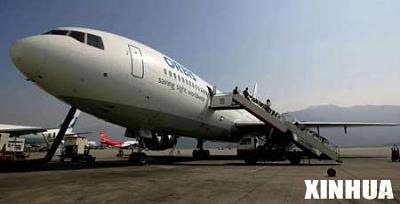
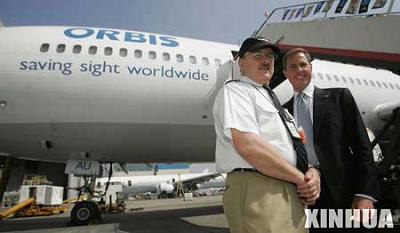 World’s only flying eye hospital starts tour
in Hong Kong - Paul Forrest
(R), Director of Global Development of ORBIS, and John Gordon Platt, pilot of
the ORBIS Flying Eye Hospital, pose before the plane hospital for a photo on the
parking apron of Hong Kong International Airport on Nov. 15, 2007 in Hong Kong
of south China. The ORBIS Flying Eye Hospital started the Goodwill Tour in Hong
Kong on Thursday, inviting donors and local students to get aboard to visit the
world’s only flying eye hospital. Since its first program in 1982, the ORBIS
Flying Eye Hospital has traveled to more than 70 countries and regions, saving
the sight of millions of people by training local doctors and eye care workers
and conducting surgeries for patients with eye disease. ORBIS is an
international nonprofit humanitarian organization aimed at strengthening the
capabilities of local health care communities in blindness prevention and
treatment.
World’s only flying eye hospital starts tour
in Hong Kong - Paul Forrest
(R), Director of Global Development of ORBIS, and John Gordon Platt, pilot of
the ORBIS Flying Eye Hospital, pose before the plane hospital for a photo on the
parking apron of Hong Kong International Airport on Nov. 15, 2007 in Hong Kong
of south China. The ORBIS Flying Eye Hospital started the Goodwill Tour in Hong
Kong on Thursday, inviting donors and local students to get aboard to visit the
world’s only flying eye hospital. Since its first program in 1982, the ORBIS
Flying Eye Hospital has traveled to more than 70 countries and regions, saving
the sight of millions of people by training local doctors and eye care workers
and conducting surgeries for patients with eye disease. ORBIS is an
international nonprofit humanitarian organization aimed at strengthening the
capabilities of local health care communities in blindness prevention and
treatment.
Hong Kong Exchanges and Clearing Ltd (HKEx)
has not yet decided on a timetable for domestic direct stock investment in Hong
Kong and is currently focusing on investors' risk education, said an official
with HKEx yesterday. Domestic investors will have to wait until the Hong Kong
market fully opens to the mainland, said Lawrence Fok, executive vice president
of HKEx Issuer Marketing Division, at the 2007 Annual Conference of China's
Financial Market. HKEx is working on investor education to help bridge
differences between the Chinese mainland and Hong Kong stock markets. He added
the market is confident in the direct Hong Kong stock investment program. The
program has greatly impacted the Hong Kong stock market. Following the
announcement of the pilot program, the Hang Seng Index rose to around 30,000
from 20,000 points and has only fallen slightly ever since. Li Jing, China head
of JP Morgan Chase, also attended the annual conference. She said the direct
Hong Kong stock investment program is likely to be postponed till 2008. However,
she didn't believe that was bad news, saying the sudden descent of green
mainland investors could cause capital to flood in, potentially harming the Hong
Kong market. She said the QDII (qualified domestic institutional investor)
should still play the main role in ensuring a stable current of capital influx.
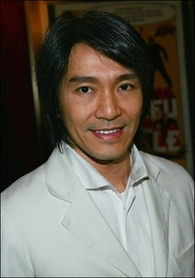 Hong Kong's Chow takes on Japanese cartoon - Hong Kong comedian and director
Stephen Chow will be producing the movie adaptation of popular Japanese manga
cartoon "Dragon Ball" for 20th Century Fox, his company spokesman said Thursday.
But Chow, best known for "Kung Fu Hustle" and "Shaolin Soccer", turned down a
Fox offer to direct the project, saying he would only take the helm for his own
film ideas, the spokesman said. "Dragon Ball" will be directed by James Wong,
the 48-year-old who directed thrillers "Final Destination" and "Final
Destination 3". It will star Justin Chatwin, who played Tom Cruise's son in "War
of the Worlds" as Goku. The spokesman said Chow, a fan of the Japanese comic,
would want Asian and Chinese actors to feature in the film, a project that took
two years to negotiate. "Dragon Ball", created by Akira Toriyama in 1984,
follows the adventures of a young martial artist named Son Goku who defends the
Earth against evil as he collects the mystical Dragon Balls that give him
incredible powers. It has been made into an animated series in Hong Kong and has
also been developed into video games.
Hong Kong's Chow takes on Japanese cartoon - Hong Kong comedian and director
Stephen Chow will be producing the movie adaptation of popular Japanese manga
cartoon "Dragon Ball" for 20th Century Fox, his company spokesman said Thursday.
But Chow, best known for "Kung Fu Hustle" and "Shaolin Soccer", turned down a
Fox offer to direct the project, saying he would only take the helm for his own
film ideas, the spokesman said. "Dragon Ball" will be directed by James Wong,
the 48-year-old who directed thrillers "Final Destination" and "Final
Destination 3". It will star Justin Chatwin, who played Tom Cruise's son in "War
of the Worlds" as Goku. The spokesman said Chow, a fan of the Japanese comic,
would want Asian and Chinese actors to feature in the film, a project that took
two years to negotiate. "Dragon Ball", created by Akira Toriyama in 1984,
follows the adventures of a young martial artist named Son Goku who defends the
Earth against evil as he collects the mystical Dragon Balls that give him
incredible powers. It has been made into an animated series in Hong Kong and has
also been developed into video games.
 Hong Kong's Ritz-Carlton will host a mouth-watering gourmet truffle dinner
within the next few days for a select few friends of three well-heeled bidders
who paid a world-record HK$1.63 million (US$215,000) for a 750-gram truffle in
the Ninth Worldwide Alba Truffle Auction. Mainland-based property developers Su
Meng, president of Gold Tak Land and owner of Guangzhou's Ritz-Carlton, Li
Sze-lim, chairman of R&F (Beijing) Properties Development, and Kong Jianmin,
chairman of KWG Property Holding, joined forces to pay 143,000 euros on Sunday
for the truffle - dubbed "Queen Tartufo" - at a Ritz-Carlton dinner linked by
satellite to the global auction. Compared to the Alba truffle auctioned last
year - a massive 1.59kg Tuber magnatum pico fungus snapped up by Hopewell
Holdings (SEHK: 0054)' Gordon Wu Ying-sheung for HK$1.25 million - this year's
truffle was relatively paltry. Apparently this season was one of the worst in
recent years in Alba, in Italy's northwestern Piedmont region famous for its
autumn truffles. The bad season resulted in higher prices, with top-class
truffles selling this year for up to 8,000 euros a kilogram, against a gold
price of 17,862 euros. That has meant that this year's winners paid about 10 per
cent more for a fungus half the size of last year's delicacy. That translates
into about HK$2,173 per gram. Sunday night's five-course dinner at the
Ritz-Carlton included a warm-up auction during which 180 or so guests whetted
their appetites, bidding for six smaller lots that collectively fetched HK$1.42
million. All the proceeds went to the local charity Mother's Choice. This year's
winners plan to serve "Queen Tartufo" to friends at the Ritz-Carlton within
days. The "Queen" arrived in the city yesterday. Truffles, of which there are
several edible varieties, are from a group of underground fungi belonging to the
genus Tuber. The ascoma, or fruiting body, is a highly prized delicacy. Its
aroma is similar to deep-fried sunflower seeds or walnuts, although not everyone
can smell it. Water in which truffles have soaked tastes a little like soy
sauce. It has been described as "the diamond of the kitchen" and is praised for
its aphrodisiac powers - a characteristic that has not been scientifically
established. It is held in particularly high culinary esteem in France, northern
Italy and the Croatian peninsula of Istria.
Hong Kong's Ritz-Carlton will host a mouth-watering gourmet truffle dinner
within the next few days for a select few friends of three well-heeled bidders
who paid a world-record HK$1.63 million (US$215,000) for a 750-gram truffle in
the Ninth Worldwide Alba Truffle Auction. Mainland-based property developers Su
Meng, president of Gold Tak Land and owner of Guangzhou's Ritz-Carlton, Li
Sze-lim, chairman of R&F (Beijing) Properties Development, and Kong Jianmin,
chairman of KWG Property Holding, joined forces to pay 143,000 euros on Sunday
for the truffle - dubbed "Queen Tartufo" - at a Ritz-Carlton dinner linked by
satellite to the global auction. Compared to the Alba truffle auctioned last
year - a massive 1.59kg Tuber magnatum pico fungus snapped up by Hopewell
Holdings (SEHK: 0054)' Gordon Wu Ying-sheung for HK$1.25 million - this year's
truffle was relatively paltry. Apparently this season was one of the worst in
recent years in Alba, in Italy's northwestern Piedmont region famous for its
autumn truffles. The bad season resulted in higher prices, with top-class
truffles selling this year for up to 8,000 euros a kilogram, against a gold
price of 17,862 euros. That has meant that this year's winners paid about 10 per
cent more for a fungus half the size of last year's delicacy. That translates
into about HK$2,173 per gram. Sunday night's five-course dinner at the
Ritz-Carlton included a warm-up auction during which 180 or so guests whetted
their appetites, bidding for six smaller lots that collectively fetched HK$1.42
million. All the proceeds went to the local charity Mother's Choice. This year's
winners plan to serve "Queen Tartufo" to friends at the Ritz-Carlton within
days. The "Queen" arrived in the city yesterday. Truffles, of which there are
several edible varieties, are from a group of underground fungi belonging to the
genus Tuber. The ascoma, or fruiting body, is a highly prized delicacy. Its
aroma is similar to deep-fried sunflower seeds or walnuts, although not everyone
can smell it. Water in which truffles have soaked tastes a little like soy
sauce. It has been described as "the diamond of the kitchen" and is praised for
its aphrodisiac powers - a characteristic that has not been scientifically
established. It is held in particularly high culinary esteem in France, northern
Italy and the Croatian peninsula of Istria.
China:
A fleet of hybrid, clean energy fuel-cell buses will be operating in this city
by 2009, giving green technology a major role in public life. A hydrogen
refueling station for the buses has been built in the city's Anting area. The
development was announced yesterday at the launch of the second phase of a
fuel-cell bus commercialization project jointly carried out by the United
Nations Development Program (UNDP) and the Ministry of Science and Technology.
"Fuel-cell vehicles are an important technology for the future development of
the automotive industry in China," Minister Wan Gang said at the launch
ceremony. The automotive industry has spent 20 years working on
environment-friendly technology, and clean energy represents the future, Yu
Zhuoping, dean of the school of automotive studies at Tongji University, said.
China, Singapore agree to upgrade
relations to new height - China would like to work with Singapore to promote the
relations to a new height to benefit the two peoples and the region, said
Chinese President Hu Jintao on Friday.
Majority in favor of new holiday
plan - The majority of 1.3 million people who voted online are in favor of a new
public holiday plan that eliminates one of the three Golden Week holidays and
adds three traditional festivals to the list. That was the result from four of
the five websites that conducted the survey, which ended last night. The fifth -
the National Development and Reform Commission's (NDRC) official website -
didn't make its poll findings public. According to sina.com, which drew the
largest number of 590,000 voters, 88 percent supported increasing the number of
official holidays from 10 to 11; and 62 percent agreed to including the three
traditional holidays - Tomb-Sweeping Day, Dragon-Boat Festival and the
Mid-Autumn Festival - in public holidays. In addition, 81 percent voted for
retaining the two Golden Weeks of the Spring Festival and the National Day
holidays, and 79 percent supported starting the Spring Festival holiday a day
earlier - from the Lunar New Year's Eve - instead of the New Year's Day. An NDRC
official, who did not want to be named, said the economic planner will collect
and submit the poll results to the State Council. Some, however, criticized the
poll for the way the questionnaire was framed. Sang Jie, a Beijing resident,
said the survey did not ask if people agreed with the cancellation of the May
Day holiday. "I will lose a week-long holiday, which I used to spend visiting my
husband who is working abroad," she said. A survey conducted by ctrip.com, an
online travel service, found that nearly half of more than 1,000 people surveyed
said it would be a pity to lose the May Day holiday. Lin Zhiyuan, a member of
the Beijing People's Political Consultative Conference, an advisory body, said
soliciting public opinion before a policy is implemented reflects progress in
governance, the Oriental Morning News reported. The new holiday plan, if
approved, will entail changes in weddings and travel. Shanghai Youth Daily
reported that many couples may have to cancel wedding banquets booked for the
next May Day holiday. Travel agencies, meanwhile, are tailoring package tours to
reflect the new holidays. Zhang Lingjie, deputy general manager of the domestic
tourism department of China International Travel Service Head Office, said that
travel agencies will offer more three- or four-day outbound trips.
 Tires are on
display at RubberTech China 2007 in Shanghai. With an exhibition space of 11,500
square meters, RubberTech China 2007, which runs from November 14 to 16, has
attracted nearly one thousand enterprises from more than 50 countries and
regions. Tires are on
display at RubberTech China 2007 in Shanghai. With an exhibition space of 11,500
square meters, RubberTech China 2007, which runs from November 14 to 16, has
attracted nearly one thousand enterprises from more than 50 countries and
regions.
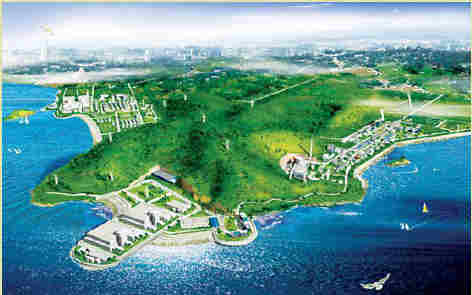 A bird's eye
view of Qinshan nuclear power plant in Haiyan, East China's Zhejiang Province.
China is to double its nuclear power capacity by 2020, the general manager of
China National Nuclear Corporation said here on Thursday. Kang Rixin told the
World Energy Congress in Rome that at present China's nuclear power capacity
accounts for 2 percent of the total installed capacity of the country. By 2020,
the percentage will stand at 4 percent. China's installed capacity of nuclear
power will hit 40 million kilowatts by 2020, he said. Kang said China has 11
nuclear power generation units in operation, 8 units are under construction and
another 8 units are in their preparation stage. He said China will invest a
total of 400 billion yuan in building the 16 nuclear units, and "banks in China
are active in pouring the funds and there is no shortage of funds." The general
manager said China has already listed the nuclear power industry as a priority,
and the move is to reduce the CO2 emission to tackle climate change. The
five-day World Energy Congress is to end later on Thursday. A bird's eye
view of Qinshan nuclear power plant in Haiyan, East China's Zhejiang Province.
China is to double its nuclear power capacity by 2020, the general manager of
China National Nuclear Corporation said here on Thursday. Kang Rixin told the
World Energy Congress in Rome that at present China's nuclear power capacity
accounts for 2 percent of the total installed capacity of the country. By 2020,
the percentage will stand at 4 percent. China's installed capacity of nuclear
power will hit 40 million kilowatts by 2020, he said. Kang said China has 11
nuclear power generation units in operation, 8 units are under construction and
another 8 units are in their preparation stage. He said China will invest a
total of 400 billion yuan in building the 16 nuclear units, and "banks in China
are active in pouring the funds and there is no shortage of funds." The general
manager said China has already listed the nuclear power industry as a priority,
and the move is to reduce the CO2 emission to tackle climate change. The
five-day World Energy Congress is to end later on Thursday.
November 17 - 18, 2007
Hong Kong:
The ongoing Cosmoprof Asia and Natural Health Fair 2007, starting on Nov. 14,
has become larger in scale which encourage better business opportunity. In its
12th edition, Cosmoprof Asia this year covers 47,000 square meter of exhibition
space. Particularly outstanding growth is observed in the Hair sector, where the
overall exhibition size is up by 30 percent over 2006. The Packaging sector has
also enjoyed steady growth over the years; its exhibition area has increased by
16 percent over 2006. Michael Duck, Director of Cosmoprof Asia Ltd which is
organizer of the show, said that apart from its comprehensive products,
Cosmoprof Asia also provides a perfect platform for industry and experts, to
exchange ideas and information on the latest trends and techniques in the
international beauty industry. Over 1,260 exhibitors from 35 countries and
regions participate in the fair. About 40,000 visitors, out of which more than
50 percent from abroad are expected to attend the three-day fair. Duck said,
given this expanded space, Cosmoprof Asia is featured by the new "Made to
Measure" hall layout that will maximize the visitors' itineraries thanks to more
user-friendly categorization of the fair's product sectors, making the journey
through all facets of the beauty industry easier and more convenient. The three
renamed product sectors are identified by new names and logos in order to make
it easier to locate sections of interests. They are: "Retail-Distribution"
displaying fragrances, cosmetics and toiletries; "Pack" showing raw materials,
machinery; and "Hair and Beauty Salon" featuring hair and beauty salon products
and equipment for professional sectors. This year, Cosmoprof Asia launches its
first International Buyer Program, which brings together qualified buyers from
three major cosmetic markets in Asia, namely India, Japan and Thailand.
Perfumery, cosmetics and Toiletries is the main market sector represented by the
panel of international qualified buyers participating in the program. The buyer
delegation will be invited to introduce to their company and market segment at a
business meeting over 100 pre-matched and qualified exhibitors. This meeting
will also be an informal discussion to explore business potential and establish
new business relations. Inside the exhibition halls, exhibitors and buyers are
bustling around to search for business opportunities. A Germany-based company
doing mainly hand care and nail treatment business provide nail beauty
demonstration at its counter to demonstrate visitors the characteristics of
their products. Sales Director of the company Elke Schmidt told the reporter
that they have planned to open up Asian market and was in the hope to get access
to more buyers by joining the show. Sales representative Serene Goh of a
Japanese cosmetic brand seizes any chance to introduce their products to
passers-by. Now having products on sale in Malaysia and Singapore, Goh said that
their next stop will be Shanghai in the Chinese Mainland. She believed that the
show could help promoting their brand to more people, which in turn, might bring
more business.
The move to limit cash withdrawals
from bank accounts in Shenzhen is designed to stop money laundering and the
illegal flow of mainland funds into Hong Kong that have been one of the major
drivers of the recent stock market boom, state-run media reported.
The Link REIT (0823), which invests
in a portfolio of retail and carpark facilities, said yesterday first-half
income distributable to unitholders, jumped 10.54 percent to HK$776 million, or
36.11 HK cents per unit, underpinned by higher rental income.
Hutchison Telecommunications
International Ltd (2332), the telecom unit controlled by Li Ka-shing's Hutchison
Whampoa (0013), said net profit in the first three quarters surged to HK$70.2
billion, including the one-time disposal gain from the sale of its entire
interest in Hutchison Essar in India.
China Light and Power's Castle Peak
power plant has been named the third most polluting electricity generator in the
world.
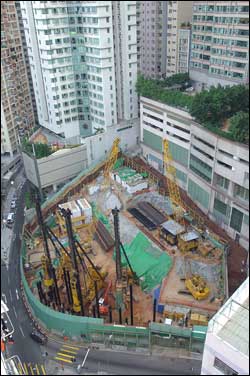 Swire Properties - one of Hong Kong's largest property developers - has won a
legal battle with the Town Planning Board over height restrictions imposed on a
luxury residential project in the Mid-Levels. The site is one of several located
between Seymour Road and Castle Steps where the developer plans to build a high
rise complex comprising blocks of 50 stories or more. International Trader - a
Swire subsidiary - launched a judicial review after the board twice refused its
application to relax the site's plot ratio and height curbs from 12 to 50
stories. The proposed complex - at the junction of Seymour Road, Castle Road and
Castle Steps - would cover an area of 2,132 square meters. But the board
rejected the application, saying it would cause severe traffic congestion and
visual problems in the area. The company appealed against the decision last
December, but this was also turned down by the board. In his ruling yesterday,
Court of First Instance Judge Andrew Cheung Kui- nang said Swire's argument
about traffic and visual considerations was not relevant in the planning
process. He said it would be unfair to isolate a relatively small site since it
is surrounded by commercial and residential buildings as tall as 40 stories and
with no height restrictions. The judge also pointed out the plot was originally
zoned as residential zoning group A in 1986, although it was later rezoned as
residential zoning group C in 1995, with limitations imposed. The court was also
told that at a meeting in 1996, the Planning Department had allowed the site to
be redeveloped without vehicular access.
Swire Properties - one of Hong Kong's largest property developers - has won a
legal battle with the Town Planning Board over height restrictions imposed on a
luxury residential project in the Mid-Levels. The site is one of several located
between Seymour Road and Castle Steps where the developer plans to build a high
rise complex comprising blocks of 50 stories or more. International Trader - a
Swire subsidiary - launched a judicial review after the board twice refused its
application to relax the site's plot ratio and height curbs from 12 to 50
stories. The proposed complex - at the junction of Seymour Road, Castle Road and
Castle Steps - would cover an area of 2,132 square meters. But the board
rejected the application, saying it would cause severe traffic congestion and
visual problems in the area. The company appealed against the decision last
December, but this was also turned down by the board. In his ruling yesterday,
Court of First Instance Judge Andrew Cheung Kui- nang said Swire's argument
about traffic and visual considerations was not relevant in the planning
process. He said it would be unfair to isolate a relatively small site since it
is surrounded by commercial and residential buildings as tall as 40 stories and
with no height restrictions. The judge also pointed out the plot was originally
zoned as residential zoning group A in 1986, although it was later rezoned as
residential zoning group C in 1995, with limitations imposed. The court was also
told that at a meeting in 1996, the Planning Department had allowed the site to
be redeveloped without vehicular access.
The poor language skills of local
workers, a shortage of labor and inflated operational costs are some of the
challenges businesses will have to face next year, according to the Hong Kong
General Chamber of Commerce.
The Hong Kong Food Festival
attracts tens of thousands of food lovers from far and wide every year. And
sister city Macau, not to be left behind, is hosting its own food festival,
drawing thousands of mainland and foreign tourists, buyers and suppliers to the
gastronomic event.
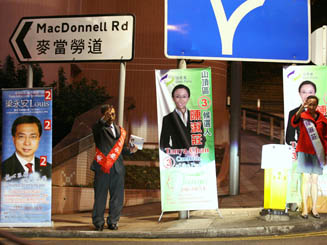 Candidates pin
hopes on negative spin - Candidates campaigning for The Peak constituency have
downplayed their chances in Sunday's district council elections - an apparent
ploy to get more votes. Candidates pin
hopes on negative spin - Candidates campaigning for The Peak constituency have
downplayed their chances in Sunday's district council elections - an apparent
ploy to get more votes.
A move to reduce the working hours of public doctors may
result in one having to take care of 200 patients at night if the Hospital
Authority fails to put in more resources, a hospital administrator has warned.
Senior hospital executives have been asked to assess how the reform - which aims
to cut doctors' working hours to 65 a week and cap continuous working hours at
16 to 24 hours - will affect care. The department head said he would quit if he
was forced to implement "a policy that will endanger the safety of patients".
"It is, of course, a good move to cut doctors' working hours, but we are very
concerned that so far there has been no indication of extra manpower," he said.
The survey, conducted on about 700 doctors in September last year, found that
public doctors worked 38 to 91 hours per week, with junior doctors working the
longest, the final report of the authority's steering committee found. To reduce
workloads, the committee recommends the authority: Set up emergency wards in
selected acute hospitals as a "gatekeeper to reduce avoidable hospital
admissions"; Employ part-time private doctors at overstretched outpatient
clinics to cut 10 to 25 per cent of the workload; Hire a 24-hour technician
service to take blood and carry out electrocardiograms; Extend nursing
consultation services over the telephone to provide initial assessment to
elderly patients who intend to go to accident and emergency departments; and Put
doctors on general call to cover sub-specialty calls by the end of next year.
Under the reform, fewer doctors will be put on the night shift. The department
head said many doctors feared that the authority would not add enough resources.
"If we have to cap the continuous working period at 24 hours, each doctor will
be on night call only once every week, instead of the current twice. The doctor
will have to take care of 200 patients and he cannot afford to have any sleep.
Such a situation will be unacceptable." The authority said it would spend about
HK$12 million to hire extra doctors, nurses and paramedics for pilot programmes
later this year. The steering committee also called on the authority to pay for
doctors' excess work hours and to attain "100 per cent" compliance by the end of
June next year to provide a half-day off to doctors who have finished on-site
call duties. Medical legislator Kwok Ka-ki said frontline staff were becoming
upset about heavier workloads because hospitals cut doctors' working hours. "The
reform will be a failure if it is just a numbers game," he said.
Customs has made this year's biggest seizure of untaxed
petrol, smuggled from the mainland by sea, as pump prices exceed HK$15 a litre -
nearly three times the mainland price.
China:
China has drafted executive regulations for a new corporate income tax law that
will harmonize the domestic and foreign rates, and the final draft has been
submitted to the State Council for approval, the China Securities Journal
reported on Wednesday, citing an expert close to the issue.
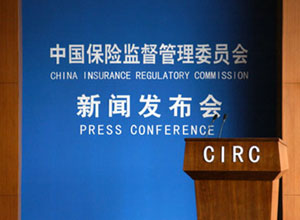 The figure compares with
304 billion yuan in 2002 and 564 billion yuan last year when China jumped from
16th to ninth in the world ranking of insurance premium revenues, Wu Dingfu,
head of the China Insurance Regulatory Commission, told a forum on pension funds
in Beijing on Nov.14. The figure compares with
304 billion yuan in 2002 and 564 billion yuan last year when China jumped from
16th to ninth in the world ranking of insurance premium revenues, Wu Dingfu,
head of the China Insurance Regulatory Commission, told a forum on pension funds
in Beijing on Nov.14.
World Bank forecast for China's 2007 growth maintains
unchanged at 11.3%, and it predicted a more than 8% growth for East Asia in
2007.
 The US dollar will
remain the anchor currency of China's massive foreign reserves despite
suggestions that the country is too heavily skewed toward the weakening
greenback, a senior Chinese central bank official said Wednesday. Yi Gang, the
assistant governor of the People's Bank of China, said the dollar had to
continue as key component of the country's 1.4 trillion dollar reserves because
it was "the largest currency that we use" in terms of trade and foreign direct
investment as well as financial clearances and settlements. "It is also a very
firm policy for China that the US dollar is the main currency in our reserves
and that policy is very firm," he said to a question at a forum in Washington.
Yi said recent suggestions that Beijing shift its largely dollar-based reserves
toward presently stronger currencies, like the euro, were mere "opinion." "There
is some discussion or comment from maybe scholars, maybe other persons in China
in terms of 'there is huge amount of adjustment of reserves.' "I think that
probably is opinion ... if they want to express their opinion, that will be
fine, we consider it, we listen (to) it but that does not change our policy," Yi
said at a monetary conference organized by Washington-based CATO Institute. The US dollar will
remain the anchor currency of China's massive foreign reserves despite
suggestions that the country is too heavily skewed toward the weakening
greenback, a senior Chinese central bank official said Wednesday. Yi Gang, the
assistant governor of the People's Bank of China, said the dollar had to
continue as key component of the country's 1.4 trillion dollar reserves because
it was "the largest currency that we use" in terms of trade and foreign direct
investment as well as financial clearances and settlements. "It is also a very
firm policy for China that the US dollar is the main currency in our reserves
and that policy is very firm," he said to a question at a forum in Washington.
Yi said recent suggestions that Beijing shift its largely dollar-based reserves
toward presently stronger currencies, like the euro, were mere "opinion." "There
is some discussion or comment from maybe scholars, maybe other persons in China
in terms of 'there is huge amount of adjustment of reserves.' "I think that
probably is opinion ... if they want to express their opinion, that will be
fine, we consider it, we listen (to) it but that does not change our policy," Yi
said at a monetary conference organized by Washington-based CATO Institute.
The United Arab Emirates may end
the dirham's 30-year-old peg to the dollar and link it instead to a basket of
currencies, central bank Governor Sultan Bin Nasser al-Suwaidi said.
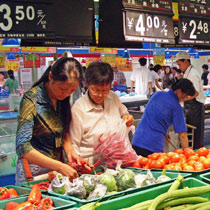 Shoppers buy
vegetables at a supermarket in Yichang, Hubei Province. China's retail sales
grew by an impressive 18.1 percent year-on-year in October, thanks to rising
prices and incomes. Shoppers buy
vegetables at a supermarket in Yichang, Hubei Province. China's retail sales
grew by an impressive 18.1 percent year-on-year in October, thanks to rising
prices and incomes.
The mainland could obtain as much as a third of its energy
from renewable sources by 2050 as a manufacturing expansion pulled down prices
worldwide, if Beijing improved pricing and policy support for the sector, a
report said.
November 16, 2007
Hong Kong:
China Construction Bank (Asia) chief executive Charles Ma Chi-man said mortgage
applications in the past two months jumped 30 percent from July and August
levels amid a low-interest environment.
 Hong Kong actor Andy Lau and a man in Santa Claus costume
wear 3D spectacles at a Christmas lighting ceremony outside a shopping mall in
Hong Kong November 14, 2007.
Hong Kong actor Andy Lau and a man in Santa Claus costume
wear 3D spectacles at a Christmas lighting ceremony outside a shopping mall in
Hong Kong November 14, 2007.
The growing multi-million global
low- carbon market will throw up new opportunities for Hong Kong's banking
sector to make even more money, a newly created climate change action group said
yesterday.
Hong Kong blue chips jumped nearly 5 per cent on
Wednesday, boosted by Wall Street gains, as China Mobile (SEHK: 0941,
announcements, news) surged after the wireless operator said it was talking to
Apple about offering iPhones in the mainland.
Yahoo, reeling from a growing backlash over human rights
and its operations in mainland China, settled a lawsuit on Tuesday that accused
it of illegally helping the central government jail and torture two journalists.
 Financial Secretary
John Tsang Chun-wah on Tuesday said Hong Kong was on target to meet its forecast
of a record 26.4 million visitors this year. Mr Tsang was discussing
developments in the territory’s tourism industry at the Hong Kong Association of
Travel Agents’ 50th Anniversary Gala Dinner in Tsim Sha Tsui late on Tuesday. He
said the number of mainland visitors last year was more than double the number
in 2003. “For the first nine months of this year, mainland arrivals were up 10
per cent compared to the same period last year and next year, eight more
mainland provinces in the Pan Pearl River Delta region, – Fujian, Guangxi,
Jiangxi, Hunan, Guizhou, Yunnan, Hainan and Sichuan – will also open up to Hong
Kong travel agents,” he said. Mr Tsang said outbound travel was a growth area of
tourism – with turnover for outbound tours this year estimated to reach a new
record of HK$10 billion. But he said Hong Kong could not afford to “let down its
guard and become complacent”. “We face intense competition from neighboring
destinations that target similar markets and are promoting aggressively. This is
a good opportunity for us to take a long hard look at areas where we can improve
and advantages that can be built upon,” he explained. He said the territory’s
meetings, incentives, conferences, and exhibitions (MICE) industries needed to
review and formulate development strategies. “We need to strengthen our
promotion efforts to attract more large-scale international conventions and
exhibitions to Hong Kong...” he said. MICE is a particular type of tourism in
which large groups, usually planned in advance, are brought together for some
particular purpose such as trade shows. Citing future projects to promote Hong
Kong’s tourism industry, Mr Tsang said the government was developing its cruise
industry. He said the government had issued an open tender for the new cruise
terminal at Kai Tak. “We expect to award the tender in the second quarter of
next year, with February 2012 as the target opening date for the first berth.
When completed, it will be a world-class terminal capable of handling the
biggest cruise ships,” he said. The financial secretary said other projects in
the pipeline included the Ocean Park project and other district enhancement
schemes. Financial Secretary
John Tsang Chun-wah on Tuesday said Hong Kong was on target to meet its forecast
of a record 26.4 million visitors this year. Mr Tsang was discussing
developments in the territory’s tourism industry at the Hong Kong Association of
Travel Agents’ 50th Anniversary Gala Dinner in Tsim Sha Tsui late on Tuesday. He
said the number of mainland visitors last year was more than double the number
in 2003. “For the first nine months of this year, mainland arrivals were up 10
per cent compared to the same period last year and next year, eight more
mainland provinces in the Pan Pearl River Delta region, – Fujian, Guangxi,
Jiangxi, Hunan, Guizhou, Yunnan, Hainan and Sichuan – will also open up to Hong
Kong travel agents,” he said. Mr Tsang said outbound travel was a growth area of
tourism – with turnover for outbound tours this year estimated to reach a new
record of HK$10 billion. But he said Hong Kong could not afford to “let down its
guard and become complacent”. “We face intense competition from neighboring
destinations that target similar markets and are promoting aggressively. This is
a good opportunity for us to take a long hard look at areas where we can improve
and advantages that can be built upon,” he explained. He said the territory’s
meetings, incentives, conferences, and exhibitions (MICE) industries needed to
review and formulate development strategies. “We need to strengthen our
promotion efforts to attract more large-scale international conventions and
exhibitions to Hong Kong...” he said. MICE is a particular type of tourism in
which large groups, usually planned in advance, are brought together for some
particular purpose such as trade shows. Citing future projects to promote Hong
Kong’s tourism industry, Mr Tsang said the government was developing its cruise
industry. He said the government had issued an open tender for the new cruise
terminal at Kai Tak. “We expect to award the tender in the second quarter of
next year, with February 2012 as the target opening date for the first berth.
When completed, it will be a world-class terminal capable of handling the
biggest cruise ships,” he said. The financial secretary said other projects in
the pipeline included the Ocean Park project and other district enhancement
schemes.
 The
influx of mainland women giving birth in Hong Kong posed no threat to local
people in the next decade, Secretary for Labor and Welfare Matthew Cheung Kin-chung
said on Wednesday. The
influx of mainland women giving birth in Hong Kong posed no threat to local
people in the next decade, Secretary for Labor and Welfare Matthew Cheung Kin-chung
said on Wednesday.
China:
OPEC Secretary General Abdallah al- Badri denied on Wednesday claims that China
and India stood behind the rise in the international oil prices. In an exclusive
statement to Xinhua, al-Badri rejected the allegations which hold China and
India responsible for the soaring oil prices, adding that the consumption of the
two countries is normal and just in line with their demands. The chief of the
oil cartel made the remarks during the preparatory meetings for the 3rd OPEC
summit in Riyadh.
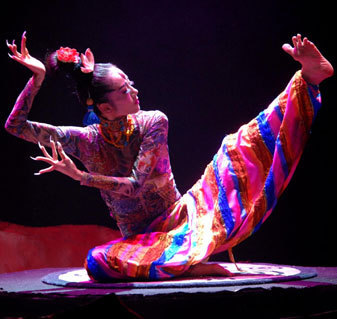 Yang Liping, the
internationally acclaimed dancer of China, performs her latest work "Tibetan
Mystery" during the fifth Beijing International Dance Festival in Beijing Nov
13, 2007. Yang Liping, the
internationally acclaimed dancer of China, performs her latest work "Tibetan
Mystery" during the fifth Beijing International Dance Festival in Beijing Nov
13, 2007.
China has drafted executive
regulations for a new corporate income tax law that will harmonize the domestic
and foreign rates, and the final draft has been submitted to the State Council
for approval, the China Securities Journal reported on Wednesday, citing an
expert close to the issue. The income tax rate for foreign companies in special
bonded zones, which previously enjoyed a preferential rate of 15 percent, will
rise in stages to 18 percent, 20 percent, 22 percent, 24 percent and finally 25
percent, the same as domestic companies, over five years, according to the
draft. The arrangement would apply to such bonded zones as Shenzhen Special
Economic Zone, economic development zones set up in coastal cities like Hongqiao
Economic and Technological Development Zone in Shanghai, and high- and new-tech
development zones including Zhongguancun Science Park in Beijing. The
unidentified expert also said the 24-percent rate for foreign companies
established in coastal regional development zones, such as the Yangtze River
Delta and the Pearl River Delta, would rise directly to 25 percent in 2008.
However, foreign companies that have tax holidays, which provide for five
tax-free years and another five years of up to 50 percent reduction, will retain
those concessions for the full 10 years before facing the new higher rates. The
15-percent rate will be retained until 2010 for foreign companies that invest in
middle and western regions of China, an apparent effort by the government to
redress regional economic imbalances. The regulations will include new criteria
for high- and new-technology firms, which can enjoy a lower 15-percent rate. The
qualifications could include the ownership of core proprietary property rights
or government-supported products. The regulations will also specify the
proportion of sales that must be devoted to research and development and the
ratio of research employees among total staff for qualified high- and new-tech
firms. The changes will make it more difficult for companies to gain the status
of high- or new-tech investors, according to the expert. "They would no longer
enjoy the status forever and qualifications will be re-evaluated every one or
two years. Those who fail to meet the standards would be disqualified," said the
expert. The regulations also state, in detail, tax policies that will favor
infrastructure projects, environmental protection, and energy and water
conservation. The expert said the draft is still subject to revision by the
State Council. The new law, adopted this past March to allow fair competition
between foreign and domestic companies, is set to take effect on Jan. 1, 2008.
Motorola Inc has gained approval to
set up a wholly owned finance company in Tianjin with registered capital of 100
million yuan (13.3 million U.S. dollars). The green light is expected to boost
Motorola's development in China, the world's No. 2 mobile phone-maker said
yesterday. Motorola received the nod from the China Banking Regulatory
Commission to set up Motorola (China) Finance Limited (MCFL) in Tianjin's Binhai
New Area. It will provide financial services for Motorola's subsidiaries, joint
ventures and affiliates in China, the company said in a statement. "MCFL will
provide more diversified and flexible financial services to support Motorola's
business growth in China's highly competitive market," Tom Meredith, Motorola's
chief financial officer, said in the statement. Motorola said the incorporation
of MCFL proves the company's firm commitment to Tianjin.
 National Grand Theater
to open on Dec. 22 - From Dec. 22 to April 6, about 6,000 Chinese and overseas
artists will give 180 performances. National Grand Theater
to open on Dec. 22 - From Dec. 22 to April 6, about 6,000 Chinese and overseas
artists will give 180 performances.
China Petroleum and Chemical Corp.
(Sinopec) on Tuesday started issuing bonds worth 20 billion yuan (2.67 billion
U.S. dollars) to finance the construction of a 2,800 kilometer natural gas
pipeline from southwestern Sichuan province to Shanghai.
 Bankable director
Ang Lee's spy thriller "Lust, Caution" has raked in 90 million yuan (about
11.25million U.S. dollars) on the Chinese mainland since it opened at local
cinemas on Nov. 1, a source with the China Film Group Corporation revealed. An
company official surnamed Lai predicted that the box office gross for the film
would exceed 100 million yuan "several days later". The "Bourne Ultimatum" and
"Live Free or Die Hard", the next two foreign films introduced by the China Film
Group Corporation, will hit Chinese mainland screens on Thursday. "These two
films will not greatly impact the box office of "Lust, Caution", said Gao Jun,
spokesman for the Beijing Film Association, one of the capital's major cinema
lines. Set in World War-II era Shanghai, "Lust, Caution," starring mainland
actress Tang Wei and Hong Kong actor Tony Leung Chiu-wai, is about a
sexually-charged relationship between an undercover female student activist and
a Japanese-allied intelligence chief. Lee's movie, called "Se, Jie" in Chinese,
has been a hot topic in the mainland media and among the public long before its
official screening here due to its bold sex scenes. The movie has been given the
restricted NC-17 label in the United States, banning viewers under 17. In order
to get approval for a mainland release, Lee, the Academy Award winning director
of "Brokeback Mountain," cut about seven minutes from the film. Despite being
shorn of some of its sexual scenes, the film's mainland version has still won
acclaim among most viewers. Bankable director
Ang Lee's spy thriller "Lust, Caution" has raked in 90 million yuan (about
11.25million U.S. dollars) on the Chinese mainland since it opened at local
cinemas on Nov. 1, a source with the China Film Group Corporation revealed. An
company official surnamed Lai predicted that the box office gross for the film
would exceed 100 million yuan "several days later". The "Bourne Ultimatum" and
"Live Free or Die Hard", the next two foreign films introduced by the China Film
Group Corporation, will hit Chinese mainland screens on Thursday. "These two
films will not greatly impact the box office of "Lust, Caution", said Gao Jun,
spokesman for the Beijing Film Association, one of the capital's major cinema
lines. Set in World War-II era Shanghai, "Lust, Caution," starring mainland
actress Tang Wei and Hong Kong actor Tony Leung Chiu-wai, is about a
sexually-charged relationship between an undercover female student activist and
a Japanese-allied intelligence chief. Lee's movie, called "Se, Jie" in Chinese,
has been a hot topic in the mainland media and among the public long before its
official screening here due to its bold sex scenes. The movie has been given the
restricted NC-17 label in the United States, banning viewers under 17. In order
to get approval for a mainland release, Lee, the Academy Award winning director
of "Brokeback Mountain," cut about seven minutes from the film. Despite being
shorn of some of its sexual scenes, the film's mainland version has still won
acclaim among most viewers.
 While tea has long been
a favorite drink of the Chinese, in the last few years, quite a few tea-flavored
drinks are on the market. Supermarket statistics show that sales of Kangshifu
Icy Black Tea, Green Tea or Afternoon Milk tea are far ahead of other drinks
such as juice, water and bubble drinks. While it's wonderful to see the success
of this traditional Chinese drink today, there are also concerns about choosing
the right tea. Here's some information about tea. While tea has long been
a favorite drink of the Chinese, in the last few years, quite a few tea-flavored
drinks are on the market. Supermarket statistics show that sales of Kangshifu
Icy Black Tea, Green Tea or Afternoon Milk tea are far ahead of other drinks
such as juice, water and bubble drinks. While it's wonderful to see the success
of this traditional Chinese drink today, there are also concerns about choosing
the right tea. Here's some information about tea.
Shanghai would build a large theme
park by 2020 but had yet to decide on any specific project, a district official
said on Wednesday, discounting a media report that plans for a Disneyland park
in the city had been revived. “A theme park is part of Shanghai’s blueprint, but
it could be either a foreign park or a Chinese one,” said Qian Weizhong, head of
the economic committee of Shanghai’s Nanhui district, where the theme park will
be built. The China Daily on Wednesday reported that Shanghai had received
positive feedback from the central government about a Disneyland project and
that preparations were going ahead full steam. Shanghai government spokeswoman
Zhang Qin said a Disneyland park had not received the necessary nod from
Beijing. “We have not yet got central government approval for the Disneyland
project,” she said. No comment was immediately available on the matter from Walt
Disney Co in Hong Kong. Plans for a Shanghai Disneyland emerged in 2005 but were
suspended when the city’s Communist Party boss Chen Liangyu was implicated in a
corruption investigation last September. Walt Disney has been exploring options
for a theme park outside Shanghai amid concerns it may not get support from
Beijing for the Shanghai project, sources familiar with the issue told Reuters
in December. Disney signed a statement of intent to build a Disneyland on the
mainland in 2002, and then set up a venture with Shanghai’s Lujiazui Group to
develop the site, which would be about 4.7 times the size of Hong Kong’s
Disneyland. The mainland plan was soon suspended, partly because of concerns
that the Hong Kong park, which opened in 2005, would suffer, the China Daily
reported.
 Yangtze pollution hits record levels - A
record 30.5 billion tonnes of industrial, farming and human waste were dumped
last year into China’s Yangtze River, the country’s longest, state media
reported. Yangtze pollution hits record levels - A
record 30.5 billion tonnes of industrial, farming and human waste were dumped
last year into China’s Yangtze River, the country’s longest, state media
reported.
November 15, 2007
Hong Kong:
The Hong Kong stock market took
investors on a roller-coaster ride yesterday, with the benchmark index
alternately climbing and dipping in volatile trade before closing up from
Monday's four-week low.
 Macao's Chief Executive Edmund Ho yesterday vowed to put economic development
and improving people's livelihoods high on the government agenda. During his
annual address he told members of the Legislative Assembly that the government
will also step up efforts to crack down on illegal labor and corruption. "In the
coming year, the government will continue to implement various measures for the
benefit of the people, further propel economic development and create a
prosperous society in conjunction with all quarters of society," he said. A tax
concession package worth more than 1.1 billion patacas ($137 million) was also
announced yesterday, as Macao's economy has seen huge growth over the past year.
Ho said he was happy with the continued economic growth and also that
unemployment had fallen to 3.1 percent. He said the convention and exhibitions
sector had made good progress, tax income was satisfactory and the overall
business environment had remained stable. In addition, people's median wage had
risen 36 percent on 2006, and bank deposits had doubled over the period. He
announced a 25 percent reduction in personal tax and an increase of the personal
tax allowance from 95,000 patacas to 110,000 patacas. On housing, he said all
non-rental units will be exempt from housing tax, while rental units will enjoy
a 50 percent tax reduction. He said the housing problem was a priority for the
government and vowed it will build 19,000 public housing units by the end of
2012. To encourage first-time house buyers, Ho said they will be exempt from
paying stamp duty on the first 3 million patacas of the property's value.
Addressing one of the past year's major public concerns, Ho pledged to beef up
efforts to combat illegal labor and better protect local workers. On the
government's anti-corruption drive, the chief executive said: "The Commission
Against Corruption of Macao will do its best ... to investigate major graft
cases and attack corruption in order to ensure a clean government." He added
that the authorities will also broaden the powers of the graft-busters. "Once we
have evidence of corruption, those involved will be punished using the full
power of the law, regardless of his rank," he said. He said the government will
also seek to amend the law to extend the scope of control to the private sector.
Although Ho did not mention the case directly, the former secretary for
transport and public works, Ao Man-long, is on trial in the biggest corruption
case in Macao's history.
Macao's Chief Executive Edmund Ho yesterday vowed to put economic development
and improving people's livelihoods high on the government agenda. During his
annual address he told members of the Legislative Assembly that the government
will also step up efforts to crack down on illegal labor and corruption. "In the
coming year, the government will continue to implement various measures for the
benefit of the people, further propel economic development and create a
prosperous society in conjunction with all quarters of society," he said. A tax
concession package worth more than 1.1 billion patacas ($137 million) was also
announced yesterday, as Macao's economy has seen huge growth over the past year.
Ho said he was happy with the continued economic growth and also that
unemployment had fallen to 3.1 percent. He said the convention and exhibitions
sector had made good progress, tax income was satisfactory and the overall
business environment had remained stable. In addition, people's median wage had
risen 36 percent on 2006, and bank deposits had doubled over the period. He
announced a 25 percent reduction in personal tax and an increase of the personal
tax allowance from 95,000 patacas to 110,000 patacas. On housing, he said all
non-rental units will be exempt from housing tax, while rental units will enjoy
a 50 percent tax reduction. He said the housing problem was a priority for the
government and vowed it will build 19,000 public housing units by the end of
2012. To encourage first-time house buyers, Ho said they will be exempt from
paying stamp duty on the first 3 million patacas of the property's value.
Addressing one of the past year's major public concerns, Ho pledged to beef up
efforts to combat illegal labor and better protect local workers. On the
government's anti-corruption drive, the chief executive said: "The Commission
Against Corruption of Macao will do its best ... to investigate major graft
cases and attack corruption in order to ensure a clean government." He added
that the authorities will also broaden the powers of the graft-busters. "Once we
have evidence of corruption, those involved will be punished using the full
power of the law, regardless of his rank," he said. He said the government will
also seek to amend the law to extend the scope of control to the private sector.
Although Ho did not mention the case directly, the former secretary for
transport and public works, Ao Man-long, is on trial in the biggest corruption
case in Macao's history.
 The hated Article 23 anti-subversion law - scrapped in Hong Kong following
massive protests - is to be enforced in Macau. Chief Executive Edmund Ho Hau-
wah announced yesterday Article 23 of Macau's Basic Law dealing with treason,
subversion, secession and sedition will be enacted before the end of next year.
He dropped the bombshell at a news conference after delivering his annual policy
address - his eighth since taking office. Debate over the controversial bill was
ignited two years ago after pro- Beijing circles cited the importance of
prohibiting any act of treason, secession, sedition or subversion against the
central government in the former Portuguese enclave. Macau lawmakers told The
Standard Ho's decision appeared to be his last major initiative "to avoid
passing to the next chief executive the burden of giving a form to Article 23 of
the Basic Law." "It's not really a priority. The government should be focusing
on the bill relating to trade unions and collective bargaining. This
announcement is just a favor to Beijing and a way to cover up incompetence and
corruption in the Macau administration," independent legislator Jose Pereira
Coutinho said. The debate over the issue, however, is less intense than that in
Hong Kong before the bill was shelved in 2003 after half a million people took
to the streets in protest, culminating in the resignation of security chief
Regina Ip Lau Suk-yee. Some lawmakers said they recognized that "every country
has its own sedition and treason bill. "Although theres no rush, I'm not against
the bill, democrat Au Kam-san said. No major event has threatened Macau's
peaceful lifestyle since the handover, and that if the legislation respects
Macau's autonomy, as stated in the Basic Law, it should not be harmful, he said.
Secretary for Public Administration and Justice Florinda Chan said: "The
government has already begun implementing the measures concerning the regulation
of the article as part of the public administration reform package. According to
a source close to the justice secretary, the bill is being worked out by
Portuguese jurists who are "very aware of the importance of respecting
international pacts and human rights. "The contents of the bill must and will
safeguard basic rights like freedom of expression or of protest, the source
said. An expert in international law drew attention to the difference between
Macau's laws, which are based on German-Roman law, and Hong Kong's common law.
"The main point is that, in Macau, Articles 4 and 40 of the Basic Law stipulate
that fundamental human rights and international pacts signed by Macau are to be
respected and observed, and they have the same value as constitutional laws. Any
ordinary law enacted by the Legislative Assembly that goes against these two
articles will be considered anti-constitutional, the expert said. "Whereas in
Hong Kong, the common law gives international pacts and ordinary laws the same
value, meaning that the newest law prevails. The bill will be subject to popular
scrutiny before being submitted to the Legislative Assembly. "The secretary for
justice is very well aware of the importance of guaranteeing the rights of the
population. It would be suicide to enact a bill without those safeguards, a
jurist said.
The hated Article 23 anti-subversion law - scrapped in Hong Kong following
massive protests - is to be enforced in Macau. Chief Executive Edmund Ho Hau-
wah announced yesterday Article 23 of Macau's Basic Law dealing with treason,
subversion, secession and sedition will be enacted before the end of next year.
He dropped the bombshell at a news conference after delivering his annual policy
address - his eighth since taking office. Debate over the controversial bill was
ignited two years ago after pro- Beijing circles cited the importance of
prohibiting any act of treason, secession, sedition or subversion against the
central government in the former Portuguese enclave. Macau lawmakers told The
Standard Ho's decision appeared to be his last major initiative "to avoid
passing to the next chief executive the burden of giving a form to Article 23 of
the Basic Law." "It's not really a priority. The government should be focusing
on the bill relating to trade unions and collective bargaining. This
announcement is just a favor to Beijing and a way to cover up incompetence and
corruption in the Macau administration," independent legislator Jose Pereira
Coutinho said. The debate over the issue, however, is less intense than that in
Hong Kong before the bill was shelved in 2003 after half a million people took
to the streets in protest, culminating in the resignation of security chief
Regina Ip Lau Suk-yee. Some lawmakers said they recognized that "every country
has its own sedition and treason bill. "Although theres no rush, I'm not against
the bill, democrat Au Kam-san said. No major event has threatened Macau's
peaceful lifestyle since the handover, and that if the legislation respects
Macau's autonomy, as stated in the Basic Law, it should not be harmful, he said.
Secretary for Public Administration and Justice Florinda Chan said: "The
government has already begun implementing the measures concerning the regulation
of the article as part of the public administration reform package. According to
a source close to the justice secretary, the bill is being worked out by
Portuguese jurists who are "very aware of the importance of respecting
international pacts and human rights. "The contents of the bill must and will
safeguard basic rights like freedom of expression or of protest, the source
said. An expert in international law drew attention to the difference between
Macau's laws, which are based on German-Roman law, and Hong Kong's common law.
"The main point is that, in Macau, Articles 4 and 40 of the Basic Law stipulate
that fundamental human rights and international pacts signed by Macau are to be
respected and observed, and they have the same value as constitutional laws. Any
ordinary law enacted by the Legislative Assembly that goes against these two
articles will be considered anti-constitutional, the expert said. "Whereas in
Hong Kong, the common law gives international pacts and ordinary laws the same
value, meaning that the newest law prevails. The bill will be subject to popular
scrutiny before being submitted to the Legislative Assembly. "The secretary for
justice is very well aware of the importance of guaranteeing the rights of the
population. It would be suicide to enact a bill without those safeguards, a
jurist said.
 The managing director
of McDonald's who turned business around for the restaurant chain in the
Philippines in three years appeared in Hong Kong's Eastern Court yesterday on
charges of accepting bribes from a corn supplier. Lau Si-sing, 47, faces two
counts of accepting kickbacks and one count of trying to pervert the course of
justice. The case was adjourned to January 8 for prosecution to secure bank
documents in relation to the case. No plea was taken from Lau, who was released
on HK$500,000 bail. In charging Lau, the Independent Commission Against
Corruption alleged that between May 2005 and April this year Lau conspired with
a director of a corn supplier and received kickbacks in return for recommending,
approving and placing orders with the company for the more than 200 McDonald's
restaurants in Hong Kong. The ICAC alleged that Lau received about 10 percent of
the order price as commission. Lau is also accused of asking the chain's food
director on June 29 this year to tell law enforcement officials that the alleged
bribes were for property ventures in the mainland. Lau, who was appointed to his
post in June 2004, was previously managing director for McDonald's operations in
the Philippines, where he turned the business around to achieve profitability
within three years. Before that, he spent 10 years developing McDonald's
business in the mainland, helping to establish operation teams in Beijing,
Tianjin, Shanghai, Fujian, Xiamen and Guangzhou. Lau, a Hong Kong native, joined
McDonald's in 1983 when he was in Los Angeles. The managing director
of McDonald's who turned business around for the restaurant chain in the
Philippines in three years appeared in Hong Kong's Eastern Court yesterday on
charges of accepting bribes from a corn supplier. Lau Si-sing, 47, faces two
counts of accepting kickbacks and one count of trying to pervert the course of
justice. The case was adjourned to January 8 for prosecution to secure bank
documents in relation to the case. No plea was taken from Lau, who was released
on HK$500,000 bail. In charging Lau, the Independent Commission Against
Corruption alleged that between May 2005 and April this year Lau conspired with
a director of a corn supplier and received kickbacks in return for recommending,
approving and placing orders with the company for the more than 200 McDonald's
restaurants in Hong Kong. The ICAC alleged that Lau received about 10 percent of
the order price as commission. Lau is also accused of asking the chain's food
director on June 29 this year to tell law enforcement officials that the alleged
bribes were for property ventures in the mainland. Lau, who was appointed to his
post in June 2004, was previously managing director for McDonald's operations in
the Philippines, where he turned the business around to achieve profitability
within three years. Before that, he spent 10 years developing McDonald's
business in the mainland, helping to establish operation teams in Beijing,
Tianjin, Shanghai, Fujian, Xiamen and Guangzhou. Lau, a Hong Kong native, joined
McDonald's in 1983 when he was in Los Angeles.
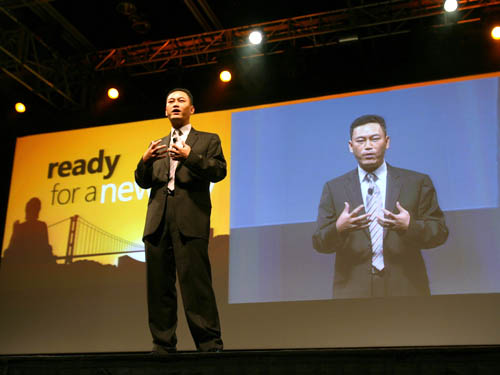 New investments and
other information technology activities by Microsoft Corp and its business
partners in Hong Kong will be worth more than HK$2.5 billion next year,
according to a new independent market study. Research firm International Data
Corp (IDC) estimated Microsoft-related IT activities this year will help create
around 54,000 jobs or more than 43 per cent of the total workforce employed by
the local IT sector. "Our research underscores what we've always known to be
true: software provides a disproportionate contribution to a vibrant IT
economy." said John Gantz, chief research officer at United States-based IDC.
"It also shows the significant contribution made by the Microsoft ecosystem,
especially in the creation of local businesses and local jobs." The Microsoft
ecosystem is defined by IDC as "people working at IT companies and IT
professionals who create, sell or distribute products that run on Microsoft
platforms." Microsoft ecosystem investments, as calculated by IDC, included
infrastructure, people, marketing and business development projects. Microsoft
products include the Windows operating system for computers and advanced mobile
phones, office productivity software, business applications such as enterprise
resource planning, video games and the Xbox gaming console, and computer
peripheral devices. The IDC study said Microsoft-related activities serve as an
economic catalyst in markets where the company operates, noting that revenue
earned by local companies working with Microsoft exceeded the revenue earned by
Microsoft itself. For every HK$1 of revenue Microsoft earned in Hong Kong,
HK$16.32 was generated by companies in the Microsoft ecosystem of value-added
software suppliers, distributors, IT services firms and original equipment
manufacturers, such as makers of computers, advanced mobile telephones and other
consumer electronics devices. New investments and
other information technology activities by Microsoft Corp and its business
partners in Hong Kong will be worth more than HK$2.5 billion next year,
according to a new independent market study. Research firm International Data
Corp (IDC) estimated Microsoft-related IT activities this year will help create
around 54,000 jobs or more than 43 per cent of the total workforce employed by
the local IT sector. "Our research underscores what we've always known to be
true: software provides a disproportionate contribution to a vibrant IT
economy." said John Gantz, chief research officer at United States-based IDC.
"It also shows the significant contribution made by the Microsoft ecosystem,
especially in the creation of local businesses and local jobs." The Microsoft
ecosystem is defined by IDC as "people working at IT companies and IT
professionals who create, sell or distribute products that run on Microsoft
platforms." Microsoft ecosystem investments, as calculated by IDC, included
infrastructure, people, marketing and business development projects. Microsoft
products include the Windows operating system for computers and advanced mobile
phones, office productivity software, business applications such as enterprise
resource planning, video games and the Xbox gaming console, and computer
peripheral devices. The IDC study said Microsoft-related activities serve as an
economic catalyst in markets where the company operates, noting that revenue
earned by local companies working with Microsoft exceeded the revenue earned by
Microsoft itself. For every HK$1 of revenue Microsoft earned in Hong Kong,
HK$16.32 was generated by companies in the Microsoft ecosystem of value-added
software suppliers, distributors, IT services firms and original equipment
manufacturers, such as makers of computers, advanced mobile telephones and other
consumer electronics devices.
China:
China's consumer price index (CPI) rebounded to 6.5 percent in October, matching
the peak decade high in August, the National Bureau of Statistics said
Wednesday.
The first Chinese economic zone, out
of the five proposed in Africa, is likely to be established in Egypt, which will
contribute to the growth of Chinese investment in that country, said a top
Egyptian investment promoter.
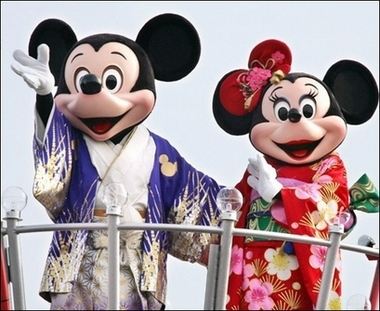 The
authorities have confirmed that the previously suspended plan to build a
Disneyland theme park in this city has been revived and preparations are going
ahead full steam. Qian Weizhong, director of the economy committee of Nanhui
district, said residents had moved off the land targeted for Shanghai
Disneyland, in suburban Chuansha town. The planned theme park will occupy 6 sq
km, which is about 4.7 times the size of Hong Kong's Disneyland, according to
the original plan. "Local authorities have received positive feedback from the
central government about the Disneyland project," Qian was quoted as saying by
the Oriental Outlook. Representatives of Disney Tuesday declined to comment on
the development, saying only: "Our focus is on the successful operation of our
first theme park in China - Hong Kong Disneyland." However, Walt Disney Company
(Shanghai) Ltd said in a statement faxed to China Daily:"China is a priority for
the entire company, and we have a continuing dialogue about a variety of Disney
initiatives, including television, motion pictures and consumer products, of
which theme parks are only a part." Qian said arrangements had been made to ease
travel to the planned site. "The Shanghai A20 highway has opened an exit for
Chuansha, near the planned east gate of the Disneyland," Qian said. Foxtown, an
outlet mall located near the site of the planned theme park, is one beneficiary
of the development. Lu Qiang, its CEO, said he was glad to hear the Disneyland
project had been revived, as Foxtown had won the right to set up shop after
several rounds of bidding. "If the Disney project was aborted, Foxtown would
face great difficulties recruiting tenants," Lu said. He said he had been
briefed about the recent developments by Nanhui authorities last week. The
planned Pudong railway will stop at the theme park. Metro line No 11 will also
stop there. When finished, the transportation connecting the park will be the
biggest in the country's eastern region, bringing visitors from more than 50
cities in the Yangtze River Delta. The plan to build a Disneyland park in
Shanghai was first floated in 2005, but was soon suspended. Disney signed a
statement of intent to build a Disneyland on the mainland in 2002. Several
suburban district authorities competed over the location of the theme park. The
municipality compromised by putting the park in both Chuansha and Nanhui. The
Lujiazui Group and Walt Disney Company then set up a joint-stock company, but
the plan was suspended. Hong Kong media reported there were widespread fears
that having a third Disneyland in Asia, especially if it were in Shanghai, would
harm Hong Kong's park. An unidentified official from the Shanghai economy
committee said the Shanghai plan had been suspended in part because of concerns
the Hong Kong park would suffer. The
authorities have confirmed that the previously suspended plan to build a
Disneyland theme park in this city has been revived and preparations are going
ahead full steam. Qian Weizhong, director of the economy committee of Nanhui
district, said residents had moved off the land targeted for Shanghai
Disneyland, in suburban Chuansha town. The planned theme park will occupy 6 sq
km, which is about 4.7 times the size of Hong Kong's Disneyland, according to
the original plan. "Local authorities have received positive feedback from the
central government about the Disneyland project," Qian was quoted as saying by
the Oriental Outlook. Representatives of Disney Tuesday declined to comment on
the development, saying only: "Our focus is on the successful operation of our
first theme park in China - Hong Kong Disneyland." However, Walt Disney Company
(Shanghai) Ltd said in a statement faxed to China Daily:"China is a priority for
the entire company, and we have a continuing dialogue about a variety of Disney
initiatives, including television, motion pictures and consumer products, of
which theme parks are only a part." Qian said arrangements had been made to ease
travel to the planned site. "The Shanghai A20 highway has opened an exit for
Chuansha, near the planned east gate of the Disneyland," Qian said. Foxtown, an
outlet mall located near the site of the planned theme park, is one beneficiary
of the development. Lu Qiang, its CEO, said he was glad to hear the Disneyland
project had been revived, as Foxtown had won the right to set up shop after
several rounds of bidding. "If the Disney project was aborted, Foxtown would
face great difficulties recruiting tenants," Lu said. He said he had been
briefed about the recent developments by Nanhui authorities last week. The
planned Pudong railway will stop at the theme park. Metro line No 11 will also
stop there. When finished, the transportation connecting the park will be the
biggest in the country's eastern region, bringing visitors from more than 50
cities in the Yangtze River Delta. The plan to build a Disneyland park in
Shanghai was first floated in 2005, but was soon suspended. Disney signed a
statement of intent to build a Disneyland on the mainland in 2002. Several
suburban district authorities competed over the location of the theme park. The
municipality compromised by putting the park in both Chuansha and Nanhui. The
Lujiazui Group and Walt Disney Company then set up a joint-stock company, but
the plan was suspended. Hong Kong media reported there were widespread fears
that having a third Disneyland in Asia, especially if it were in Shanghai, would
harm Hong Kong's park. An unidentified official from the Shanghai economy
committee said the Shanghai plan had been suspended in part because of concerns
the Hong Kong park would suffer.
China has issued new rules
governing pension funds, allowing a greater number of selected fund managers and
financial institutions to help manage the nation's 90 billion yuan (HK$94.5
billion) of corporate pensions.
China's plans to quadruple the per
capita income of its 1.3 billion population by 2050 present a "win-win"
opportunity for the world's economy, its US ambassador, Zhou Wenzhong, said.
November 13 - 14, 2007
Hong Kong:
Rising political star Xi Jinping, one of China's leaders in waiting, will become
the Politburo's new point man on Hong Kong and Macau affairs, a Beijing official
said on Friday.
 Batman welcomed on his first journey to HK - The crew of latest Batman's movie
"The Dark Knight" arrived in Hong Kong for a four-day filming this week. Tempers
were frayed when the shooting of the latest Batman movie was interrupted by
crowds of fans trying to get a closer glimpse of the caped crusader as police
and other security personnel battled with the lunch-hour traffic around Hong
Kong's oldest wet market.
Batman welcomed on his first journey to HK - The crew of latest Batman's movie
"The Dark Knight" arrived in Hong Kong for a four-day filming this week. Tempers
were frayed when the shooting of the latest Batman movie was interrupted by
crowds of fans trying to get a closer glimpse of the caped crusader as police
and other security personnel battled with the lunch-hour traffic around Hong
Kong's oldest wet market.
 Hong Kong banks, with the
Hongkong and Shanghai Banking Corporation taking the lead, cut the best lending
and saving rates by 25 basis points Friday - the second time this month. Hong Kong banks, with the
Hongkong and Shanghai Banking Corporation taking the lead, cut the best lending
and saving rates by 25 basis points Friday - the second time this month.
 The Walt Disney
Company admitted for the first time yesterday that the poor performance of Hong
Kong Disneyland is dragging down its results - prompting calls from the SAR
government that the park's management improve its operations. The Walt Disney
Company admitted for the first time yesterday that the poor performance of Hong
Kong Disneyland is dragging down its results - prompting calls from the SAR
government that the park's management improve its operations.
China:
China will raise the reserve requirement ratio by 0.5 percentage points for
commercial banks to 13.5 percent in an effort to cool the booming economy, the
People's Bank of China said.
China will strengthen anti-money
laundering checks and monitoring at the securities and insurance companies to
safeguard financial security.
China's Huawei Technologies Co Ltd
has agreed to suspend its controversial "voluntary resignation" scheme after
talks with trade unions, the All China Federation of Trade Unions (ACFTU) said
Saturday. The ACFTU said it called on China's biggest maker of
telecommunications network equipment to protect workers' interests after its
plan sparked fears that the company was trying to sidestep a new labor law. The
ACFTU and union organizations in Guangdong Province and Shenzhen City called on
Huawei to solicit workers' opinions and respect their rights while making
regulations related to their benefits. Huawei would soon hold a workers'
conference to review the interim regulations, sources with the ACFTU said
Saturday. A company source confirmed on condition of anonymity they had reached
a consensus with the trade unions. He said the company agreed to suspend the
plan but the exact date to implement the suspension will be decided after
workers' opinions were solicited at the impending workers' conference since the
plan was launched with the consent of workers. Huawei initiated a plan, calling
for its staff who have worked for eight consecutive years to hand in "voluntary
resignations", according to the Nanfang Daily, a local newspaper in southern
China's Guangdong Province, where Huawei is headquartered. The staff would have
to compete for their posts, and sign new labor contracts with the firm once they
were re-employed, while those who lost out would receive compensation.
China Eastern Airlines' strategic
sales of equities to Singapore Airlines has sharply focused attention on the
restructuring of the booming Chinese aviation industry to meet the rapidly
growing demand for global travel. Outgoing airline passengers from China are
seen to be increasing at a faster rate than those on domestic flights. In July,
for instance, passengers on international flights increased 20 percent
year-on-year compared with 15 percent for domestic flights. The trend is widely
seen by aviation industry experts to have touched off the race between domestic
airlines to search for equity partners to expand their global reach and to
quickly lift the standard of management and service to international levels. Air
China, the nation's largest carrier, forged a cross-shareholding partnership
with Hong Kong's Cathay Pacific last year. The agreement between China Eastern
and Singapore Airlines, which is pending shareholders' approval, is simply a
move in the same direction by another major domestic carrier. These alliances
are the opening moves of what aviation experts expect to be a grand
restructuring of the airline industry. Some analysts say Air China, with the
most balanced route structure among all the aviation companies, is likely to
lead the industry restructuring by merging other companies. Consolidation is an
inevitable trend in the global aviation industry, you can find examples in
developed countries such as Germany and the United States where only a few
airlines have survived," Air China Chaiman Li Jiaxiang recently said while
releasing his new book Route to Fly in Beijing. "As one of the world's fastest
growing aviation markets, China needs an internationally competitive airline.
That's Air China's target. And that must be realized through consolidation," Li
said.
China Merchants Bank (3968) has
received approval from the US Federal Reserve on Thursday to open a branch in
New York, ahead of peers such as Industrial and Commercial Bank of China (1398)
and China Construction Bank (0939).
November 9 - 12, 2007
Hong Kong:
Hong Kong shares suffered the largest single-day drop Monday since September
2001 on fears that an investment scheme allowing mainlanders to buy Hong Kong
stocks directly will be delayed. The benchmark Hang Seng Index (HSI) nosedived
1526 points, or 5 percent, to 28942 following Premier Wen Jiabao's remarks over
the weekend that the implementation of the pilot scheme should not hamper the
stability of the Hong Kong share market. News that central regulators have asked
fund managers to cut their exposure to the Hong Kong market also added to the
sluggish sentiment. Many investors found Wen's remarks and the news as reasons
to sell off their shares. Major market movers such as China Mobile, Sinopec and
CNOOC saw heavy sell-offs. The turnover amounted to HK$158 billion. The Chinese
Enterprise Index, which gauges the performance of Hong Kong-listed mainland
companies, dropped 1248 points, or 6.39 percent, to 18291. China Mobile fell
6.96 percent to close at HK$141. Sinopec and CNOOC dropped 10.24 percent and
7.15 percent respectively. The mainland's largest oil operator PetroChina made a
strong debut in Shanghai yesterday. But its H shares dipped 8 percent to close
at HK$18. The mainland's major lenders all went down. Bank of China dropped 9.98
percent, or HK$0.49, to HK$4.57. China Construction Bank fell 6.17 percent to
HK$7.75. Bank of Communications and China Merchants Bank lost 8.17 percent and
3.86 percent respectively. Dually listed stocks, whose H shares have a large
premium over their A-share counterparts, dropped substantially. Datang
International Power fell 5.5 percent to HK$7.9 while Chalco dropped 7.39 percent
to HK$19.54. An analyst, however, said the drop was a due correction as Hong
Kong shares have risen too fast in the past weeks. Patrick Shum, chief portfolio
strategist of Karl Thomson Securities, said: "The market thinks the pilot scheme
will not become a reality in the short run. Investors just used Wen's remarks as
an excuse to sell off their stocks. "The moderate transaction volume shows
investors are not very pessimistic about the outlook. The drop is a temporary
correction rather than a bearish signal. We see the market is able to rebound at
the 28500 level." Property developers and Chinese banks rose Tuesday, helping
Hong Kong's benchmark index to stage a partial rebound from the previous
session's record one-day loss. The benchmark Hang Seng Index rose 495.81 points,
or 1.7 percent, to 29,438.13 after trading between 29,470.97 and 28,479. 03
during the session. H-share index, which reflected the performance of
state-owned companies registered in the Chinese mainland, climbed 566.02 points,
or 2.66 percent, to 21,810.31. Turnover rose to 169.64 billion HK dollars (21.87
billion U.S. dollars from Monday's 158.76 billion HK dollars (20.46 billion U.S.
dollars). However, renewed concerns over problems in the global credit markets
capped local share prices, and some traders said the Hong Kong bourse's
correction may not be over yet.
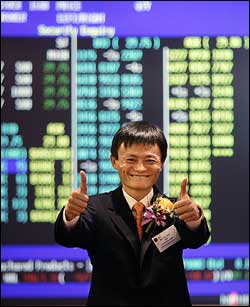 Thousands of investors
rubbed their hands in glee yesterday watching the stock price of Alibaba.com
(1688) nearly triple from its offer price on its first trading day, reviving
memories of the clamor for information technology plays at the height of the
dotcom bubble. Institutional investors and retail punters, ranging from
housewives to retirees, watched with amazement as trading screens flashed the
price for the stock, which rocketed 192.6 percent to close at HK$39.5, up HK$26.
The electronic commerce company, which brings together largely Chinese suppliers
and buyers in an online marketplace, priced its offer at the high end of the
indicated range at HK$13.50 per share. Thousands of investors
rubbed their hands in glee yesterday watching the stock price of Alibaba.com
(1688) nearly triple from its offer price on its first trading day, reviving
memories of the clamor for information technology plays at the height of the
dotcom bubble. Institutional investors and retail punters, ranging from
housewives to retirees, watched with amazement as trading screens flashed the
price for the stock, which rocketed 192.6 percent to close at HK$39.5, up HK$26.
The electronic commerce company, which brings together largely Chinese suppliers
and buyers in an online marketplace, priced its offer at the high end of the
indicated range at HK$13.50 per share.
Private equity firms Texas Pacific
Group (TPG), Newbridge Capital and General Atlantic together realized up to
HK$2.92 billion by placing 350.46 million shares in Asia's leading personal
computer manufacturer, Lenovo Group (0992), as Hong Kong stocks bounced back
yesterday.
Banks bullish on HK property prices
- Investment banks are bullish on Hong Kong's real estate market, predicting
sharp price rises as early as next year. Goldman Sachs forecast residential
prices to rise up to 30 percent each year in 2008 and 2009, while Merrill Lynch
expects them to increase 50 percent by the end of 2009. Shares of local
developers surged after the reports were released. Capital values of luxury
residential units will rise 25 percent to 30 percent annually for 2008 and 2009,
according to Goldman Sachs, while the mass market has a growth rate of 20
percent annually over the same period. The estimate is backed by strong economic
growth and higher wages as a result of low unemployment. Larger-sized flats have
climbed 18 percent on average so far this year while mid-sized apartments have
risen 8 percent. Goldman said larger housing units will outperform smaller ones,
continuing a trend since the revival of the private residential market in late
2003. The investment bank raised the target prices of local developers to
reflect the better outlook. It lifted its target for Sun Hung Kai Properties
(0016) to HK$175 from HK$138, while it raised Kerry Properties (0683) to
HK$80.80 from HK$61.80. SHKP and Kerry are Goldman's top picks because they have
higher exposure to luxury or high-end residential properties. Merrill Lynch's
preferred stock is Henderson Land Development (0012), whose price forecast it
raised to HK$87 from HK$73. SHKP, which had dropped 17 percent since it sold
HK$10.9 billion worth of shares on October 29, jumped 6.62 percent yesterday to
HK$141.60. Kerry edged up 1.02 percent to close at HK$64.65. Henderson gained
3.82 percent to HK$65.20. Merrill Lynch says it is "maximum bullish" on the
property market as it sees strong pent-up demand after several years of low
primary transactions. It said the government's policy on environmental
protection and heritage conservation will result in low land supply and a
"structural housing shortage."
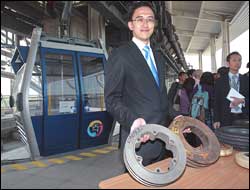 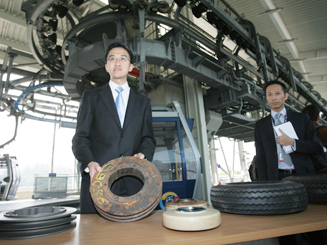
 A travel agency
yesterday said it hoped the Lantau cable car system will be up and running in
time for the long Christmas holiday season. China Travel Service (Hong Kong),
which runs inbound tours, hoped Ngong Ping 360, which now operates the cable car
service, will give a specific date, hopefully before Christmas, to help them
plan their tours. But Morris Cheung Siu-wa, managing director of Ngong Ping 360,
did not give a definite opening date beyond saying that the cable cars will
start running at the end of the year. Cheung said the cable car system, which
was shut down when an empty cable car plunged to the ground in June, has been
tested. The tests were satisfactory. The whole system has been thoroughly
checked by Leitner, the Austrian manufacturer, under normal operating
conditions, including a dummy load test in which water containers weighing 1.5
tonnes were used. Test reports will be submitted in two weeks' time to the
Electrical and Mechanical Services Department for review. There will also be a
reliability test on the entire system using different load conditions and
operating speeds. A report on this test, including preparatory tasks such as
drills and contingency measures, will be sent to the EMSD. When the reports have
been reviewed and judged satisfactory, the cable car system will reopen as
expected by the end of the year, Cheung said. He added that all rusting
components have been replaced with non- rusting aluminum alloy parts or parts
with anti-rust coating. A travel agency
yesterday said it hoped the Lantau cable car system will be up and running in
time for the long Christmas holiday season. China Travel Service (Hong Kong),
which runs inbound tours, hoped Ngong Ping 360, which now operates the cable car
service, will give a specific date, hopefully before Christmas, to help them
plan their tours. But Morris Cheung Siu-wa, managing director of Ngong Ping 360,
did not give a definite opening date beyond saying that the cable cars will
start running at the end of the year. Cheung said the cable car system, which
was shut down when an empty cable car plunged to the ground in June, has been
tested. The tests were satisfactory. The whole system has been thoroughly
checked by Leitner, the Austrian manufacturer, under normal operating
conditions, including a dummy load test in which water containers weighing 1.5
tonnes were used. Test reports will be submitted in two weeks' time to the
Electrical and Mechanical Services Department for review. There will also be a
reliability test on the entire system using different load conditions and
operating speeds. A report on this test, including preparatory tasks such as
drills and contingency measures, will be sent to the EMSD. When the reports have
been reviewed and judged satisfactory, the cable car system will reopen as
expected by the end of the year, Cheung said. He added that all rusting
components have been replaced with non- rusting aluminum alloy parts or parts
with anti-rust coating.
One small step for a luxury brand,
one giant step for shoe lovers in Hong Kong. Italian high-end footwear and
accessory brand Sergio Rossi opened its first flagship store here on Friday with
an exclusive party held at Cuisine Cuisine, followed by the ribbon cutting at
Pacific Place.
 Trade chief warns of Macau threat - Hong Kong must not lose its market-leading
position as the hub for conventions and exhibitions in the face of growing
competition from Macau, the new chairman of the Hong Kong Trade Development
Council told the media in Beijing yesterday. "Hong Kong must have the
determination not to lose its status as leader of the pack in holding
conventions and exhibitions," said Jack So Chak-kwong, who took over a month
ago. "Conventions and exhibitions are not only important for Hong Kong's tourism
but also lead to actual deals signed, and are crucial to export businesses for
industries both local and mainland." He said Hong Kong should not lose its
confidence. "Hong Kong has its own edges. Commercial foundations, law,
accounting, banking, finance and trade are some of its strengths. These will not
be lost." The need for more space was a problem the council was already
discussing with the government, he said. For many of the large exhibitions more
than a third, or even half, of interested exhibitors could not secure a place.
"More space is required even for accommodating current needs," he said. As new
resort hotels enhance Macau's appeal as a choice for conventions, the government
recently set up a special working group to look at the supporting facilities
that could be introduced to boost Hong Kong's position. Flanked by more than 100
Hong Kong business chiefs, Mr So was in the capital attending the 11th Beijing-
Hong Kong Economic Co-operation Symposium. He said government and business
leaders from both cities discussed possible co-operation in areas including IT
research and products, service outsourcing, product design and logistics. Ahead
of the Beijing Olympics, Hong Kong businesses were interested in playing a role
in the capital's property market and infrastructure building. Mr So said the
council was helping small and medium-sized Hong Kong enterprises in the Pearl
River Delta to explore opportunities in neighbouring provinces. Many Hong Kong
factories are having to leave the delta region as governments there tighten
policies on value-adding industries in an attempt to upgrade manufacturing in
the region.
Trade chief warns of Macau threat - Hong Kong must not lose its market-leading
position as the hub for conventions and exhibitions in the face of growing
competition from Macau, the new chairman of the Hong Kong Trade Development
Council told the media in Beijing yesterday. "Hong Kong must have the
determination not to lose its status as leader of the pack in holding
conventions and exhibitions," said Jack So Chak-kwong, who took over a month
ago. "Conventions and exhibitions are not only important for Hong Kong's tourism
but also lead to actual deals signed, and are crucial to export businesses for
industries both local and mainland." He said Hong Kong should not lose its
confidence. "Hong Kong has its own edges. Commercial foundations, law,
accounting, banking, finance and trade are some of its strengths. These will not
be lost." The need for more space was a problem the council was already
discussing with the government, he said. For many of the large exhibitions more
than a third, or even half, of interested exhibitors could not secure a place.
"More space is required even for accommodating current needs," he said. As new
resort hotels enhance Macau's appeal as a choice for conventions, the government
recently set up a special working group to look at the supporting facilities
that could be introduced to boost Hong Kong's position. Flanked by more than 100
Hong Kong business chiefs, Mr So was in the capital attending the 11th Beijing-
Hong Kong Economic Co-operation Symposium. He said government and business
leaders from both cities discussed possible co-operation in areas including IT
research and products, service outsourcing, product design and logistics. Ahead
of the Beijing Olympics, Hong Kong businesses were interested in playing a role
in the capital's property market and infrastructure building. Mr So said the
council was helping small and medium-sized Hong Kong enterprises in the Pearl
River Delta to explore opportunities in neighbouring provinces. Many Hong Kong
factories are having to leave the delta region as governments there tighten
policies on value-adding industries in an attempt to upgrade manufacturing in
the region.
Hong Kong renowned local zheng
soloist So Chun-bo, dubbed the "king of zheng in Hong Kong", will give a recital
next month, the Information Services Department of Hong Kong Special
Administrative Region government said on Tuesday. Playing in a unique style, So
will perform his compositions and rearranged works, including the theme from
"Yesterday's Glitter", "Fish Hawks Dabbling in the Water", "Red Candles' Tears",
and "The Worship" (zheng and cello ensemble), a press release from the
department said. Zheng is a traditional Chinese musical instrument. It belongs
to the zither family of string instruments. So will also incorporate
improvisation, an essential element in jazz, in a performance of his work
"Impromptu". The Hong Kong Zheng Orchestra will perform "A Sketch of Hong Kong"
(zheng ensemble) and "Chant of Pu An" (zheng and percussion). So began studying
zheng in 1963 and formed the first zheng ensemble in Hong Kong in 1971. In 1974,
he gave the first zheng recital in Hong Kong. Since then, he has given more than
100 recitals and appeared in music festivals throughout the world. He has
composed more than 70 zheng works, recorded 18 albums and published "A Complete
Anthology of Chinese Zheng Music" in two volumes.
Sinotrans Shipping Ltd may raise as much as HK$11.45
billion in a Hong Kong initial public offering (IPO) that has drawn US hedge
fund Citadel Investment Group LLC.
Li & Fung (0494) will pay US$128
million (HK$998.4 million) in cash to fully acquire a US-based company that owns
brand licenses to tap the cartoon apparel business. The Hong Kong-based export
trading giant will also sell five properties in Hong Kong to its parent, Li &
Fung (1937) Ltd, for HK$1.4 billion. The US target, American Marketing
Enterprises, holds more than 40 licensed brands including Spider- Man, Barbie
and Disney Princess. "The acquisition will double our brand portfolio to over
100 brands, making us one of the biggest companies in the high-margin
entertainment business," said Li & Fung president Bruce Rockowitz. The
newly-acquired brands are expected to generate US$200 million of sales next
year, he said. Completion of the deal is expected by the end of November. Li &
Fung had made five acquisitions this year before the latest announcement,
spending more than US$612 million on four companies and four brands, including
Tommy Hilfiger Corp's Asia-based sourcing arm. American Marketing Enterprises'
sales in the year ended December 31, 2006, were US$140 million, with pre-tax
profit of US$14.9 million. The company designs, sources and markets sleepwear
brands to retailers including Wal-Mart and Sears. Li & Fung will book an audited
one-time gain of HK$449 million from the real estate sale, it said. The listed
firm will lease back the properties for a maximum HK$72 million a year for the
next three years. Li & Fung shares closed at HK$35.10, down 6.3 percent.
 HKEx downplays ‘through-train’
delay - Hong Kong’s stock exchange played down fears over delays in a strongly
anticipated scheme to let mainland individuals buy Hong Kong shares, saying an
education program for mainland investors would start soon. The comments on
Tuesday by Hong Kong Exchanges and Clearing (SEHK: 0388) chairman Ronald Arculli
came a day after Hong Kong blue chips posted their worst one-day percentage fall
since September 2001 as investors believed an expected flood of funds would fail
to materialize soon. Premier Wen Jiabao raised doubts about the “through train”
scheme over the weekend, saying it needed to be studied further. But Mr Arculli
said the exchange would soon sign an agreement with mainland regulators to help
push the program, focusing on educating mainland investors on global market
risk. He gave no further details. Mainland investors, notorious for trading on
rumour and whim rather than fundamentals, have helped more than double prices on
the Shanghai stock market this year. “It’s not so important as to when the
through train arrives, it’s more important that it runs smoothly,” Mr Arculli
told reporters after a ceremony to mark the listing of Alibaba.com (SEHK: 1688,
announcements, news) , which saw its share price more than double on its debut.
“We have to educate mainland investors, to let them know clearly how the Hong
Kong equity market works.” The investment scheme, which would let mainland
individuals to invest in Hong Kong stocks directly for the first time, could
pour as much as HK$545 billion into the Hong Kong market over its first 6 to 12
months, according to some estimates. Since the plan was unveiled on August 20,
hopes for a rush of new investment helped stoke share prices, especially for
Hong Kong-listed mainland firms such as ICBC (SEHK: 0349) and China Construction
Bank (SEHK: 0939). HKEx downplays ‘through-train’
delay - Hong Kong’s stock exchange played down fears over delays in a strongly
anticipated scheme to let mainland individuals buy Hong Kong shares, saying an
education program for mainland investors would start soon. The comments on
Tuesday by Hong Kong Exchanges and Clearing (SEHK: 0388) chairman Ronald Arculli
came a day after Hong Kong blue chips posted their worst one-day percentage fall
since September 2001 as investors believed an expected flood of funds would fail
to materialize soon. Premier Wen Jiabao raised doubts about the “through train”
scheme over the weekend, saying it needed to be studied further. But Mr Arculli
said the exchange would soon sign an agreement with mainland regulators to help
push the program, focusing on educating mainland investors on global market
risk. He gave no further details. Mainland investors, notorious for trading on
rumour and whim rather than fundamentals, have helped more than double prices on
the Shanghai stock market this year. “It’s not so important as to when the
through train arrives, it’s more important that it runs smoothly,” Mr Arculli
told reporters after a ceremony to mark the listing of Alibaba.com (SEHK: 1688,
announcements, news) , which saw its share price more than double on its debut.
“We have to educate mainland investors, to let them know clearly how the Hong
Kong equity market works.” The investment scheme, which would let mainland
individuals to invest in Hong Kong stocks directly for the first time, could
pour as much as HK$545 billion into the Hong Kong market over its first 6 to 12
months, according to some estimates. Since the plan was unveiled on August 20,
hopes for a rush of new investment helped stoke share prices, especially for
Hong Kong-listed mainland firms such as ICBC (SEHK: 0349) and China Construction
Bank (SEHK: 0939).
Shares in Alibaba.com (SEHK: 1688,
announcements, news) nearly tripled on their trading debut on Tuesday, beating
all expectations, after China’s largest e-commerce firm raised HK$11.6 billion
in Hong Kong’s most popular initial public offering. The stirring debut reflects
voracious appetite for mainland-related stocks, as investors, many of whom
received far fewer IPO shares than they wanted, shrugged off the Hong Kong
market’s sharp drop on Monday and what several observers consider to be a
sky-high valuation to buy Alibaba.com shares. “I’m not convinced,” said Andrew
Clarke, a trader at Societe Generale Securities in Hong Kong. “It’s massively
overpriced. I’d rather go buy Exxon at 15 times earnings.” Shares in Alibaba.com,
in which United States internet giant Yahoo is a key investor, traded as high as
HK$39.95, compared with an IPO price of HK$13.50, which was at the top of an
indicated range after the company’s share sale drew record demand from Hong Kong
retail investors. The stock rose steadily through the day despite a see-sawing
broader market and closed at HK$39.50 for a gain of nearly 193 per cent, valuing
Alibaba.com at roughly US$25.6 billion (HK$200 billion) and ranking it fifth
among global Internet firms and top in Asia outside Japan. Trading in Hong Kong
was so frenetic that the Stock Exchange took calls from brokers asking whether
there were slowdowns in the order-placing system. "It’s helped by the recent
strength of tech stocks in the US,” said Louis Wong, research director at
Phillip Securities. “Baidu has risen above US$400 and Google has held well above
US$700,” he said, referring to the mainland and US-based Internet search firms,
respectively. With more than 162 million Web users, the mainland is the world’s
second-largest internet market after the US.
China:
The second stage of Olympic ticket sales will revert to a lottery draw, the
Games organizers said Monday. The announcement comes days after sales - meant to
be on a first-come, first-served basis - were suspended last Tuesday when the
booking system crashed as a result of overwhelming demand on the first day. The
change aims to reflect a people-oriented policy and to adhere to "the principles
of fairness, impartiality, and convenience to the public", the Beijing
Organizing Committee for the Games of the XXIX Olympiad (BOCOG) said on its
official website. Ticket applications will be accepted from December 10 to 30.
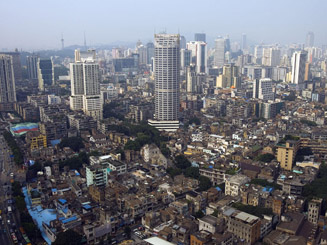 A slowdown
in Shenzhen property transactions triggered by Beijing's latest policy measures
to slow demand in the market has forced developers to reduce asking prices for
new projects. A slowdown
in Shenzhen property transactions triggered by Beijing's latest policy measures
to slow demand in the market has forced developers to reduce asking prices for
new projects.
China's first lunar probe,
Chang'e-1, successfully completed its first braking at perilune and entered the
moon's orbit Monday morning, becoming China's first circumlunar satellite.
Chang'e-1, following the instructions of the Beijing Aerospace Control Center (BACC),
started braking at 11:15 a.m. at a position around 300 km away from the moon and
entered the moon's orbit at around 11:37 a.m. after completing the braking,
according to the BACC.
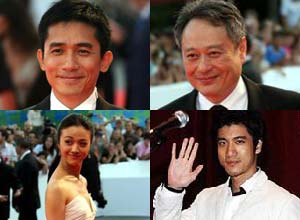 Ang
Lee's new spy thriller "Lust, Caution," has taken a remarkable 40 million yuan
at Chinese mainland box offices in its first four days, proving to be a hit
despite significant cuts to meet mainland censorship requirements. Ang
Lee's new spy thriller "Lust, Caution," has taken a remarkable 40 million yuan
at Chinese mainland box offices in its first four days, proving to be a hit
despite significant cuts to meet mainland censorship requirements.
The securities regulator has blocked a bid from US
investment bank Goldman Sachs for a stake in Fuyao Group, the country's largest
auto glass maker.
A reorganization of Wal-Mart's
global purchasing center in Shenzhen will result in 110 jobs being lost, the
world's biggest retailer said yesterday as it rejected a media report that it
planned to shed more than 1,000 people.
 Strong relations with China crucial to West, says Blair -
Former British prime minister Tony Blair said nurturing a relationship with
China was as important for the West as the global fight against terrorism.
Blair, now a Middle East envoy, told the Hong Kong General Chamber of Commerce
that terrorism was not the only major development in the world. "How we deepen
our relationship with China is as important as any other issue that faces us. It
is important for the United States and Europe to understand what is happening in
China and be sympathetic to what is happening." Blair added the relationship
could be defined as friendship, partnership and mutual respect. Blair's speech
focused on four major developments facing the world today - global politics,
building alliances, the openness of the world economy and permanent
modernization. He explained countries would need to build alliances to find
their place in the world. Even powerful countries like China and the United
States will need to forge an alliance in order to move forward, Blair said,
pointing to the Kyoto treaty. "We will never get a global deal on Kyoto unless
the US and China are in it. They are going to have to find an accommodation to
let China grow and yet ensure that they do not enter into financial obligations
where they are losing financially," Blair said. During the speech the former
British leader spoke about globalization, touching on the recent global turmoil
stemming from the American subprime fallout. "With the trends in the financial
markets, some people may be thinking: `Is there something intrinsically wrong
with the system?' But my view is that there may be individual problems from time
to time but that we benefit from openness," he said. Blair added the greater the
openness of the markets, the greater the opportunity for prosperity. Commenting
on climate change, Blair noted that companies, countries and people around the
world will have to factor the green element into their decision-making and
policies. He stressed the war against terrorism would not be won simply by
promoting democracy and freedom, but by focusing on justice. "If we want to
fight terrorism we must fight global poverty and find peace between Israel and
Palestine. We need to find a just and fair solution in the Middle East," he
said. During the 30-minute talk Blair praised Hong Kong's economic development
since the handover to China in 1997. "Hong Kong has defied every notion of
conventional politics. Hong Kong people are rather exceptional and can be proud
of what they have achieved," he said.
Strong relations with China crucial to West, says Blair -
Former British prime minister Tony Blair said nurturing a relationship with
China was as important for the West as the global fight against terrorism.
Blair, now a Middle East envoy, told the Hong Kong General Chamber of Commerce
that terrorism was not the only major development in the world. "How we deepen
our relationship with China is as important as any other issue that faces us. It
is important for the United States and Europe to understand what is happening in
China and be sympathetic to what is happening." Blair added the relationship
could be defined as friendship, partnership and mutual respect. Blair's speech
focused on four major developments facing the world today - global politics,
building alliances, the openness of the world economy and permanent
modernization. He explained countries would need to build alliances to find
their place in the world. Even powerful countries like China and the United
States will need to forge an alliance in order to move forward, Blair said,
pointing to the Kyoto treaty. "We will never get a global deal on Kyoto unless
the US and China are in it. They are going to have to find an accommodation to
let China grow and yet ensure that they do not enter into financial obligations
where they are losing financially," Blair said. During the speech the former
British leader spoke about globalization, touching on the recent global turmoil
stemming from the American subprime fallout. "With the trends in the financial
markets, some people may be thinking: `Is there something intrinsically wrong
with the system?' But my view is that there may be individual problems from time
to time but that we benefit from openness," he said. Blair added the greater the
openness of the markets, the greater the opportunity for prosperity. Commenting
on climate change, Blair noted that companies, countries and people around the
world will have to factor the green element into their decision-making and
policies. He stressed the war against terrorism would not be won simply by
promoting democracy and freedom, but by focusing on justice. "If we want to
fight terrorism we must fight global poverty and find peace between Israel and
Palestine. We need to find a just and fair solution in the Middle East," he
said. During the 30-minute talk Blair praised Hong Kong's economic development
since the handover to China in 1997. "Hong Kong has defied every notion of
conventional politics. Hong Kong people are rather exceptional and can be proud
of what they have achieved," he said.
 EMC Corp, the world's largest supplier of enterprise data-storage systems and
software, will double its investment in the mainland to US$1 billion over the
next five years to drive expansion and bolster its foray into the global
consumer market. The new investment program, an increase from the original
US$500 million plan announced in June last year, will focus on building up
research and development operations, partner communities, and sales and services
across the country. Joseph Tucci, EMC's chairman, president and chief executive,
disclosed that the spending strategy on the mainland was expected to help move
forward the introduction of key storage technologies and services designed for
consumers worldwide. "We do have our eye on the consumer space, which is a big
market. Everything we're doing with consumers has some research and development
going on here," he said. "China's contribution, both in terms of a market and as
a culture of innovation, has been spectacular. We have demonstrated our success
by gaining customer confidence in the local marketplace and our China research
and development operation is an integral part of our industry-leading
information infrastructure product development efforts."
EMC Corp, the world's largest supplier of enterprise data-storage systems and
software, will double its investment in the mainland to US$1 billion over the
next five years to drive expansion and bolster its foray into the global
consumer market. The new investment program, an increase from the original
US$500 million plan announced in June last year, will focus on building up
research and development operations, partner communities, and sales and services
across the country. Joseph Tucci, EMC's chairman, president and chief executive,
disclosed that the spending strategy on the mainland was expected to help move
forward the introduction of key storage technologies and services designed for
consumers worldwide. "We do have our eye on the consumer space, which is a big
market. Everything we're doing with consumers has some research and development
going on here," he said. "China's contribution, both in terms of a market and as
a culture of innovation, has been spectacular. We have demonstrated our success
by gaining customer confidence in the local marketplace and our China research
and development operation is an integral part of our industry-leading
information infrastructure product development efforts."
November 8, 2007
Hong Kong:
Hong Kong stocks had their worst
one- day points drop in history Monday as fears of a delay in the
much-anticipated "direct-train" scheme intensified after Premier Wen Jiabao said
"careful study and planning" is needed before the scheme would get the green
light.
E-commerce giant Alibaba.com (1688)
is on course to becoming the best initial public offering performer this year
after soaring nearly 88 percent above its offer price in the gray market, on the
eve of its listing debut.
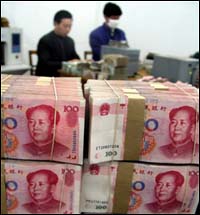 The yuan may eventually crowd out the HK dollar as the preferred currency in the
territory as the economies of the city and the mainland become ever more
integrated, according to Morgan Stanley.
The yuan may eventually crowd out the HK dollar as the preferred currency in the
territory as the economies of the city and the mainland become ever more
integrated, according to Morgan Stanley.
Hong Kong can only attain universal
suffrage if three conditions are met - Beijing's approval, a consensus among the
political elite and a strong democratic movement with the middle class at the
core, says Professor Lau Siu-kai, who heads the Central Policy Unit, a
government think-tank.
 Financial Secretary John Tsang Chun-wah told lawmakers
yesterday that maintaining healthy fiscal reserves was necessary to guard
against market volatility and to defend the currency peg. Hong Kong's fiscal
reserves are projected to balloon to HK$587.9 billion by March 2012 - enough to
cover government expenditure for 24 months. Official data indicates the figure
will grow beyond HK$394.7 billion this year - or 19 months of spending. Mr Tsang
has said the budget surplus this year was likely to be double the initial
forecast of HK$25.4 billion. "Right now, there is high volatility so I would be
more conservative. I think at this particular moment, the bigger the reserves
the better," he told the Legislative Council's financial affairs panel
yesterday. "But, of course, if we need to spend more money, we will." The
government spent almost HK$10 billion last week defending the currency peg. Tax
experts generally believe fiscal reserves that cover 12 to 18 months of spending
are reasonable. One year of expenditure is equivalent to about HK$250 billion.
Lawmakers called on Mr Tsang to loosen the fiscal purse strings to increase old
age allowances and boost personal allowances and other benefits for taxpayers.
Mr Tsang said he was currently consulting the public on the 2008-09 budget,
which will be announced at the end of February. The Liberal Party estimates this
year's surplus will be HK$60 billion and is pressing the government to use HK$40
billion of it to improve people's livelihoods. Party chairman James Tien Pei-chun,
who met Mr Tsang for an hour yesterday to discuss the coming budget, said he
believed the government's finances would remain healthy for the short and
medium-term. "In view of the fact that this year's surplus will be much larger
than what government forecasted ... we feel the government is in the position to
collect less tax and also help the needy," he said. The Liberal Party wants
HK$20 billion given back to the public directly through one-off handouts.
Another HK$20 billion would go towards permanent changes. The party wants
corporate and salaries tax rates to revert to 2003 levels, plus a one-off
salaries tax cut up to a limit of HK$15,000. Other proposals include a loan
scheme to help up to 3,000 first-time home buyers a year to replace the defunct
Home Ownership Scheme.
Financial Secretary John Tsang Chun-wah told lawmakers
yesterday that maintaining healthy fiscal reserves was necessary to guard
against market volatility and to defend the currency peg. Hong Kong's fiscal
reserves are projected to balloon to HK$587.9 billion by March 2012 - enough to
cover government expenditure for 24 months. Official data indicates the figure
will grow beyond HK$394.7 billion this year - or 19 months of spending. Mr Tsang
has said the budget surplus this year was likely to be double the initial
forecast of HK$25.4 billion. "Right now, there is high volatility so I would be
more conservative. I think at this particular moment, the bigger the reserves
the better," he told the Legislative Council's financial affairs panel
yesterday. "But, of course, if we need to spend more money, we will." The
government spent almost HK$10 billion last week defending the currency peg. Tax
experts generally believe fiscal reserves that cover 12 to 18 months of spending
are reasonable. One year of expenditure is equivalent to about HK$250 billion.
Lawmakers called on Mr Tsang to loosen the fiscal purse strings to increase old
age allowances and boost personal allowances and other benefits for taxpayers.
Mr Tsang said he was currently consulting the public on the 2008-09 budget,
which will be announced at the end of February. The Liberal Party estimates this
year's surplus will be HK$60 billion and is pressing the government to use HK$40
billion of it to improve people's livelihoods. Party chairman James Tien Pei-chun,
who met Mr Tsang for an hour yesterday to discuss the coming budget, said he
believed the government's finances would remain healthy for the short and
medium-term. "In view of the fact that this year's surplus will be much larger
than what government forecasted ... we feel the government is in the position to
collect less tax and also help the needy," he said. The Liberal Party wants
HK$20 billion given back to the public directly through one-off handouts.
Another HK$20 billion would go towards permanent changes. The party wants
corporate and salaries tax rates to revert to 2003 levels, plus a one-off
salaries tax cut up to a limit of HK$15,000. Other proposals include a loan
scheme to help up to 3,000 first-time home buyers a year to replace the defunct
Home Ownership Scheme.
China:
More than 7,000 loyal employees of Huawei, China's largest private telecom gear
maker based in the southern city of Shenzhen, have quit in exchange for the
chance to work for the company again. The mass resignation triggered by the
company management started last month. Many legal experts believe it was an
irresponsible decision to exploit a legal loophole before the Labor Contract Law
takes effect on January 1 next year. Under the new law, employees can sign
open-ended labor contracts if they have worked for the same company for 10 or
more years in a row. Huawei employees who have been serving the company for at
least eight years, including founder Ren Zhengfei, will soon sign new contracts,
lasting one to three years, but may have to leave when they expire. To encourage
them to accept the new arrangement, Huawei worked out a compensation scheme
based on length of service, salaries and bonuses. The total cost of the package
is expected to reach 1 billion yuan (US$134 million). "I can't understand why
Huawei has taken such an unwise step," You Yunting, a lawyer with JoinWay Law
Firm in Shanghai, said. "Once this problem is solved, new problems will arise
and the costs will mount up." You added that open-ended contracts did not
necessarily mean the employees had jobs for life. According to the Labor
Contract Law, employers can revoke the contract under six circumstances,
including seriously violating the company's rules and causing the employer major
losses due to serious dereliction of duty or engagement in malpractice for
selfish ends. "I think it's more important to improve internal governance and
the existing rules rather than look for legal loopholes," You said. Lu Tong, a
researcher at the China Academy of Social Sciences, said: "I think it's a very
bad example. Other companies will follow Huawei's example and mess things up."
Xiao Fangsheng, director of the labor law committee of the lawyer's associations
of Guangzhou in Guangdong Province, agreed that Huawei did not have a clear
understanding of the contract law. "It tries to dodge the disadvantages of the
open-ended contract but its efforts will turn out to be invalid. "Even with the
new contracts, employees can still enjoy the benefits of open-ended contracts
because they never left the company and are still working for the company even
if they quit," Xiao said. An official at the Shenzhen labor authority told China
Daily that an official investigation into the case is ongoing.
 PetroChina's
chairman Jiang Jiemin rings the gong at the Shanghai Stock Exchange. Shares in
PetroChina opened Monday at 48.6 yuan on their first day of trade.
PetroChina, China's largest oil and gas producer, replaced Exxon Mobil as the
world's largest listed company by market value on Monday as its share price
surged 163 percent to close at 43.96 yuan on its first day of trading on the
Shanghai Stock Exchange. The company's share price opened at 48.6 yuan on
Monday, almost tripling its IPO price of 16.7 yuan, and ended the morning
session at 43.65 yuan. By offering shares on the mainland, the company is trying
to increase its crude oil production to match its refining capacity, said Zheng
Yi, an analyst with Guangfa Securities. The company's market value on the
Shanghai bourse swelled to above the one-trillion-dollar mark, surging past
Exxon Mobil, valued at 487.7 billion U.S. dollars. It is the first time a
company has been valued at one trillion dollars. The share offering would reduce
the weight of bank and financial institution stocks to 30 percent from 39
percent and help increase that of industrial sectors such as power, coal and
refining, said Wang Jing, an analyst with Orient Securities Co. Ltd. PetroChina
is the first of the country's three petrochemical giants, including Sinopec and
the China National Offshore Oil Corp. (CNOOC), to be listed on overseas stock
markets. PetroChina's
chairman Jiang Jiemin rings the gong at the Shanghai Stock Exchange. Shares in
PetroChina opened Monday at 48.6 yuan on their first day of trade.
PetroChina, China's largest oil and gas producer, replaced Exxon Mobil as the
world's largest listed company by market value on Monday as its share price
surged 163 percent to close at 43.96 yuan on its first day of trading on the
Shanghai Stock Exchange. The company's share price opened at 48.6 yuan on
Monday, almost tripling its IPO price of 16.7 yuan, and ended the morning
session at 43.65 yuan. By offering shares on the mainland, the company is trying
to increase its crude oil production to match its refining capacity, said Zheng
Yi, an analyst with Guangfa Securities. The company's market value on the
Shanghai bourse swelled to above the one-trillion-dollar mark, surging past
Exxon Mobil, valued at 487.7 billion U.S. dollars. It is the first time a
company has been valued at one trillion dollars. The share offering would reduce
the weight of bank and financial institution stocks to 30 percent from 39
percent and help increase that of industrial sectors such as power, coal and
refining, said Wang Jing, an analyst with Orient Securities Co. Ltd. PetroChina
is the first of the country's three petrochemical giants, including Sinopec and
the China National Offshore Oil Corp. (CNOOC), to be listed on overseas stock
markets.
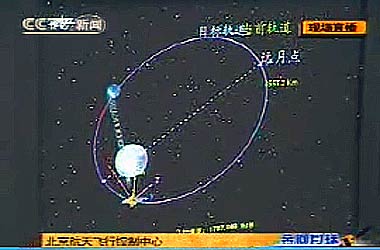 The CCTV footage shows
that China's first lunar probe Chang'e-1 successfully completed its first
braking at perilune and enters the moon's orbit Monday morning, Nov. 5, 2007.
China's first lunar probe, Chang'e-1, successfully completed its first braking
at perilune and enters the moon's orbit Monday morning, becoming China's first
circumlunar satellite. Chang'e-1, following the instructions of the Beijing
Aerospace Control Center (BACC), started braking at 11:15 a.m. at a position
around 300 km away from the moon and entered the moon's orbit at around 11:37
a.m. after completing the braking, according to the BACC. The braking was
performed just in time to decelerate the probe, enabling it to be captured by
the lunar gravity and become a "real" circumlunar satellite, said Wang Yejun,
chief engineer of BACC. The CCTV footage shows
that China's first lunar probe Chang'e-1 successfully completed its first
braking at perilune and enters the moon's orbit Monday morning, Nov. 5, 2007.
China's first lunar probe, Chang'e-1, successfully completed its first braking
at perilune and enters the moon's orbit Monday morning, becoming China's first
circumlunar satellite. Chang'e-1, following the instructions of the Beijing
Aerospace Control Center (BACC), started braking at 11:15 a.m. at a position
around 300 km away from the moon and entered the moon's orbit at around 11:37
a.m. after completing the braking, according to the BACC. The braking was
performed just in time to decelerate the probe, enabling it to be captured by
the lunar gravity and become a "real" circumlunar satellite, said Wang Yejun,
chief engineer of BACC.
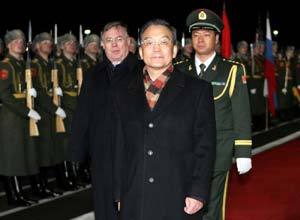 Chinese Premier Wen
Jiabao arrived in Moscow on Monday to begin a two-day official visit to Russia
at the invitation of Russian Prime Minister Viktor Zubkov. Chinese Premier Wen
Jiabao arrived in Moscow on Monday to begin a two-day official visit to Russia
at the invitation of Russian Prime Minister Viktor Zubkov.
 Cast members
Tang Wei (R) and Lee-Hom Wang attend the premiere of "Lust, Caution" in Shanghai
on October 31, 2007. Cast members
Tang Wei (R) and Lee-Hom Wang attend the premiere of "Lust, Caution" in Shanghai
on October 31, 2007.
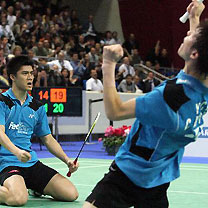 China's world
number one Cai Yun (Right) and Fu Haifeng kneel down to celebrate after winning
the men's doubles final game at French Super Series in Paris November 4, 2007.
The Chinese pair beat Malaysia's Choong Tan Fook and Lee Wan Wah 21-14 21-19. China's world
number one Cai Yun (Right) and Fu Haifeng kneel down to celebrate after winning
the men's doubles final game at French Super Series in Paris November 4, 2007.
The Chinese pair beat Malaysia's Choong Tan Fook and Lee Wan Wah 21-14 21-19.
China and the United States agreed
yesterday to open a military hotline as US Defense Secretary Robert Gates held
talks in Beijing aimed at strengthening ties overshadowed by years of mistrust.
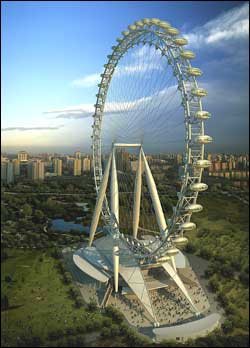 You have climbed the Great Wall of China, now Beijing
wants you to "fly" the Great Wheel of China. Higher than both the London Eye and
the Singapore Flyer, which opens in March, the Beijing Great Wheel will tower
208 meters when finished in 2009, executives said, making it the highest and
largest in the world. The giant ferris wheel will have 48 air-conditioned
observation capsules, each of which can carry up to 40 passengers, and on a good
day even the Great Wall is expected to be visible in the mountains to Beijing's
north. "The wheel itself is a nice add-on to the city. It's a new icon for the
city," Great Wheel chief executive Stephan Matter said ahead of the
ground-breaking ceremony. The wheel will be in east Beijing's Chaoyang Park, and
it will have far greater capacity than the London Eye. "A capsule in London
caters for 25. Ours will cater for 40 people. It's like a little bus. It's 18
tonnes heavy," Matter said, adding that the project will cost around 200 million
euros (HK$2.25 billion), and tickets will go for about 100 yuan (HK$104) a head.
Chairman Florian Bollen, whose company is involved in the Singapore wheel, said:
"It will allow the people of Beijing to ... see the city from a completely new
perspective. It is a flight." Matter brushed off worries Beijing's notorious
smog may spoil the party."It is an issue, but it's increasingly better," he
said. "I believe the Chinese government will improve it further, and ... the
wheel itself is an attraction. From that perspective, I'm not worried at all."
You have climbed the Great Wall of China, now Beijing
wants you to "fly" the Great Wheel of China. Higher than both the London Eye and
the Singapore Flyer, which opens in March, the Beijing Great Wheel will tower
208 meters when finished in 2009, executives said, making it the highest and
largest in the world. The giant ferris wheel will have 48 air-conditioned
observation capsules, each of which can carry up to 40 passengers, and on a good
day even the Great Wall is expected to be visible in the mountains to Beijing's
north. "The wheel itself is a nice add-on to the city. It's a new icon for the
city," Great Wheel chief executive Stephan Matter said ahead of the
ground-breaking ceremony. The wheel will be in east Beijing's Chaoyang Park, and
it will have far greater capacity than the London Eye. "A capsule in London
caters for 25. Ours will cater for 40 people. It's like a little bus. It's 18
tonnes heavy," Matter said, adding that the project will cost around 200 million
euros (HK$2.25 billion), and tickets will go for about 100 yuan (HK$104) a head.
Chairman Florian Bollen, whose company is involved in the Singapore wheel, said:
"It will allow the people of Beijing to ... see the city from a completely new
perspective. It is a flight." Matter brushed off worries Beijing's notorious
smog may spoil the party."It is an issue, but it's increasingly better," he
said. "I believe the Chinese government will improve it further, and ... the
wheel itself is an attraction. From that perspective, I'm not worried at all."
November 7, 2007
Hong Kong:
Batman will make an ear-shattering entry into Hong Kong Tuesday when he spreads
his wings across the city's skies. Noisy aircraft and helicopters are to swoop
over some of the busiest areas in Hong Kong during the filming of Batman: The
Dark Knight. C-130 aircraft, similar to the one pictured, will fly over Victoria
Harbour between 3pm and 7pm tomorrow as well as on Friday. Two helicopters will
fly low over West Kowloon, Causeway Bay, Central and Western districts between
7am and 11pm between tomorrow and Monday. The film services office of the
Television and Entertainment Licensing Authority, which is helping Warner Bros
in shooting the movie, has appealed to the public for tolerance and
understanding. In September, councilors voiced concerns over the noise and
traffic that would result from the Hollywood movie, which stars Christian Bale
as Batman, Heath Ledger as the Joker and Michael Caine as the butler Alfred. It
is a sequel to the 2005 movie Batman Begins. But the FSO yesterday said the
filming would reap "tangible benefits" for Hong Kong. "Films for international
release will help showcase Hong Kong to an international audience and would
generate other economic benefits, for example promoting tourism. Moreover,
overseas film production may bring in new technology and facilitate exchanges,
hence benefit the local film industry."
 Mickey Mouse and
his mates at Hong Kong Disneyland look set for another massive cash handout -
courtesy of the taxpayer. The Standard has learned that the government has
softened its stance on the theme park's second-phase expansion. It is
considering providing a lifeline to the theme park, where visitor numbers and
sales have fallen short of projections. Secretary for Commerce and Economic
Development Frederick Ma Si- hang told The Standard the government would be
inclined to inject funds for expansion so that it could continue to be a draw
card for visitors. "I don't want to hear visitors saying they are seeing the
same things they saw last year and lose interest in Disneyland," Ma said. But he
would not say how much capital the government would commit. This is the first
time the government has indicated its willingness to support the theme park,
which Disney has stated may require extra financing. Former secretary for
economic development and labor Stephen Ip Shu- kwan previously made it clear the
government had no intention of injecting funds. Ma, in his earlier capacity as
secretary for financial services and treasury, also suggested the government
might sell its stake in the company that operates the theme park. Ma's latest
comments follow remarks by Chief Executive Donald Tsang Yam-kuen, who said early
last month in a briefing following his policy address that he had asked the
financial secretary to clarify the government's role and its level of
participation as a shareholder in managing government- held assets, including
Disneyland. Also in mid-October, Ma and Financial Secretary John Tsang Chun- wah
convened a cross-sector committee to review how the city can improve its
attractions and outline strategies. Since opening in 2005, the theme park has
been climbing a financial mountain. In May, Walt Disney said it would not be
able to draw on a US$294 million (HK$2.28 billion) revolving credit facility,
and may require alternative financing to meet operating and development needs.
Reporting that second-quarter earnings to the end of March rose 27 percent,
Disney said guest spending, attendance and operating income at the Hong Kong
theme park was lower. Overall, revenue from parks and resorts rose 9 percent to
US$2.4 billion while operating income rose 19 percent to US$254 million. Ma said
the people of Hong Kong have complained that "Disneyland is small." He said no
one will disagree it needs to expanded and that the government should inject
funds in that event. The park belongs to the people of Hong Kong as the
government holds a 57 percent stake, Ma said. The government has invested HK$25
billion. "I think nobody would like to see our stake being diluted, Ma said,
adding he remained confident lawmakers will approve additional financing. Ma
also attempted to defend the scale of the theme park at the beginning. "If I
were to open a restaurant, I wouldn't start by having 100,000 square meters
right away, as I wouldn't know how business would be like in the beginning." Ma
said he is trying to view the development of the theme park from an objective
perspective, noting that he was not a party to the original decision to build
Hong Kong Disneyland. "Allan Zeman [Ocean Park chairman] once said what we show
visitors are real animals, while what Disneyland shows are only cartoon
characters. We need people to dress up as those characters, and hiring cost is
an issue," Ma said. He added that on average visitors stay just three days in
Hong Kong, with one day usually spent at Disneyland, unlike visitors to
California, where people stay about a week, spending three days in Disneyland.
"You can only blame the government if it does not have any plan for further
development, but that is not the case," Ma said. Meanwhile, Ma said he hopes
Ngong Ping 360 cable car rides will be ready by Christmas. "I have confidence in
MTR management, they have never let the people of Hong Kong down." Mickey Mouse and
his mates at Hong Kong Disneyland look set for another massive cash handout -
courtesy of the taxpayer. The Standard has learned that the government has
softened its stance on the theme park's second-phase expansion. It is
considering providing a lifeline to the theme park, where visitor numbers and
sales have fallen short of projections. Secretary for Commerce and Economic
Development Frederick Ma Si- hang told The Standard the government would be
inclined to inject funds for expansion so that it could continue to be a draw
card for visitors. "I don't want to hear visitors saying they are seeing the
same things they saw last year and lose interest in Disneyland," Ma said. But he
would not say how much capital the government would commit. This is the first
time the government has indicated its willingness to support the theme park,
which Disney has stated may require extra financing. Former secretary for
economic development and labor Stephen Ip Shu- kwan previously made it clear the
government had no intention of injecting funds. Ma, in his earlier capacity as
secretary for financial services and treasury, also suggested the government
might sell its stake in the company that operates the theme park. Ma's latest
comments follow remarks by Chief Executive Donald Tsang Yam-kuen, who said early
last month in a briefing following his policy address that he had asked the
financial secretary to clarify the government's role and its level of
participation as a shareholder in managing government- held assets, including
Disneyland. Also in mid-October, Ma and Financial Secretary John Tsang Chun- wah
convened a cross-sector committee to review how the city can improve its
attractions and outline strategies. Since opening in 2005, the theme park has
been climbing a financial mountain. In May, Walt Disney said it would not be
able to draw on a US$294 million (HK$2.28 billion) revolving credit facility,
and may require alternative financing to meet operating and development needs.
Reporting that second-quarter earnings to the end of March rose 27 percent,
Disney said guest spending, attendance and operating income at the Hong Kong
theme park was lower. Overall, revenue from parks and resorts rose 9 percent to
US$2.4 billion while operating income rose 19 percent to US$254 million. Ma said
the people of Hong Kong have complained that "Disneyland is small." He said no
one will disagree it needs to expanded and that the government should inject
funds in that event. The park belongs to the people of Hong Kong as the
government holds a 57 percent stake, Ma said. The government has invested HK$25
billion. "I think nobody would like to see our stake being diluted, Ma said,
adding he remained confident lawmakers will approve additional financing. Ma
also attempted to defend the scale of the theme park at the beginning. "If I
were to open a restaurant, I wouldn't start by having 100,000 square meters
right away, as I wouldn't know how business would be like in the beginning." Ma
said he is trying to view the development of the theme park from an objective
perspective, noting that he was not a party to the original decision to build
Hong Kong Disneyland. "Allan Zeman [Ocean Park chairman] once said what we show
visitors are real animals, while what Disneyland shows are only cartoon
characters. We need people to dress up as those characters, and hiring cost is
an issue," Ma said. He added that on average visitors stay just three days in
Hong Kong, with one day usually spent at Disneyland, unlike visitors to
California, where people stay about a week, spending three days in Disneyland.
"You can only blame the government if it does not have any plan for further
development, but that is not the case," Ma said. Meanwhile, Ma said he hopes
Ngong Ping 360 cable car rides will be ready by Christmas. "I have confidence in
MTR management, they have never let the people of Hong Kong down."
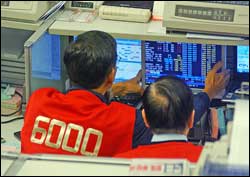 Hong Kong
stocks are expected to fall below 30,000 today after Premier Wen Jiabao set out
over the weekend new conditions on launching the "Hong Kong stock direct train."
Analysts said market sentiment will be affected, but only for the short term, on
the implication that the plan will proceed more slowly. The direct investment
program, which is expected to narrow the gap between A- and H-share prices, may
now be delayed. The Hang Seng Index is expected to drop about 400 to 500 points
on opening today and fluctuate between 29,000 and 31,000 this week, with H
shares worst hit. "The HSI this week will not exceed 30,800 points," Sun Hung
Kai Financial strategist Castor Pang Wai-sun said. Wen told Hong Kong
journalists during a visit to Uzbekistan that the government needs to educate
Chinese investors on risks, implement regulations to minimize shock brought to
mainland and Hong Kong markets and hear opinions from financial regulators,
including those in Hong Kong. Analysts believe Wen's comments will cool the
desire to invest in the Hong Kong stock market. "The stock market will enter a
phase of correction and consolidation in November," KGI Asia chief operating
officer Ben Kwong Man-bun said. Hong Kong
stocks are expected to fall below 30,000 today after Premier Wen Jiabao set out
over the weekend new conditions on launching the "Hong Kong stock direct train."
Analysts said market sentiment will be affected, but only for the short term, on
the implication that the plan will proceed more slowly. The direct investment
program, which is expected to narrow the gap between A- and H-share prices, may
now be delayed. The Hang Seng Index is expected to drop about 400 to 500 points
on opening today and fluctuate between 29,000 and 31,000 this week, with H
shares worst hit. "The HSI this week will not exceed 30,800 points," Sun Hung
Kai Financial strategist Castor Pang Wai-sun said. Wen told Hong Kong
journalists during a visit to Uzbekistan that the government needs to educate
Chinese investors on risks, implement regulations to minimize shock brought to
mainland and Hong Kong markets and hear opinions from financial regulators,
including those in Hong Kong. Analysts believe Wen's comments will cool the
desire to invest in the Hong Kong stock market. "The stock market will enter a
phase of correction and consolidation in November," KGI Asia chief operating
officer Ben Kwong Man-bun said.
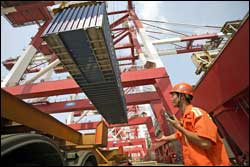 China's
third largest dry bulk shipper, Sinotrans Shipping, sister company of Sinotrans
(0598), plans to raise up to HK$11.47 billion from its Hong Kong share flotation
thanks to a global shipping boom, sources familiar with the deal said. China's
unabated demand for the energy and raw materials needed to fuel its galloping
economic growth has fueled strong demand for bulk cargo ships and sent the
Baltic Exchange's dry freight index to a record level. The company, which is the
key vessel-owning subsidiary of state- owned Sinotrans Group, kicks off a market
roadshow for its IPO today and is offering 1.4 billion shares, or 35 percent of
its enlarged share capital, in a price range of HK$7.18-HK$8.18 each, the
sources said. The indicative price range represents a price-to-earnings multiple
of 26.9 to 30.6 times the syndicate earnings forecast for this year, or 12.3 to
14 times next year's earnings forecast. The firm also has seven cornerstone
investors for a combined HK$1.37 billion worth of shares, including China
Merchants Group, China COSCO Group, China Shipping Group, Ping An Insurance
(2318), Cheung Kong (0001) chairman Li Ka-shing, Henderson Land (0012) chairman
Lee Shau-kee and investment firm Citadel. The sponsors, UBS and BOC
International, on average expected the company could increase net profit 15
percent to HK$1.07 billion this year before more than doubling the figure to
HK$2.33 billion next year due to the strong upward momentum of the Baltic Dry
Index. By comparison, China COSCO (1919), is buying its parent's dry-bulk
shipping fleet for HK$35.88 billion, making it the world's largest transporter
of resources. It now trades at 68 times 2007 earnings forecast. Other peers
include China Shipping Development (1138) and Pacific Basin Shipping (2343),
which trade at 18 times and 11 times prospective earnings, respectively.
Sinotrans Shipping will start its Hong Kong public offering next Monday, with a
trading debut scheduled for November 23. The Baltic Dry Index has risen more
than 140 percent this year and hit a record high on October 29 because of port
congestion and changing trade flows through China, but it has since slipped 4
percent from its peak. China's
third largest dry bulk shipper, Sinotrans Shipping, sister company of Sinotrans
(0598), plans to raise up to HK$11.47 billion from its Hong Kong share flotation
thanks to a global shipping boom, sources familiar with the deal said. China's
unabated demand for the energy and raw materials needed to fuel its galloping
economic growth has fueled strong demand for bulk cargo ships and sent the
Baltic Exchange's dry freight index to a record level. The company, which is the
key vessel-owning subsidiary of state- owned Sinotrans Group, kicks off a market
roadshow for its IPO today and is offering 1.4 billion shares, or 35 percent of
its enlarged share capital, in a price range of HK$7.18-HK$8.18 each, the
sources said. The indicative price range represents a price-to-earnings multiple
of 26.9 to 30.6 times the syndicate earnings forecast for this year, or 12.3 to
14 times next year's earnings forecast. The firm also has seven cornerstone
investors for a combined HK$1.37 billion worth of shares, including China
Merchants Group, China COSCO Group, China Shipping Group, Ping An Insurance
(2318), Cheung Kong (0001) chairman Li Ka-shing, Henderson Land (0012) chairman
Lee Shau-kee and investment firm Citadel. The sponsors, UBS and BOC
International, on average expected the company could increase net profit 15
percent to HK$1.07 billion this year before more than doubling the figure to
HK$2.33 billion next year due to the strong upward momentum of the Baltic Dry
Index. By comparison, China COSCO (1919), is buying its parent's dry-bulk
shipping fleet for HK$35.88 billion, making it the world's largest transporter
of resources. It now trades at 68 times 2007 earnings forecast. Other peers
include China Shipping Development (1138) and Pacific Basin Shipping (2343),
which trade at 18 times and 11 times prospective earnings, respectively.
Sinotrans Shipping will start its Hong Kong public offering next Monday, with a
trading debut scheduled for November 23. The Baltic Dry Index has risen more
than 140 percent this year and hit a record high on October 29 because of port
congestion and changing trade flows through China, but it has since slipped 4
percent from its peak.
 Ocean Park ready to
take on the world - Saudi Arabia and Shanghai want copy of HK attraction - Saudi
Arabia and several mainland cities including Shanghai have expressed interest in
building their own version of Ocean Park, according to a source close to the
theme park. The moves reflect keen international interest in the 30-year-old
park, which has enjoyed growing attendance figures. The park, home to Hong
Kong's pandas, is undergoing an ambitious HK$5.5 billion facelift that is
expected to further raise its profile. A source said some private enterprises in
Saudi Arabia and mainland cities such as Shanghai had expressed interest in
building their own version of the park. Saudi Arabia's consul-general in Hong
Kong, Alaudeen Alaskary, confirmed the oil-rich country was studying the idea.
"The talks are still at an initial stage," he said. "But Ocean Park is one of
the most successful parks in the world. It is both amusing and educational."
Park chairman Allan Zeman might visit Saudi Arabia in January. Mr Alaskary said
such an undertaking would be financed by the private sector in both Saudi Arabia
and Hong Kong and there was no need to speak to the government. The country
could also be interested in acquiring a stake in the Hong Kong park if it was
open to outside investors, he said. Investment-hungry Saudi Arabia, like
Shanghai, is eager to upgrade its tourism infrastructure, spending billions of
dollars to attract and develop first-class hotels and brand-name theme parks.
Both destinations are no stranger to theme parks and are home to local offerings
- the Al-Shallal Theme Park in Jeddah and Jin Jiang Amusement Park in Shanghai -
but want to capitalise on a successful brand name. Ocean Park ready to
take on the world - Saudi Arabia and Shanghai want copy of HK attraction - Saudi
Arabia and several mainland cities including Shanghai have expressed interest in
building their own version of Ocean Park, according to a source close to the
theme park. The moves reflect keen international interest in the 30-year-old
park, which has enjoyed growing attendance figures. The park, home to Hong
Kong's pandas, is undergoing an ambitious HK$5.5 billion facelift that is
expected to further raise its profile. A source said some private enterprises in
Saudi Arabia and mainland cities such as Shanghai had expressed interest in
building their own version of the park. Saudi Arabia's consul-general in Hong
Kong, Alaudeen Alaskary, confirmed the oil-rich country was studying the idea.
"The talks are still at an initial stage," he said. "But Ocean Park is one of
the most successful parks in the world. It is both amusing and educational."
Park chairman Allan Zeman might visit Saudi Arabia in January. Mr Alaskary said
such an undertaking would be financed by the private sector in both Saudi Arabia
and Hong Kong and there was no need to speak to the government. The country
could also be interested in acquiring a stake in the Hong Kong park if it was
open to outside investors, he said. Investment-hungry Saudi Arabia, like
Shanghai, is eager to upgrade its tourism infrastructure, spending billions of
dollars to attract and develop first-class hotels and brand-name theme parks.
Both destinations are no stranger to theme parks and are home to local offerings
- the Al-Shallal Theme Park in Jeddah and Jin Jiang Amusement Park in Shanghai -
but want to capitalise on a successful brand name.
 The Jockey Club
and the Sports Federation want to build an Olympic equestrian museum in Penfold
Park, Sha Tin, after the Olympic equestrian events are held in Hong Kong next
year. The Jockey Club
and the Sports Federation want to build an Olympic equestrian museum in Penfold
Park, Sha Tin, after the Olympic equestrian events are held in Hong Kong next
year.
China:
The government will take measures to prevent asset bubbles and avoid huge
fluctuations in the stock market, Premier Wen Jiabao told reporters on Saturday.
Preventing asset bubbles is like preventing inflation and it is the government's
responsibility to ensure a fair, healthy and transparent stock market, Wen said
in Uzbekistan where he was attending the Sixth Meeting of Prime Ministers of
Member States of the Shanghai Cooperation Organization. He added that all
measures will be market-oriented options rather than administrative actions. The
stability of the stock market relies on two basic factors: The quality of listed
companies and a transparent market which protect not only the interests of
enterprises, but also those of consumers, Wen said. With more people having
entered the stock market, abnormal fluctuations affect both the national economy
and the interests of shareholders, so the government will closely watch
developments, he said. Wen also said that lifting gasoline prices by 10 percent
on November 1 was necessary to keep China's oil product prices partly in sync
with global oil prices.
  At the invitation of Chinese Defense Minister Cao Gangchuan, the United States
Secretary of Defense Robert M. Gates arrived here Sunday night, kicking off his
first official visit to China. During his three-day China tour, Gates will hold
talks with Cao, who is also vice-chairman of China's Central Military Commission
and state councilor, and meet with top Chinese leaders and Foreign Ministry
officials, according to the Chinese Defense Ministry. The two sides will
exchange views on the current international and regional security situation,
bilateral relations, military ties of two countries, and other issues of common
concern. Chinese Foreign Ministry spokesman Liu Jianchao said on Thursday China
hopes the visit will help strengthen understanding and trust between the two
militaries in a bid to promote healthy development of bilateral ties. China
believes Gates' China trip is an important event in Sino-U.S. relations this
year, and attach great importance to it, said Liu. This is Gates' first visit to
China since he became the U.S. secretary of defense in December 2006.
At the invitation of Chinese Defense Minister Cao Gangchuan, the United States
Secretary of Defense Robert M. Gates arrived here Sunday night, kicking off his
first official visit to China. During his three-day China tour, Gates will hold
talks with Cao, who is also vice-chairman of China's Central Military Commission
and state councilor, and meet with top Chinese leaders and Foreign Ministry
officials, according to the Chinese Defense Ministry. The two sides will
exchange views on the current international and regional security situation,
bilateral relations, military ties of two countries, and other issues of common
concern. Chinese Foreign Ministry spokesman Liu Jianchao said on Thursday China
hopes the visit will help strengthen understanding and trust between the two
militaries in a bid to promote healthy development of bilateral ties. China
believes Gates' China trip is an important event in Sino-U.S. relations this
year, and attach great importance to it, said Liu. This is Gates' first visit to
China since he became the U.S. secretary of defense in December 2006.
Wal-Mart quadruples size of
distribution center in N China - The expanded center in Tianjin's Beichen
district, can handle 330,000 packages of goods.
Air New Zealand has added flights
between Shanghai and Auckland following strong demand from travellers for more
services between China and New Zealand. From November, Air New Zealand has
started to operate two extra services per week between Shanghai and Auckland,
increasing its weekly operations from three to five. The two new services fly
Thursday and Saturday, complementing Air New Zealand's current services that fly
Tuesday, Friday and Sunday. All flights between Shanghai and Auckland are
operated with the313-seat Boeing 777-200ER aircraft, which is fitted with the
airline's Business Premier, Pacific Premium Economy and Pacific Economy cabins,
all featuring in-flight digital entertainment on demand.
Tourists from China's three key
cities of Beijing, Shanghai and Guangzhou are inclined to spend more in trips to
Europe than to other places in the world, according to a report released by the
Nielsen Company. The Nielsen China Outbound Travel Monitor 2007 found that among
outbound travelers in the three cities, those to Europe were the biggest
spenders, splashing out an average of 5,253 U.S. dollars per person. Travelers
to Asia spent just a bit more than a third the amount of those to Europe,
reaching 1,904 U.S. dollars a head, with the exception of those to Hong Kong and
Macao, where the average per capita spending was 2,185 U.S. dollars, reflecting
the two destinations' status as shopping and entertainment centers, according to
the company. On average, Chinese outbound travelers spent nearly 3,000 U.S.
dollars per trip per person, which included expenses prior to the trip, such as
prepaid packages, airfares and accommodation, revealed Nielsen's survey based on
a combination of telephone and online interviews. "Asia remains the most popular
destination for Chinese travelers because of the region's proximity. However,
trips to Europe and America are increasing rapidly in numbers, particularly when
it comes to business travel," said Dr. Grace Pan, head of Travel and Leisure
Research for The Nielsen Company, China. "We also found that while most Chinese
travelers were still focusing on budget travel, there was a fast-emerging
affluent market group prepared to indulge themselves in luxury travel," Dr. Pan
said. Nielsen's survey showed more than one third of Chinese outbound travelers
in the three cities chose to stay in four-star hotels, with a further 10 percent
opting for five-star luxury accommodation when heading overseas. "Chinese
consumers are becoming increasingly sophisticated and the travel industry needs
to monitor changes and trends in their travel preferences, attitudes and
perceptions towards various destinations," Dr. Pan said. "While Chinese
travelers appear to seek comfort, they are also becoming wise and well-prepared
as they plan their trips accessing all the information available to them on the
Internet," he said.
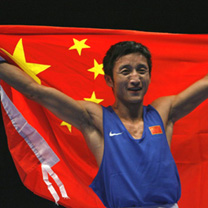 Zou Shiming of China
celebrates after defeating Harry Tanamor in the World Boxing Championship 48kg
bout in Chicago, Illinois November 3, 2007. Zou got the defense of the champion. Zou Shiming of China
celebrates after defeating Harry Tanamor in the World Boxing Championship 48kg
bout in Chicago, Illinois November 3, 2007. Zou got the defense of the champion.
The investment quota allowed to
China's qualified domestic institutional investors (QDII) has reached US$42.17
billion by the end of September, statistics from the country's forex watchdog
shows. A total investment of US$10.86 billion has already been made in overseas
markets by the end of September, according to Li Dongrong, deputy head of the
State Administration of Foreign Exchange (SAFE), which sanctions the quota. The
QDII scheme, launched in last July, allows mainland institutions and residents
to entrust mainland commercial banks to invest in overseas financial products,
and allows insurance institutions to invest some of their assets in overseas
fixed-income products and monetary market products. Li said the QDII program
offers more channels of investment for mainland residents, who are not allowed
to directly invest in overseas markets, and has become an effective channel for
them to decentralize risks. He said the administration would continue to promote
the QDII program steadily, and vowed to strengthen supervision. So far, 21
commercial banks, including both Chinese and foreign banks like HSBC China,
Deutsche Bank, the Agriculture Bank of China and Shanghai Pudong Development
Bank, have been allowed a combined quota of US$16.1 billion. Another five fund
management firms, such as China Asset Management Corp, enjoy a combined
investment quota of US$19.5 billion, while 14 insurance companies, including
Ping An of China and China Life Insurance, hold the remaining US$6.57 billion.
November 6, 2007
Hong Kong:
As there are regulatory and operational differences between Hong Kong and
Mainland financial markets, further integration of them will take time, a
financial official of the Hong Kong Special Administrative Region government
said here Saturday. Speaking on a radio talk show, Secretary for Financial
Services and the Treasury KC Chan said that the Government will facilitate
co-operation between the two markets, adding the two jurisdictions' stock
exchanges may consider joining forces to develop new markets. He said Hong Kong
should continue to attract Mainland enterprises to do business in Hong Kong and
should further strengthen its asset management center by assisting Mainland
investors to invest in overseas markets. To enhance Hong Kong financial market
competitiveness the Government will organize overseas promotions to attract more
overseas companies to list on the city's exchange, said Chan. When asked if the
Government will do something to prevent local stock and property markets from
overheating, Chan said the Government will explore ways to ensure Hong Kong's
economic stability and help the public overcome inflation problems. He also
urged investors to make proper risk assessments. Noting the U.S. sub-prime
mortgage crisis may affect Hong Kong's economy in the short term, he said the
city should make long-term investment in infrastructure. On anti-poverty
measures, Chan said the Financial Secretary will start consulting the public on
his coming Budget next week and will explore ways to alleviate poverty.
 A plan to ban idling
vehicle engines by mid-2009 has drawn fire from public transport groups,
including taxi and minibus operators, but was hailed by conservationists as a
major step in the battle against worsening air pollution in the territory. The
government on Friday launched a five-month public consultation exercise on the
proposal which would impose a fixed penalty of HK$320 on offenders, with taxi
and minibus drivers likely to bear the brunt of the ban. Government sources,
however, admitted there is a gray area in enforcing the legislation as it is
difficult to determine whether passengers are boarding or alighting from
vehicles at any one time. The sources also admitted that the statutory ban will
only have a very minimal effect on reducing emissions. Under the proposals,
drivers would have to switch off their engines when they stop their vehicles, no
matter how long they wait - unlike in other countries where drivers are allowed
to switch off their engines about three or five minutes after they have stopped
their vehicles. The ban would be imposed territory- wide regardless of the
locality or time. However, there would be exemptions for certain vehicles, such
as those which stop for active boarding or alighting, the first two taxis or
minibuses at a public stand, security transit vehicles and those which have to
keep the engine running for ancillary purposes, including lorry cranes and
mobile concrete pumps. Secretary for the Environment Edward Yau A plan to ban idling
vehicle engines by mid-2009 has drawn fire from public transport groups,
including taxi and minibus operators, but was hailed by conservationists as a
major step in the battle against worsening air pollution in the territory. The
government on Friday launched a five-month public consultation exercise on the
proposal which would impose a fixed penalty of HK$320 on offenders, with taxi
and minibus drivers likely to bear the brunt of the ban. Government sources,
however, admitted there is a gray area in enforcing the legislation as it is
difficult to determine whether passengers are boarding or alighting from
vehicles at any one time. The sources also admitted that the statutory ban will
only have a very minimal effect on reducing emissions. Under the proposals,
drivers would have to switch off their engines when they stop their vehicles, no
matter how long they wait - unlike in other countries where drivers are allowed
to switch off their engines about three or five minutes after they have stopped
their vehicles. The ban would be imposed territory- wide regardless of the
locality or time. However, there would be exemptions for certain vehicles, such
as those which stop for active boarding or alighting, the first two taxis or
minibuses at a public stand, security transit vehicles and those which have to
keep the engine running for ancillary purposes, including lorry cranes and
mobile concrete pumps. Secretary for the Environment Edward Yau
Tang-wah said vehicles are the second-largest source of air pollution in Hong
Kong. "We really hope to reduce emissions by idling engines," he said. Yau said
the government is forced to act because motorists have failed to switch off
engines while waiting despite many past campaign to get them to do so. He said
the number of complaints against idling vehicles had doubled - from 238 in 2002
to 501 last year.
Hong Kong's growth may be affected
by a significant slowdown of the US economy, according to an economic update
report to be presented Thursday to the Legislative Council by the Hong Kong
Monetary Authority.
 The founder of
home accessories store G.O.D. (Goods of Desire) Douglas Young Chi-Chiu said he
has learned a lesson from his brush with the law. "The incident happened because
we have touched on words with double meanings. I never thought [the designs
would violate the law]," he said after being released on bail. Young and 17
sales and design staff were arrested on Thursday for allegedly selling products
with triad connotations. All were released on bail on Friday and ordered to
report to the police by the middle of this month. Young said his product designs
are intended to reflect Hong Kong culture and preserve the community's
collective memory. "The logo too reflects local culture, the inspiration coming
from old jewelry shops in Hong Kong and the gold measure of a carat," Young
said. "I have learned a lesson and will be careful in making designs in the
future," he added. Young went to his Causeway Bay outlet after his release. He
apologized to as well as ex- pressed concern for staff affected by the police
raids on the outlet, other branches, offices and warehouse, which are located in
Central, Causeway Bay, Tsim Sha Tsui and Yuen Long. Young, a grandson of Kowloon
Motor Bus founder William Louey Sui- tak, is an award-winning architect-cum-
designer. He and a partner founded the furniture, homeware and lifestyle
accessories store in 1996. On Thursday police confiscated 88 T-shirts and more
than 500 postcards printed with a "14K" logo - written in Chinese characters.
The word "14K" also refers to one of Hong Kong's biggest triad societies. The
maximum penalty for a first- time offender of the Societies Ordinance, which
prohibits possession of any insignia related to a triad society, is a fine of
HK$100,000 and three years' imprisonment. The police have yet to receive any
calls on its 2527-7887 hotline. G.O.D. is recalling the T-shirts, with more than
10 being sold since they went on sale in mid-September. Police said the raid
followed a recent media report but the incident also sparked concerns about the
stifling of creativity. The founder of
home accessories store G.O.D. (Goods of Desire) Douglas Young Chi-Chiu said he
has learned a lesson from his brush with the law. "The incident happened because
we have touched on words with double meanings. I never thought [the designs
would violate the law]," he said after being released on bail. Young and 17
sales and design staff were arrested on Thursday for allegedly selling products
with triad connotations. All were released on bail on Friday and ordered to
report to the police by the middle of this month. Young said his product designs
are intended to reflect Hong Kong culture and preserve the community's
collective memory. "The logo too reflects local culture, the inspiration coming
from old jewelry shops in Hong Kong and the gold measure of a carat," Young
said. "I have learned a lesson and will be careful in making designs in the
future," he added. Young went to his Causeway Bay outlet after his release. He
apologized to as well as ex- pressed concern for staff affected by the police
raids on the outlet, other branches, offices and warehouse, which are located in
Central, Causeway Bay, Tsim Sha Tsui and Yuen Long. Young, a grandson of Kowloon
Motor Bus founder William Louey Sui- tak, is an award-winning architect-cum-
designer. He and a partner founded the furniture, homeware and lifestyle
accessories store in 1996. On Thursday police confiscated 88 T-shirts and more
than 500 postcards printed with a "14K" logo - written in Chinese characters.
The word "14K" also refers to one of Hong Kong's biggest triad societies. The
maximum penalty for a first- time offender of the Societies Ordinance, which
prohibits possession of any insignia related to a triad society, is a fine of
HK$100,000 and three years' imprisonment. The police have yet to receive any
calls on its 2527-7887 hotline. G.O.D. is recalling the T-shirts, with more than
10 being sold since they went on sale in mid-September. Police said the raid
followed a recent media report but the incident also sparked concerns about the
stifling of creativity.
Hong Kong in talks to host top arts show - Negotiations
under way to bring Venetian Biennale to city - The government is holding talks
with the organisers of the Venice Biennale to have the world-class arts event
held in Hong Kong. The idea for bringing the show to the city is intended
to boost the development of the West Kowloon Cultural District, according to
sources close to the government. It would also help establish Hong Kong as a
capital of international events and promote cultural diversity. The arts show
could be held in the city in 2009 at the earliest, the sources said, and
officials are currently communicating with the organisers in Italy through a
third party. The sources said the government was prepared to spend tens of
millions of dollars on the project. Details of the proposal, such as the venue
and the type of exhibitions to be held, have not yet been finalised. Since its
foundation in 1895, the Venice Biennale has been one of the most prestigious
cultural events in the world and draws participants from around the globe. It
promotes the avant garde and has art, architecture, film, dance and music
components. The Biennale's 52nd International Art Exhibition is now being held
in Venice. The press office of the Venice Biennale in Italy could not confirm
that talks were being held to hold the event in Hong Kong. But its spokesman
said the show had not been held outside Venice since the 1930s. The biennale
would be one of the biggest international events to be staged in the city
following the World Trade Organisation conference in 2005, the International
Telecom Union last year, the 10-year anniversary of the handover this year, the
Olympic Games equestrian events next year and the East Asian Games in 2009. "We
want to keep Hong Kong as the capital of events in the region and to have the
Venice Biennale held in Hong Kong could boost our status," a source said. "This
could also help cultivate the growth of the arts scene in Hong Kong to
facilitate the development of West Kowloon." The sources said officials were
also carrying out a feasibility study on how much the public would welcome the
event.
China:
China Development Bank (CDB) will set up an office in
Jordan in order to benefit from booming trade ties with the Middle Eastern
country, Jordan Investment Board CEO Maen Nsour said in Beijing on Friday.
The Chinese State Council has officially approved a plan
to expand the country's installed capacity of nuclear generating units by 23
million kilowatts from 2005 to 2020, according to the National Development and
Reform Commission (NDRC). Building the newly installed generating units with a
combined capacity of 23 million kilowatts will cost total investment of 450
billion yuan (about 60 billion U.S. dollars). According to the plan, submitted
by NDRC, China will have an installed nuclear power capacity of 40 million
kilowatts on the mainland by 2020. By then, its annual nuclear power generation
capacity will reach 260-280 billion kilowatt-hours. The ratio of installed
nuclear power capacity will be increased by half to account for 4 percent of
China's total installed power generating capacity. Currently, nuclear power
capacity on the mainland stood at 16.97 million kilowatts, with 11 nuclear
generating units in operation involving a combined capacity of 9.07 million
kilowatts and another eight units under construction. The country has selected
13 sites for the new nuclear plants, which are all located in coastal areas,
including four in ZhejiangProvince, one in Jiangsu Province, three in Guangdong
Province, two in Shandong Province and the other three in Liaoning and Fujian
provinces and the Guangxi Zhuang Autonomous Region, according to the plan. The
NDRC said the government is considering to build a nuclear plant respectively in
Shandong, Fujian and Guangxi, where no nuclear power plants exist at present.
The country is also doing research work for building nuclear plants in inland
regions, including Hubei, Jiangxi and Hunan provinces. The plan said the country
would design, build and operate the megawatt pressurized water reactors on its
own while introducing and absorbing advanced foreign technologies. China has
reached an agreement in July with the U.S.-based Westinghouse Electric Co. to
build four nuclear power plants in China and transfer core technologies for
third-generation AP1000 reactors. China's first third-generation pressurized
water reactors adopting Westinghouse technology, built in Sanmen of east China's
Zhejiang Province, will be put into commercial operation at the end of 2013.
China now has 11 nuclear power reactors in operation. Among them, three use
domestic technologies, two are equipped with Russian technology and four with
French technologies, and two are Canadian designed. All the 11 reactors employ
second-generation nuclear power technologies. China is the world's
second-largest power consumer after the United States, with about 80 percent of
the total generating capacity coming from coal-fired generators. Experts said
the development of the clean nuclear power would relieve the nation's reliance
on coal.
Director Ang Lee (C), cast members Tang Wei (L) and Lee-Hom
Wang attend the premiere of "Lust, Caution" in Shanghai on Oct. 31, 2007. Taiwan
director Ang Lee's spy thriller "Lust, Caution," also this year's Golden Lion
winner, is to premiere on the Chinese mainland tonight. After being put off
several times, the blockbuster will finally roll to mainland theaters midnight
Wednesday. Director Ang Lee is expected to bring cast members Tang Wei and Lee-Hom
Wang to Shanghai for the premiere, also the only promotion on the mainland. The
mainland version of the film is 145 minutes long, with several minutes of plot
involving sex being scissored. "Lust, Caution" is vying for this year's Golden
Horse Film Awards, which will be announced on Dec. 8 in Taiwan. The film is
based on a short novel of the same name, written by famous Chinese woman author
Eileen Chang (Zhang Ailing, 1921-1995).
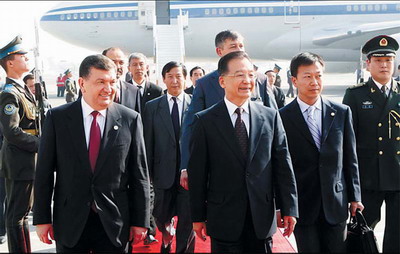 Premier Wen
Jiabao arrives in Tashkent, capital of Uzbekistan, to start his two-day official
visit to the country November 2, 2007. Wen also attended the Sixth Meeting of
Prime Ministers of the Member States of the SCO on Friday. Premier Wen
Jiabao arrives in Tashkent, capital of Uzbekistan, to start his two-day official
visit to the country November 2, 2007. Wen also attended the Sixth Meeting of
Prime Ministers of the Member States of the SCO on Friday.
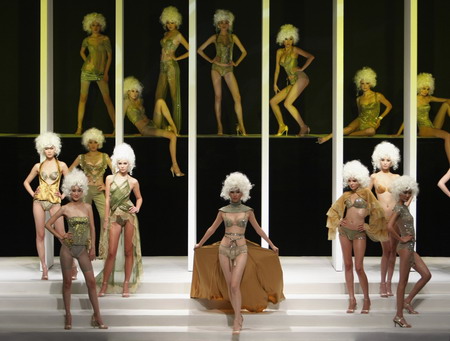 Models present
creations for the Aimer Spring/Summer 2008 lingerie trend show at China Fashion
Week in Beijing November 2, 2007. Models present
creations for the Aimer Spring/Summer 2008 lingerie trend show at China Fashion
Week in Beijing November 2, 2007.
 An old man
in Wenlin, Zhejiang Province, displays his medical insurance card. China has
promised to cover all rural residents with basic medicare by 2010. An old man
in Wenlin, Zhejiang Province, displays his medical insurance card. China has
promised to cover all rural residents with basic medicare by 2010.
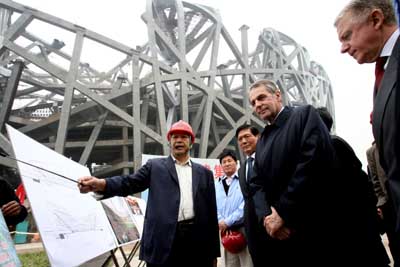 The air pollution
situation at the Beijing Olympics will be "perfectly manageable," International
Olympic Committee president Jacques Rogge said. Just last week, IOC inspection
team leader Hein Verbruggen called air quality in the city "a big problem." "The
Chinese are doing everything they can to alleviate that," Rogge said in New
York. "We believe that what they are doing now will yield good results by August
of next year." Rogge said he expected that measures taken by China will make a
major difference. Those actions include converting power plants from coal to
natural gas, planting millions of trees, and reducing the number of cars driving
in the city by about one million and slowing down the production of some
manufacturing plants during the Games. The IOC is setting up more than 20 test
sites around Beijing that will measure air quality, Rogge said. Readings taken
overnight will allow officials to make a decision each morning on whether to
postpone the outdoor endurance events that would be most affected by pollution.
Rogge played down the significance of postponing events, noting that weather
conditions long have forced changes in the schedule, from fog preempting
downhill skiing to heat delaying the marathon. "This is not something
exceptional," he said. Rogge also said he was heartened by recent comments from
World Anti- Doping Agency chief Dick Pound praising China's progress in reining
in its once-notorious doping problems. "I believe that the Chinese are far too
intelligent to indulge in doping because they want to have the best possible
games," Rogge said. The air pollution
situation at the Beijing Olympics will be "perfectly manageable," International
Olympic Committee president Jacques Rogge said. Just last week, IOC inspection
team leader Hein Verbruggen called air quality in the city "a big problem." "The
Chinese are doing everything they can to alleviate that," Rogge said in New
York. "We believe that what they are doing now will yield good results by August
of next year." Rogge said he expected that measures taken by China will make a
major difference. Those actions include converting power plants from coal to
natural gas, planting millions of trees, and reducing the number of cars driving
in the city by about one million and slowing down the production of some
manufacturing plants during the Games. The IOC is setting up more than 20 test
sites around Beijing that will measure air quality, Rogge said. Readings taken
overnight will allow officials to make a decision each morning on whether to
postpone the outdoor endurance events that would be most affected by pollution.
Rogge played down the significance of postponing events, noting that weather
conditions long have forced changes in the schedule, from fog preempting
downhill skiing to heat delaying the marathon. "This is not something
exceptional," he said. Rogge also said he was heartened by recent comments from
World Anti- Doping Agency chief Dick Pound praising China's progress in reining
in its once-notorious doping problems. "I believe that the Chinese are far too
intelligent to indulge in doping because they want to have the best possible
games," Rogge said.
November 5, 2007
Hong Kong:
Chengtian Entertainment Group paid HK$202 million for a 24.78 percent stake in
Golden Harvest Group, becoming the first mainland firm to acquire a major
interest in a Hong Kong-listed company.
 A bid to turn a
Hong Kong-made and designed T-shirt into a fashion icon for local youths has run
foul of the law with the arrest of 18 people from a local chain store yesterday.
Police said the design on the T-shirts marketed by Goods of Desire - or G.O.D.
as the store is popularly known - was linked to a triad society and that those
who purchased them could also be arrested. Possessing triad products is a
violation of the law and people wearing a shirt with such logos will be
arrested, Organized Crime Triad Bureau Acting Superintendent Cheng Fuk-chuen
warned. Police confiscated 88 T-shirts and more than 500 postcards printed with
a "14K" logo, "? x K"- with the numbers written in Chinese characters - from the
store's five offices and warehouse located in Central, Causeway Bay, Tsim Sha
Tsui and Yuen Long. They arrested nine men and nine women, including
salespersons and designers, aged between 21 and 51. It is believed one of those
arrested is the store's founder, Douglas Young Chi-chiu, who is a grandson of
Kowloon Motor Bus founder William Louey Sui-tak. They are suspected of
contravening the Societies Ordinance, which refers to slogans, published
materials and objects with symbolic meanings, and which police specialists have
confirmed to be related to the triads. The police raid followed a recent media
report on products the store was selling. A bid to turn a
Hong Kong-made and designed T-shirt into a fashion icon for local youths has run
foul of the law with the arrest of 18 people from a local chain store yesterday.
Police said the design on the T-shirts marketed by Goods of Desire - or G.O.D.
as the store is popularly known - was linked to a triad society and that those
who purchased them could also be arrested. Possessing triad products is a
violation of the law and people wearing a shirt with such logos will be
arrested, Organized Crime Triad Bureau Acting Superintendent Cheng Fuk-chuen
warned. Police confiscated 88 T-shirts and more than 500 postcards printed with
a "14K" logo, "? x K"- with the numbers written in Chinese characters - from the
store's five offices and warehouse located in Central, Causeway Bay, Tsim Sha
Tsui and Yuen Long. They arrested nine men and nine women, including
salespersons and designers, aged between 21 and 51. It is believed one of those
arrested is the store's founder, Douglas Young Chi-chiu, who is a grandson of
Kowloon Motor Bus founder William Louey Sui-tak. They are suspected of
contravening the Societies Ordinance, which refers to slogans, published
materials and objects with symbolic meanings, and which police specialists have
confirmed to be related to the triads. The police raid followed a recent media
report on products the store was selling.
Hong Kong banks lowered their prime
interest rate by 25 basis points yesterday, following a similar move by the Hong
Kong Monetary Authority after the US Federal Reserve cut the benchmark interest
rate by 25 basis points to 4.5 percent.
Hong Kong's financial regulator
insisted yesterday it has no intention of changing the "well- functioning"
fixed-exchange rate mechanism that has served the city for more than two
decades.
The bullish stock market could have
a negative impact on companies as more and more employees are giving up their
jobs to become full-time stock investors, a senior member of the Hong Kong
Institute of Human Resource Management warned yesterday.
 Hong Kong/China Talks this year on next phase of CEPA pact
- Discussion on the next phase of the free-trade pact signed four years ago
between Hong Kong and the central government will begin by the end of the year,
a senior Hong Kong trade official said yesterday. Yvonne Choi Ying-pik, the
permanent secretary for commerce and economic development, said the focus of the
next phase of the Closer Economic Partnership Arrangement (Cepa) would be on
implementing provisions agreed earlier, such as ways to simplify and standardize
procedures. Speaking after a seminar on Cepa organized by the Hong Kong Economic
and Trade Affairs Office in Shanghai, Miss Choi said the government would
discuss its next phase with representatives of Hong Kong's business community
this month. "We will listen to the business community's views on Cepa and we
hope they will tell us their views and the problems they come across so we can
reflect these to Beijing," she said. "At times, local governments have their own
rules which Hong Kong businesses must meet on top of requirements Cepa lays
down." A fourth supplementary to the original agreement, dubbed Cepa V, was
signed in June. Its provisions will be implemented from January 1. They cover 38
services sectors, 11 of them for the first time. Chan Wai-kwan, a senior
director of the Hong Kong General Chamber of Commerce, said it was time both
sides worked on the implementation aspect of the free-trade agreement. "To make
Cepa work better, the governments have to strengthen the investment facilitation
part of the agreement, such as setting up some special working groups which will
meet often to monitor implementation." The chamber says local protectionism,
such as the levying of local taxes, demands for additional documents, lengthy
licensing procedures and differing interpretations of rules by different
agencies were barriers to trade confronting Hong Kong businesses and
professionals. Last month, Hong Kong doctors complained they were caught up in
red tape when they tried to launch practices on the mainland. Cepa V allows Hong
Kong doctors qualified on the mainland to launch solo practices there, and
halves the sum required for investment in joint-venture medical practices. But
the doctors found they could not get professional indemnity insurance on the
mainland.
Hong Kong/China Talks this year on next phase of CEPA pact
- Discussion on the next phase of the free-trade pact signed four years ago
between Hong Kong and the central government will begin by the end of the year,
a senior Hong Kong trade official said yesterday. Yvonne Choi Ying-pik, the
permanent secretary for commerce and economic development, said the focus of the
next phase of the Closer Economic Partnership Arrangement (Cepa) would be on
implementing provisions agreed earlier, such as ways to simplify and standardize
procedures. Speaking after a seminar on Cepa organized by the Hong Kong Economic
and Trade Affairs Office in Shanghai, Miss Choi said the government would
discuss its next phase with representatives of Hong Kong's business community
this month. "We will listen to the business community's views on Cepa and we
hope they will tell us their views and the problems they come across so we can
reflect these to Beijing," she said. "At times, local governments have their own
rules which Hong Kong businesses must meet on top of requirements Cepa lays
down." A fourth supplementary to the original agreement, dubbed Cepa V, was
signed in June. Its provisions will be implemented from January 1. They cover 38
services sectors, 11 of them for the first time. Chan Wai-kwan, a senior
director of the Hong Kong General Chamber of Commerce, said it was time both
sides worked on the implementation aspect of the free-trade agreement. "To make
Cepa work better, the governments have to strengthen the investment facilitation
part of the agreement, such as setting up some special working groups which will
meet often to monitor implementation." The chamber says local protectionism,
such as the levying of local taxes, demands for additional documents, lengthy
licensing procedures and differing interpretations of rules by different
agencies were barriers to trade confronting Hong Kong businesses and
professionals. Last month, Hong Kong doctors complained they were caught up in
red tape when they tried to launch practices on the mainland. Cepa V allows Hong
Kong doctors qualified on the mainland to launch solo practices there, and
halves the sum required for investment in joint-venture medical practices. But
the doctors found they could not get professional indemnity insurance on the
mainland.
 Chief Executive Donald Tsang Yam-kuen is planning to lead a delegation to the
Middle East to promote Hong Kong as a centre for Islamic finance. In his policy
address last month, Mr Tsang envisaged the city tapping into the huge market for
non-interest-paying Islamic bonds. "It's an enormous market and I think Hong
Kong can perform a very important role, particularly for the Islamic community
because of our peaceful environment, with our religious equality here, with
hardly any ethnic tension. "This is an area which should be of great attraction
to Islamic countries that want to diversify their investment portfolio beyond
London and New York," Mr Tsang told an Association of Banks lunch. There was a
need to reinforce Hong Kong's role as a global financial centre in Asia, Mr
Tsang said. While the city should focus on complementing the mainland's
development, it should not neglect new opportunities such as the Islamic
financial sector, which Mr Tsang said was worth US$700 billion to US$1 trillion
and was expected to grow by 15 per cent annually. Hong Kong's focus would be on
the Islamic bond market, he said. Details of the trip early next year have yet
to be worked out but it is likely to include representatives from the business
sector. It will be the first business delegation to the Middle East led by a
chief executive since Tung Chee-hwa led one to Israel in 1999. In the same year
Mr Tsang, who was then financial secretary, led an investment mission to Dubai.
Mr Tsang said Hong Kong, Shanghai, Shenzhen and Tianjin had complementary roles
in developing China. "All of us are in a complementary and reinforcement role,
helping our country grow into an economic superpower in the coming decade," he
said. "For a country with an enormous economy like China, we definitely need
more than one centre. But as far as an international financial centre is
concerned, this is a different matter. "I do believe Hong Kong will continue to
be the premier international financial centre in our time zone." The chief
executive also said the government would issue a white paper in 2009 on
corporate governance.
Chief Executive Donald Tsang Yam-kuen is planning to lead a delegation to the
Middle East to promote Hong Kong as a centre for Islamic finance. In his policy
address last month, Mr Tsang envisaged the city tapping into the huge market for
non-interest-paying Islamic bonds. "It's an enormous market and I think Hong
Kong can perform a very important role, particularly for the Islamic community
because of our peaceful environment, with our religious equality here, with
hardly any ethnic tension. "This is an area which should be of great attraction
to Islamic countries that want to diversify their investment portfolio beyond
London and New York," Mr Tsang told an Association of Banks lunch. There was a
need to reinforce Hong Kong's role as a global financial centre in Asia, Mr
Tsang said. While the city should focus on complementing the mainland's
development, it should not neglect new opportunities such as the Islamic
financial sector, which Mr Tsang said was worth US$700 billion to US$1 trillion
and was expected to grow by 15 per cent annually. Hong Kong's focus would be on
the Islamic bond market, he said. Details of the trip early next year have yet
to be worked out but it is likely to include representatives from the business
sector. It will be the first business delegation to the Middle East led by a
chief executive since Tung Chee-hwa led one to Israel in 1999. In the same year
Mr Tsang, who was then financial secretary, led an investment mission to Dubai.
Mr Tsang said Hong Kong, Shanghai, Shenzhen and Tianjin had complementary roles
in developing China. "All of us are in a complementary and reinforcement role,
helping our country grow into an economic superpower in the coming decade," he
said. "For a country with an enormous economy like China, we definitely need
more than one centre. But as far as an international financial centre is
concerned, this is a different matter. "I do believe Hong Kong will continue to
be the premier international financial centre in our time zone." The chief
executive also said the government would issue a white paper in 2009 on
corporate governance.
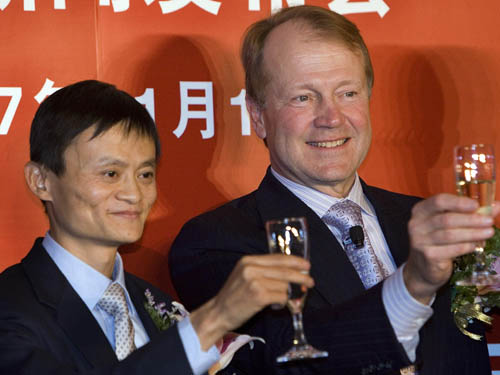 Cisco
Systems, the world's largest networking equipment manufacturer, will invest
about US$16 billion in the mainland over the next five years, marking its
biggest investment program outside the United States. John Chambers, chairman
and chief executive, said the investment strategy included an expansion in
mainland-sourced components and services, education, customer financing,
research and development, sales and service operations, and other direct and
indirect investments. Cisco yesterday also established a broader partnership
with Alibaba Group, the mainland's largest business-to-business portal operator,
after agreeing to invest US$17.5 million in Alibaba.com (SEHK: 1688,
announcements, news) , a subsidiary of the group, as part of its initial public
offering on the Hong Kong stock exchange. "Our [new investment] commitment will
lay the foundation for the next chapter in Cisco's development in China," said
Mr Chambers. Cisco's aggressive spending is expected to help grow business
across new markets in the mainland where it competes with other multinational
networking gear suppliers and homegrown rivals Huawei Technologies and ZTE Corp
(SEHK: 0763). "Today's announcements underscore both China's strategic
importance to Cisco's global operations and the broad range of growth
opportunities presented by the market, particularly as an innovator in the next
wave of the internet's development in collaboration and Web 2.0 technologies,"
Mr Chambers said. The total value of Cisco's investments in the mainland since
2002 is about US$8.5 billion. According to the company's estimates, it has
purchased more than US$7 billion of components and services in the mainland over
the last five years, making the country a big part of its manufacturing supply
chain. Mr Chambers claimed Cisco's mainland procurement helped provide
employment to 50,000 people who work with its contract manufacturers and
supplier partners, and as managers overseeing production. Yesterday's memorandum
of understanding with Hangzhou-based Alibaba Group entailed co-operating in
marketing business-management software and services to small and medium-sized
businesses in the mainland and overseas. The two companies jointly will market
internet-based collaboration applications from WebEx, a company acquired by
Cisco for US$3.2 billion in March this year and develop online
subscription-based software-as-a-service capabilities. "China is entering a
golden era for enterprise software services and collaborating with Cisco will
help us meet our goal of bringing world-class technology to China's businesses,"
said Jack Ma, chairman and chief executive of Alibaba Group. Cisco is one of
eight cornerstone investors in Alibaba.com's listing in Hong Kong. Over the past
several years, it has spent more than US$700 million in both direct and indirect
private-equity investments in the mainland. Start-ups that have benefited
included gaming firm Shanda, e-learning company Ambow and managed services
provider China Communications Services Corp. Cisco yesterday also signed an
agreement with the State Council-backed policy lender, China Development Bank,
for a joint programme to invest in domestic firms in various sectors including
information technology and communications, education, healthcare and
eco-friendly technologies. Cisco will provide about US$400 million for its Cisco
Capital China business unit to help finance customer purchases over the next
five years. It has financed more than US$60 million in customer assets since
June last year. The company will also fund the establishment of 300 vocational
colleges, in co-operation with the Ministry of Education, mostly in the
mainland's central and western provinces. The company has already set up more
than 200 so-called Networking Academies in 70 cities across the mainland. During
the next five years, Cisco will create its first global "green" technology
centre on the mainland, with an eye to address the need for energy efficiency,
reduction of electronic waste and reduction of greenhouse gas emissions in the
country. Cisco
Systems, the world's largest networking equipment manufacturer, will invest
about US$16 billion in the mainland over the next five years, marking its
biggest investment program outside the United States. John Chambers, chairman
and chief executive, said the investment strategy included an expansion in
mainland-sourced components and services, education, customer financing,
research and development, sales and service operations, and other direct and
indirect investments. Cisco yesterday also established a broader partnership
with Alibaba Group, the mainland's largest business-to-business portal operator,
after agreeing to invest US$17.5 million in Alibaba.com (SEHK: 1688,
announcements, news) , a subsidiary of the group, as part of its initial public
offering on the Hong Kong stock exchange. "Our [new investment] commitment will
lay the foundation for the next chapter in Cisco's development in China," said
Mr Chambers. Cisco's aggressive spending is expected to help grow business
across new markets in the mainland where it competes with other multinational
networking gear suppliers and homegrown rivals Huawei Technologies and ZTE Corp
(SEHK: 0763). "Today's announcements underscore both China's strategic
importance to Cisco's global operations and the broad range of growth
opportunities presented by the market, particularly as an innovator in the next
wave of the internet's development in collaboration and Web 2.0 technologies,"
Mr Chambers said. The total value of Cisco's investments in the mainland since
2002 is about US$8.5 billion. According to the company's estimates, it has
purchased more than US$7 billion of components and services in the mainland over
the last five years, making the country a big part of its manufacturing supply
chain. Mr Chambers claimed Cisco's mainland procurement helped provide
employment to 50,000 people who work with its contract manufacturers and
supplier partners, and as managers overseeing production. Yesterday's memorandum
of understanding with Hangzhou-based Alibaba Group entailed co-operating in
marketing business-management software and services to small and medium-sized
businesses in the mainland and overseas. The two companies jointly will market
internet-based collaboration applications from WebEx, a company acquired by
Cisco for US$3.2 billion in March this year and develop online
subscription-based software-as-a-service capabilities. "China is entering a
golden era for enterprise software services and collaborating with Cisco will
help us meet our goal of bringing world-class technology to China's businesses,"
said Jack Ma, chairman and chief executive of Alibaba Group. Cisco is one of
eight cornerstone investors in Alibaba.com's listing in Hong Kong. Over the past
several years, it has spent more than US$700 million in both direct and indirect
private-equity investments in the mainland. Start-ups that have benefited
included gaming firm Shanda, e-learning company Ambow and managed services
provider China Communications Services Corp. Cisco yesterday also signed an
agreement with the State Council-backed policy lender, China Development Bank,
for a joint programme to invest in domestic firms in various sectors including
information technology and communications, education, healthcare and
eco-friendly technologies. Cisco will provide about US$400 million for its Cisco
Capital China business unit to help finance customer purchases over the next
five years. It has financed more than US$60 million in customer assets since
June last year. The company will also fund the establishment of 300 vocational
colleges, in co-operation with the Ministry of Education, mostly in the
mainland's central and western provinces. The company has already set up more
than 200 so-called Networking Academies in 70 cities across the mainland. During
the next five years, Cisco will create its first global "green" technology
centre on the mainland, with an eye to address the need for energy efficiency,
reduction of electronic waste and reduction of greenhouse gas emissions in the
country.
Hong Kong’s
broadcast industry would be able to completely move over from analogue to
digital terrestrial television (DTT) broadcasting by 2012, Financial Secretary
John Tsang Chun-wah said on Wednesday. “The government is working closely with
the two local terrestrial broadcasters, [Asia Television] and [Television
Broadcasts (SEHK: 0511)], as well as TV equipment manufacturing and trading
industry as well as the community to ensure a smooth transition,” Mr Tsang told
the opening ceremony of the Cable and Satellite Broadcasting Association of Asia
(CASBAA) Convention. “We announced plans to switch to DTT back in 2004 and the
local broadcasters have been ironing out ever since details and upgrading
equipment to deal with the switch-over,” he explained. Mr Tsang said the success
of the project depended on co-operation from all stakeholders – consumers,
broadcasters and electronics industry and the government. But the financial
secretary said the emergence of new media also brought new challenges for the
industry. He suggested introducing tighter regulations. “Apart from making
sustained efforts in law enforcement and public education, we seek to keep our
copyright law under regular review to ensure that it is completely up to date.
“The next item on our agenda is how best to enhance copyright protection in the
digital environment,” Mr Tsang said.
China:
Trade between China and Russia surged to 34.9 billion U.S. dollars in the first
nine months, up 42 percent from the same period last year, according to China's
Ministry of Commerce (MOC).
China's major stock index dropped
2.3 percent on the week's last trading day with the Shanghai Composite Index
closed at 5,777.8 points.
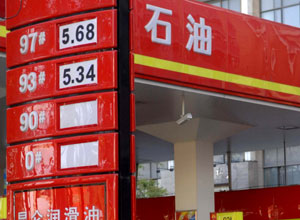 The market price of 93 octane
and 97 octane petrol rose, respectively, to 5.34 yuan (RMB) and 5.68 yuan(RMB)
from 4.90 yuan and 5.22 yuan. The market price of 93 octane
and 97 octane petrol rose, respectively, to 5.34 yuan (RMB) and 5.68 yuan(RMB)
from 4.90 yuan and 5.22 yuan.
The resignation of HNA Group's
chairman has caused some to speculate that Hainan Airlines Co, China's fourth
largest carrier, may quit the stock market. Hainan Airlines is parented by HNA.
Chen Feng resigned from the HNA board, Hainan Airlines Co said in a statement
filed to the Shanghai Stock Exchange yesterday. Chairman secretary Zhang
Shanghui said Chen has accepted a position as chairman of Grand China Air. Chen
said earlier HNA's restructuring plan was approved by the General Administration
of Civil Aviation and the group is likely to complete the restructuring by the
end of the year. The restructuring will create a flagship carrier, Grand China
Air, a combination of four of HNA's major airlines - Hainan Airlines, Xinhua
Airlines, Shanxi Airlines and Changan Airlines. Grand China Air is seeking
overseas listing next year. The Hainan government is the largest shareholder in
Grand China Air with a 48.61 percent stake. Financer George Soros holds 18.64
percent, and HNA and its subsidiaries own the remainder. It is still unknown if
the launch of Grand China Air will lead to Hainan Airlines Co's market exit,
according to an HNA Group source. Although HNA said Chen's departure would not
affect the group, it still drew attention to Hainan Airlines' shares. In June
2006, Grand China bought 1.65 billion of Hainan Airlines’ newly issued 2.8
billion shares, accounting for 46.7 percent of the enlarged capital Hainan
Airlines raised 5.6 billion yuan (US$750 million) through issuing the shares and
Grand China became the controlling shareholder. As of October 31, the five
airlines listed on the domestic stock markets had all released their
third-quarter results. Hainan Airlines ranked fourth, with earnings per share of
0.119 yuan and lagging far behind the top three.
More than 700 toy factories in
southern China have been banned from exporting what they produce as part of a
crackdown on shoddy products, the government said yesterday.
China's rural health-care system is
highly inefficient and government investment has done little to improve it,
according to World Health Organization director general Margaret Chan Fung Fu-chun.
General Motors on Monday announced
it would set up a US$250 million (HK$1.95 billion) alternative-fuel research
centre in Shanghai amid efforts by global vehicle makers to produce commercially
viable alternatives to petrol engines.
China Vanke, the mainland's largest
listed developer, warns that record high prices in recent land auctions pose
risk to the economy as they may drive up home prices further.
November 3- 4, 2007
Hong Kong:
"Infernal Affairs" director Andrew Lau Wai-kung and leading Hong Kong studio
Media Asia have reteamed to produce big-budget Chinese-language actioner "Water
Margin." Pic is an adaptation of one of China's four classic novels and sees 108
outlaws form a resistance movement to oppose the feudal king. Story was
previously made as a movie by Shaw Bros. and helmer Chang Cheh and had been
adapted for TV and as a comicbook. "This is a story that everyone in China knows
well," Lau said. "We (see) this as a three-part franchise with me directing the
first movie and Johnnie To doing the second and me acting as producer." Budget
is pegged at some HK$2 billion ($250 million) for the trilogy. Media Asia has
financed development, costume and weapon design and scouting to date, and is in
talks with mainland China's China Film Group as co-financier. Lau, one of the
rare Hong Kong directors comfortable with large-scale studio shoots, intends the
pic to be one of the first to make use of the new 16-stage studio complex that
CFG is building at Huairou, near Beijing. Lau, who recently signed a Hong Kong
representation and production deal with Media Asia, is also readying three
Asian-themed, English-language movies at Qi. Shingle is a U.S. company owned
jointly with "24" producer Tony Krantz, which has a multipicture deal with the
Weinstein Co. As well as the "Infernal Affairs" trilogy, which were co-helmed
with Alan Mak, Lau previously directed both "Confession of Pain" and hit street
race movie "Initial D" for Media Asia. Helmer may appear on U.S. screens sooner
than that. "The Flock," a drama he made for Bauer-Martinez that was held up by
disagreements over cut, has now been finished by its star Richard Gere. Lau said
pic will likely be released in December.
 Revellers dressed as ghosts celebrate
Halloween at Lan Kwai Fong, one of the most famous destinations for tourists in
Hong Kong, south China, Oct. 31, 2007. Revellers dressed as ghosts celebrate
Halloween at Lan Kwai Fong, one of the most famous destinations for tourists in
Hong Kong, south China, Oct. 31, 2007.
 The Hong Kong Monetary
Authority sold HK$7.828 billion in Hong Kong dollars to purchase US dollars five
times yesterday to defend the fixed exchange rate. This is more than 10 times
higher than the injections of HK$755 million each during two previous
interventions. But economists said the Hong Kong dollar will continue to press
closer to the higher end of the trading band. The HKMA stepped in first in the
afternoon, plowing in HK$3.1 billion, followed closely by two injections of
HK$775 million. It injected a further HK$1.55 billion and HK$1.628 billion - all
in less than four hours. The aggregate credit balance in the HKMA's account is
expected to climb to HK$10.619 billion tomorrow. "The Hong Kong dollar was
around the strong-side limit of its trading band last week. "HKMA has to defend
the dollar peg and stop it from appreciating beyond the band," Citi senior
economist Joe Lo said. Hang Seng Bank (0011) deputy general manager Andrew Fung
Hau-chung attributed the currency's strength to the robust stock market,
particularly major initial public offerings. "Alibaba's IPO lured massive funds
to the local bourse. As institutional investors need to buy Hong Kong dollars to
subscribe for the IPO, there is strong demand for the local currency," Fung
said. Meanwhile, an economist said speculators trying to test the limit of the
peg were partly responsible for the gains in the Hong Kong dollar. The Hong Kong Monetary
Authority sold HK$7.828 billion in Hong Kong dollars to purchase US dollars five
times yesterday to defend the fixed exchange rate. This is more than 10 times
higher than the injections of HK$755 million each during two previous
interventions. But economists said the Hong Kong dollar will continue to press
closer to the higher end of the trading band. The HKMA stepped in first in the
afternoon, plowing in HK$3.1 billion, followed closely by two injections of
HK$775 million. It injected a further HK$1.55 billion and HK$1.628 billion - all
in less than four hours. The aggregate credit balance in the HKMA's account is
expected to climb to HK$10.619 billion tomorrow. "The Hong Kong dollar was
around the strong-side limit of its trading band last week. "HKMA has to defend
the dollar peg and stop it from appreciating beyond the band," Citi senior
economist Joe Lo said. Hang Seng Bank (0011) deputy general manager Andrew Fung
Hau-chung attributed the currency's strength to the robust stock market,
particularly major initial public offerings. "Alibaba's IPO lured massive funds
to the local bourse. As institutional investors need to buy Hong Kong dollars to
subscribe for the IPO, there is strong demand for the local currency," Fung
said. Meanwhile, an economist said speculators trying to test the limit of the
peg were partly responsible for the gains in the Hong Kong dollar.
 Chipmaker
Semiconductor Manufacturing International Corp (0981) plans to reduce capital
expenditure for fiscal 2008 from US$700 million (HK$5.46 billion) in the 2007
financial year, faced with sharp falls in prices for memory chips used in
computers. "We expect the DRAM business to report a loss of US$20 million to
US$30 million in the fourth quarter, which will offset the net profit in the
logic business. So we will still see some losses in the fourth quarter," said
SMIC chief executive Richard Chang Ru-gin, in an online conference call
yesterday. Capex for the third quarter ended September 30 was US$139 million.
SMIC also plans to increase production capacity for non-DRAM- related (dynamic
random access memory) products. It will scale down the computer-memory chip
business. Company secretary and Hong Kong representative Anne Chen Wai-yui said
yesterday that SMIC had been negatively affected by a dramatic drop in the price
of DRAM chips, from US$4 to as low as US$1 in the first quarter, adding that
such a steep fall had not been seen in 20 years. Chen said SMIC will place more
importance on higher-margin flash- memory products. DRAM chip sales accounted
for 23.6 percent of total revenue in the third quarter, down from 28.9 percent
in the previous quarter. "Cutting capital spending will help the company at
least in two ways," said Rick Hsu, an analyst at Nomura Securities. The
initiative would help improve pricing power, while reduction in spending will
give SMIC a high utilization rate. "The company is likely to see an improved
logic pricing trend next year, which should help to offset DRAM volatility," Hsu
said. Macquarie analyst Warren Lau said he does not expect "any improvement in
the future." SMIC yesterday reported a net loss of US$25.6 million for the three
months to September. Revenue was up by 4.4 percent to US$391.3 million, from
US$374.8 million in the second quarter. SMIC shares closed yesterday at 88 HK
cents, down 1.12 percent. Chipmaker
Semiconductor Manufacturing International Corp (0981) plans to reduce capital
expenditure for fiscal 2008 from US$700 million (HK$5.46 billion) in the 2007
financial year, faced with sharp falls in prices for memory chips used in
computers. "We expect the DRAM business to report a loss of US$20 million to
US$30 million in the fourth quarter, which will offset the net profit in the
logic business. So we will still see some losses in the fourth quarter," said
SMIC chief executive Richard Chang Ru-gin, in an online conference call
yesterday. Capex for the third quarter ended September 30 was US$139 million.
SMIC also plans to increase production capacity for non-DRAM- related (dynamic
random access memory) products. It will scale down the computer-memory chip
business. Company secretary and Hong Kong representative Anne Chen Wai-yui said
yesterday that SMIC had been negatively affected by a dramatic drop in the price
of DRAM chips, from US$4 to as low as US$1 in the first quarter, adding that
such a steep fall had not been seen in 20 years. Chen said SMIC will place more
importance on higher-margin flash- memory products. DRAM chip sales accounted
for 23.6 percent of total revenue in the third quarter, down from 28.9 percent
in the previous quarter. "Cutting capital spending will help the company at
least in two ways," said Rick Hsu, an analyst at Nomura Securities. The
initiative would help improve pricing power, while reduction in spending will
give SMIC a high utilization rate. "The company is likely to see an improved
logic pricing trend next year, which should help to offset DRAM volatility," Hsu
said. Macquarie analyst Warren Lau said he does not expect "any improvement in
the future." SMIC yesterday reported a net loss of US$25.6 million for the three
months to September. Revenue was up by 4.4 percent to US$391.3 million, from
US$374.8 million in the second quarter. SMIC shares closed yesterday at 88 HK
cents, down 1.12 percent.
Despite initial public offering darling Alibaba.com
already freezing HK$435 billion from retail investors, two other listing
candidates managed to attract at least HK$14.36 billion worth of margin orders
yesterday when they opened their retail books.
 The tussle for the multi-billion-dollar
estate of late Chinachem chairwoman Nina Wang Kung Yu-sum intensified yesterday
as fung shui master Tony Chan Chun-chuen applied to the High Court to appoint an
administrator for the tycoon's assets. The tussle for the multi-billion-dollar
estate of late Chinachem chairwoman Nina Wang Kung Yu-sum intensified yesterday
as fung shui master Tony Chan Chun-chuen applied to the High Court to appoint an
administrator for the tycoon's assets.
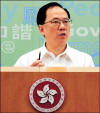 Hong Kong would become the first place in the world after the mainland to issue
yuan-denominated bonds in the coming year, Chief Executive Donald Tsang Yam-kuen
announced on Thursday. Mr Tsang was discussing potential growth areas during a
luncheon address for the Hong Kong Association of Banks. “Local banks will
continue to expand their operations in the mainland with some banks establishing
locally incorporated subsidiaries in the mainland – an important development in
the mainland’s banking sector,” he explained. Despite the current buoyant state
of the financial industry in Hong Kong, Mr Tsang stressed that “standing still
was not an option”. “To tap the massive liquidity in the mainland market, the
government will work to enhance Hong Kong’s intermediary role as more mainland
funds move off-shore – such as expanding the scope of [yuan] business”. The
chief executive added that to develop mainland-related businesses, the
government would have to look for opportunities in other markets. “Product
diversification is a key factor for success in the ever-changing financial
market. The Islamic financial sector has enormous potential and opportunities.
Globally, it is worth an estimated US$700 billion [HK$5.43 trillion] to US$1
trillion, and is expected to grow by 15 per cent annually,” he said. Middle
Eastern investors and issuers have become increasingly active in international
capital markets. This had resulted in many foreign banks, most of which have
offices in Hong Kong, to devote considerable resources in creating and servicing
a variety of Islamic financial products. But he added that in the pursuit of
market development, Hongkongers could not afford to lose sight of the need to
enhance corporate governance as “sustained development of the financial services
sector had to go hand-in-hand with effective corporate governance”.
Hong Kong would become the first place in the world after the mainland to issue
yuan-denominated bonds in the coming year, Chief Executive Donald Tsang Yam-kuen
announced on Thursday. Mr Tsang was discussing potential growth areas during a
luncheon address for the Hong Kong Association of Banks. “Local banks will
continue to expand their operations in the mainland with some banks establishing
locally incorporated subsidiaries in the mainland – an important development in
the mainland’s banking sector,” he explained. Despite the current buoyant state
of the financial industry in Hong Kong, Mr Tsang stressed that “standing still
was not an option”. “To tap the massive liquidity in the mainland market, the
government will work to enhance Hong Kong’s intermediary role as more mainland
funds move off-shore – such as expanding the scope of [yuan] business”. The
chief executive added that to develop mainland-related businesses, the
government would have to look for opportunities in other markets. “Product
diversification is a key factor for success in the ever-changing financial
market. The Islamic financial sector has enormous potential and opportunities.
Globally, it is worth an estimated US$700 billion [HK$5.43 trillion] to US$1
trillion, and is expected to grow by 15 per cent annually,” he said. Middle
Eastern investors and issuers have become increasingly active in international
capital markets. This had resulted in many foreign banks, most of which have
offices in Hong Kong, to devote considerable resources in creating and servicing
a variety of Islamic financial products. But he added that in the pursuit of
market development, Hongkongers could not afford to lose sight of the need to
enhance corporate governance as “sustained development of the financial services
sector had to go hand-in-hand with effective corporate governance”.
Lenovo Group (SEHK: 0992), battling
Taiwan’s Acer for the mantle of the world’s No3 PC maker, beat expectations with
a near tripling in quarterly earnings, thanks to robust global personal computer
demand and steady market share gains.
This marked the second-best quarterly performance since it bought IBM’s troubled
PC arm in 2005 for US$1.25 billion (HK$9.75 billion). Lenovo - one of a handful
of mainland firms trying to forge a global brand - retained its No3 perch with
8.2 per cent of worldwide shipments in the third quarter, while Acer followed
closely with an 8.1 per cent market share, according to IDC. But Acer may have
leap-frogged Lenovo after the Taiwanese PC behemoth bought United States rival
Gateway for US$710 million. The deal closed last month.
The volume of Hong Kong's retail
sales rose 13 per cent year-on-year in September, Census and Statistics
Department figures released on Thursday showed.
A spokesman for the department said: "After netting out the effect of price
changes over the same period, the revised estimate of the value of total retail
sales in August this year–estimated at HK$20.6 billion – increased by 15.2 per
cent over August last year, while the volume of total retail sales increased by
12.7 per cent," Total retail sales increased by 11.2 per cent in value over the
first nine months of this year together–with electrical goods and photographic
equipment sales volumes increasing the most (up 28.9 per cent). This was
followed by sales of jewellery, watches and clocks and valuable gifts (up 26.1
per cent in volume). Footwear, allied products and other clothing accessories
rose 23.0 per cent); furniture and fixtures (were up 11.5 per cent); apparel (up
10.6 per cent); commodities in supermarkets (up 7.3 per cent) and food,
alcoholic drinks and tobacco (up 5.5 per cent). The spokesman said the volume of
total retail sales in the third quarter of this year increased by 5.5 per cent
compared with the preceding quarter. "These retail sales statistics are
primarily intended to measure the sales receipts in respect of goods sold by
local retail establishments, for gauging the short-term business performance of
the local retail sector. "They cover consumer spending on goods but not on
services. Moreover, they include spending on goods by visitors in Hong Kong but
not by Hong Kong residents outside Hong Kong. Hence they should not be regarded
as a comprehensive indicator of overall consumer spending". The spokesman
pointed out that retail sales registered double-digit and broad-based growth in
September. "The consumer sentiment was upbeat, due to rising income and
improving job market as well as the buoyant stock market," the spokesman said.
He added that the strong performance of inbound tourism in September also
boosted retail sales and was optimistic that the "continuous robust growth of
tourism in the territory would continue to add support to retail business".
China:
Nearly 400,000 Taiwanese currently live on the Chinese mainland at the end of
September this year, including more than 18,000 who have settled down, according
to the Taiwan Affairs Office of the State Council, or cabinet. There are about
270,000 "cross-Strait marriages" made between people from the mainland and
Taiwan, said Dai Xiaofeng, director of the exchange bureau, part of the State
Council office. Up to the end of September, Taiwan people made more than 45.83
million visits to the mainland, and mainlanders made more than 1.56 million
visits to the island, said Dai in an exclusive interview with Xinhua. "More than
46 million visits to the mainland, twice the number of the Taiwan population --
23 million -- will be made by Taiwan people by the end of this year," Dai said,
adding 1.6 million visits to Taiwan would be made by people from the mainland.
The mainland-based Chengtian
Entertainment Group paid HK$202 million for a 24.78 percent stake in Golden
Harvest Group, becoming the first mainland company to acquire a major interest
in a Hong Kong-listed company. In a statement Thursday evening, Chengtian said
it bought the shares from Golden Harvest founder Reymond Chow and related
parties. On completion of transaction, Chengtian will become the single largest
shareholder in Golden harvest, well known for pioneering Kung-fu movies in the
70s and 80s. Golden Harvest's productions include box office hits such as Bruce
Lee's "Way of the Dragon" and Jackie Chan's "Police Story." It is also the first
Hong Kong film company to have established a presence in the US market.
Chengtian's founder and chairman Wu Kebo, said in the statement that combining
the respective the two companies will raise the group's film business to a
higher level. He said his group is planning to produce no less than 20 films a
year. Film distribution is one of Golden Harvest's core businesses. The company
is a major distributor of Chinese language films in Hong Kong via its Gala
cinema subsidiary. It also owns a film library with about 140 films for global
distribution. Chengtian Entertainment Group was founded in 2004. Avex Group
Holdings of Japan purchased a 20 percent stake in Septmber 2006. Chengtian
currently is engaged in film and television production and distribution, music
production, online music platform infrastructure, and artist management.
Lunar probe Chang'e I completed its fourth orbital transfer Wednesday afternoon,
a critical step in the journey to the moon. Thirteen minutes after the engine on
the probe was started at 5:15 pm, the probe was shifted to the Earth-moon
transfer orbit with an apogee of about 380,000 km. The main engine of Chang'e I
started operation and helped raise the speed to 10.916 km per second in the few
minutes before the satellite reached the "entrance" of the Earth-moon transfer
orbit, said Zhu Mincai, head of the Beijing Aerospace Control Center (BACC).
"It's a success-or-failure point and we have only one shot as the fuel carried
on the Chang'e I is limited," Zhu said earlier. "If the orbiter misses the
entrance, it will continue on the Earth orbit instead of flying to the moon."
The probe is estimated to fly another 114 hours before it reaches the moon orbit
on November 5, the next big moment in the fate of the country's first moon
orbiter, said Hao Xifan, deputy head of the Lunar Exploration Project office.
Chang'e I will brake for the first time when it arrives at a position 200 km
away from the moon - it will crash into the moon if the step is too late and may
float elsewhere in space if it is too early. "Once it is captured by lunar
gravitation, I'll be at ease," Hao said. "Before it enters the moon orbit, the
probe will be subject to two or three orbit corrections," said Sun Zezhou,
deputy chief designer of the satellite. Chang'e I was previously moving on a
48-hour orbit with an apogee of more than 120,000 km, which was raised from
70,000 km through a third orbital transfer on October 29. The probe completed
its first orbital change on October 25, which transferred the satellite to a
16-hour orbit with its perigee up from 200 km to 600 km. A second orbital
transfer was completed on October 26, which made the satellite move on a 24-hour
orbit with an apogee of 70,000 km, up from 50,000 km. The ultraviolet image
sensors installed on the orbiter began working on the morning of October 30 to
collect information on Earth and the moon. It is the first time that an
ultraviolet image sensor has been used on a satellite, though a few countries
had tested them on the ground, said Wang Yejun, chief engineer with the BACC.
Chang'e I, named after a legendary Chinese fairy who flew to the moon, was
launched on a Long March 3A carrier rocket last Wednesday from the Xichang
Satellite Launch Center in Sichuan Province.
Cisco Systems Inc, the world's
largest networking equipment maker, yesterday unveiled a US$16 billion expansion
plan to boost its presence in China, one of the world's most dynamic telecom
markets. The plan includes expanding its procurement, manufacturing and research
and development capacity, and increasing investment in China's education sector
and high-growth companies through its venture capital vehicle. "We are going to
the next chapter in China," said John Chambers, chairman and CEO of Cisco. "The
announcements underscore both China's strategic importance to Cisco's global
operations and the broad range of growth opportunities presented by the market."
The plan, following a pledged investment of US$1.16 billion in India on Tuesday,
underlines Cisco's increasing aggressiveness in cracking emerging markets. It
pledged a US$1.16 billion investment in India within two years. A large portion
of the US$16 billion in China would be spent on procurement, which totaled US$7
billion in the past five years. As part of the new initiative, Cisco said it
will spend US$17.5 million buying into China's top e-commerce firm Alibaba.com,
which is expected to launch an initial public offering in Hong Kong next
Tuesday. Cisco also signed a memorandum of understanding with China Development
Bank to set up a US$100 million program to provide capital and expertise for
high-growth Chinese companies. Cisco has invested more than US$700 million in
Chinese start-ups over the past few years. It also agreed to inject US$400
million into a wholly owned subsidiary in China that specializes in financing
and leasing services. The subsidiary, Cisco Systems Capital China, began
operation in 2006, aiming to provide financing facilities to Cisco's customers
in China. "We are now seeing more and more innovations coming for the market,"
said Chambers.
China will raise the prices of
gasoline, diesel oil and aviation kerosene by 500 yuan per ton, almost a 10
percent rise, starting from November 1.
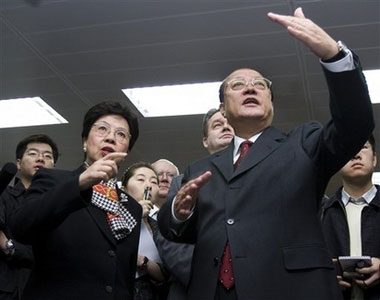 Li Changjiang (R), head of China's
General Administration of Quality Supervision, Inspection and Quarantine
(AQSIQ), shows the monitoring system on the foods processing and producing
facilities to World Health Organization Director-General Dr. Margaret Chan (L)
during her visit to the AQSIQ office in Beijing on Wednesday, October 31, 2007.
The WHO chief praised China's moves to crack down on food-safety problems as the
country stepped up efforts in recent months to clamp down on shoddy and
dangerous goods. Li Changjiang (R), head of China's
General Administration of Quality Supervision, Inspection and Quarantine
(AQSIQ), shows the monitoring system on the foods processing and producing
facilities to World Health Organization Director-General Dr. Margaret Chan (L)
during her visit to the AQSIQ office in Beijing on Wednesday, October 31, 2007.
The WHO chief praised China's moves to crack down on food-safety problems as the
country stepped up efforts in recent months to clamp down on shoddy and
dangerous goods.
China's current account surplus hit US$162.9 billion in
the first half, up from about US$90 billion in the same period of last year.
 As the wind
picks up, the temperature begins to drop. Autumn is the most beautiful season,
but it will disappear before people can fully appreciate it. So hurry up and
find time in your schedule so that you can go out for a day or two to enjoy the
fresh air. Time is short as it won't be long before the winter coldness sets in.
Here to save you time we picked several special spots in the suburbs of Beijing
and Shanghai to inspire you to go on an outing. As the wind
picks up, the temperature begins to drop. Autumn is the most beautiful season,
but it will disappear before people can fully appreciate it. So hurry up and
find time in your schedule so that you can go out for a day or two to enjoy the
fresh air. Time is short as it won't be long before the winter coldness sets in.
Here to save you time we picked several special spots in the suburbs of Beijing
and Shanghai to inspire you to go on an outing.
November 2, 2007
Hong Kong:
Hong Kong's entertainment districts
are looking to cash in on Halloween, which was once considered an expatriates-
only festival.
An institutional shareholder is
raising HK$390 million by selling Hang Lung Properties (0101) shares following a
HK$10.9 billion placement by Sun Hung Kai Properties (0016).
China's Social Security Fund raised
about HK$484 million by selling 68.73 million shares in Industrial and
Commercial Bank of China (1398) as it reportedly considers taking a minority
stake in a top private equity firm.
Hong Kong stocks continued
advancing Wednesday in a volatile session as gains in China plays boosted by
strong third-quarter earnings helped make up for losses triggered by
profit-taking in local property stocks.
Analysts said yesterday that a
potential sale of a stake in Italian mobile operator 3 Italia by parent
Hutchison Whampoa (0013) would be a positive move to help reduce the overhang on
the stock from the money-losing European mobile businesses.
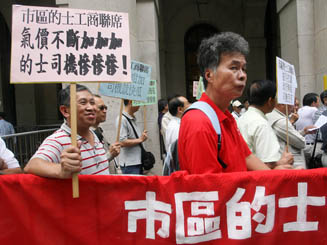 Lawmakers unanimously endorsed a motion
yesterday that urges the government to allow a fuel surcharge of HK$1 per trip
to the taxi trade as fuel prices hit historical highs.
Lawmakers unanimously endorsed a motion
yesterday that urges the government to allow a fuel surcharge of HK$1 per trip
to the taxi trade as fuel prices hit historical highs.
Asia-focused bank Standard Chartered planned to launch its
first mainland-China village bank early next year to tap the country’s growing
rural economy, sources close to the situation said on Wednesday. London-based
StanChart’s first village bank was expected to be based in Inner Mongolia, where
farming, mining and dairy were the three key contributors to the local economy,
said the sources, who declined to be identified. The central government is
trying to stimulate investment in the countryside to reduce a rising income gap
with the cities but most rural residents and businesses have great difficulty
accessing credit. “After study and research, the bank finds Inner Mongolia has
bigger market potential than other relatively poorer areas,” said one of the
sources. “Inner Mongolia has lots of booming private firms whose business in
particular support the development of local big firms, for example Yili and
Mengniu, which have really good substantial and continuous growth.” Mengniu
Dairy (SEHK: 2319) and its smaller rival Yili Industrial Group, which both have
their headquarters in Inner Mongolia, are China’s two biggest dairy product
makers. StanChart, an emerging markets specialist which won Beijing’s approval
for local incorporation this year in the long-restricted banking market, was
hiring managers and staff for the Inner Mongolia-based village bank, the sources
said. A StanChart spokeswoman said the bank was preparing for such a village
bank and was certainly interested in the mainland’s rural banking market, but
she declined to comment further. Since the end of last year, the China Banking
Regulatory Commission (CBRC) has been beefing up financial service reform in
rural areas, granting greater access for lenders in less developed Chinese areas
such as Qinghai, Gansu, Jilin and Inner Mongolia. In August, StanChart’s bigger
rival, HSBC (SEHK: 0005, announcements, news) Holding, launched a village bank
in the central province of Hubei after winning the first such bank licence given
to a foreign bank. Village banks are one of three kinds of new rural financial
institutions that regulators are cautiously encouraging - for example by
relaxing capital requirements. The sources declined to say how much StanChart
needed to invest in the village bank, although they said StanChart’s investment
would be similar to HSBC’s. HSBC invested just 10 million yuan as initial
capital in its village bank in Hubei province. “You don’t need to pay a lot for
such business as your loans to your clients in rural area will be very small,
such as 100,000 or 200,000 yuan,” another of the sources said. “But the market
is big and it is always good to do something that the regulator is encouraging.”
Last week, Zang Jingfan, a senior CBRC official said in Beijing that two more
foreign firms, Citigroup and Grameen Trust, were also preparing to take part in
village banking business in China.
The Hong Kong Monetary Authority dumped HK$6.2 billion to
buy US dollars on Wednesday, stepping up efforts to temper a strong HK dollar
that has clung stubbornly to the ceiling of its wafer-thin trading band. The
HKMA intervened four times in quick succession on Wednesday, selling HK$6.2
billion (US$800 million) over two hours as the domestic unit bumped up
repeatedly against its two-year old ceiling of 7.75 per US dollar in the
afternoon. Funds flowing into Hong Kong, plus quickening inflation as mainland
import costs rise, are stirring talk that the HKMA will have to drop a
quarter-century old peg against the US dollar, or at least widen the domestic
unit’s trading band. Fuelling the situation on Wednesday was demand for mainland
e-commerce firm Alibaba.com (SEHK: 1688, announcements, news) ’s HK$11.5 billion
initial public offering, which has tied up about HK$780 billion in orders from
institutions alone, and sustained inflows into Asia’s second-largest stock
market. Traders and analysts saw little pure speculative buying, while the
central bank reaffirmed its commitment to the peg.
China:
China's cabinet on Wednesday approved in principle a draft law on food safety to
address the "weak points" in food production, processing, delivery, storage and
sales.
 Models display
traditional Chinese Han costume during the 1st Chinese Top Model Awards in
Xuzhou, October 30, 2007. Models display
traditional Chinese Han costume during the 1st Chinese Top Model Awards in
Xuzhou, October 30, 2007.
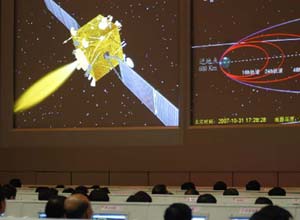 The engine on the
probe was started at 5:15 p.m.. Thirteen minutes later, the probe was
successfully shifted to the earth-moon transfer orbit with an apogee of about
380,000 km. The engine on the
probe was started at 5:15 p.m.. Thirteen minutes later, the probe was
successfully shifted to the earth-moon transfer orbit with an apogee of about
380,000 km.
 People gather
around new cars displayed at an auto show in Nanchang, East China's Jiangxi
Province, on October 22. Chinese brands account for 27% of total car sales in
the first three quarters. People gather
around new cars displayed at an auto show in Nanchang, East China's Jiangxi
Province, on October 22. Chinese brands account for 27% of total car sales in
the first three quarters.
Amid world crude oil prices hitting record levels, oil
giant China Petroleum & Chemical Corp (0386), or Sinopec, is expected to widen
losses in its core refining business in the fourth quarter.
Massive demand caused the Beijing
Olympic ticketing system to collapse yesterday as a second phase of sales for
people living in the mainland got under way, officials said.
French Foreign Minister Bernard
Kouchner held talks here on Wednesday with his Chinese counterpart Yang Jiechi,
opening a two-day trip to pave the way for President Nicolas Sarkozy's November
visit.
November 1, 2007
Hong Kong:
The 36th French Cinepanorama will be held from Dec. 7 to 16, the Alliance
Francaise of Hong Kong said Monday. The French Cinepanorama, a film festival
first launched in 1953,introduces to Hong Kong audience new French films. The
36th French Cinepanorama will offer 23 latest and hottest French movies, which
have been classified into three categories: New Films 2007, Reels Discovery and
Focus on French Film Noir. 'Passion Blows Up', the theme of the film festival
this year, throws the focus on the human passions for the cinema, life, romance
and other aspects. To Each His Own Cinema, the opening film of the 36th French
Cinepanorama, was produced for the celebration of the 60th anniversary of the
Cannes Festival this year, by 32 most distinguished directors from worldwide,
including Wong Kar-Wai of Hong Kong, Zhang Yimou and Chen Kaige of the Chinese
mainland, HouHsiao-Hsien and Tsai Ming-liang of Taiwan, Takeshi Kitario of
Japan, Roman Polanski of Poland and French directors Claude Lelouch, Olivier
Assayas and Raymond Depardon. Cannes 2007 award-winning film The Diving Bell and
the Butterfly, based on the memoir of former editor-in-chief of French fashion
magazine 'ELLE' Jean-Dominique Bauby, is chosen as one of the Gala Premiere
movies in the film festival. Other selections include science fiction movie
Chrysalis, typical French romance Twice Upon A Time, and Don't Touch the Axe by
famous New Wave director Jacques Rivette.
The Chinese mainland and Macao
Special Administrative Region (MSAR) signed a pact on Tuesday to make judgments
by each other's arbitration authorities mutually legal and enforceable. Huang
Songyou, vice president of the Supreme People' s Court, signed the arrangement
on reciprocal recognition and enforcement of arbitration judgment with Forinda
da Rosa Silva Chan, Secretary for Administration and Justice of MSAR. "This is
another example of progress in the field of judicial cooperation between the two
sides," Huang said. Economic relations between the mainland and Macao have been
much closer thanks to the Mainland and Macao Closer Economic Partnership
Arrangement signed in 2003. There have been increasing business conflicts
involved parties from both sides but no legal document covers judicial
cooperation on arbitration, Huang said. "Such a pact is in urgent need," he
said. The two sides started to talk about the pact in September 2006. According
to the agreement, the judgement made by the arbitration authorities in Macao is
legal in the mainland and vice versa. If a judgment made by the arbitration
authority in Macao involves properties in the mainland, it will be enforced
after the local court in the mainland accepts the application of enforcement and
vice versa, the agreement said. The agreement will be applied on all judgments
made after Dec. 20, 1999 when the MSAR was established. The mainland and Macao
have signed several judicial pacts, entrusting each other's courts to deliver
court orders and collect evidences for civil and commercial cases and mutually
recognizing and enforcing judgments in civil and commercial matters. "We expect
the pact to protect the legal interests and rights of people from both sides and
help maintain the long-term peace and prosperity of Macao," Huang said. The pact
will also lay the foundation for further judicial cooperation, he said. The
mainland has already signed similar pacts with Hong Kong Special Administrative
Region.
 Hong Kong taxi drivers
say they will be hard hit by record high world oil prices that will result in
them paying about 10 percent more to fill up at the pumps. Hong Kong taxi drivers
say they will be hard hit by record high world oil prices that will result in
them paying about 10 percent more to fill up at the pumps.
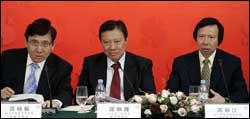 Sun Hung
Kai Properties (0016), controlled by the Kwok brothers, is placing shares worth
up to nearly HK$11.13 billion which analysts believe will be used to fund the
group's mainland expansion. The share placement to institutional investors was
made yesterday after the stock closed at a record HK$159.90. Goldman Sachs told
clients in an e-mail it is offering 72.5 million SHKP shares at HK$150.20 to
HK$153.50 apiece on behalf of the Kwoks' family- owned Vantage Captain Ltd. The
price range represents a 4 to 6 percent discount to yesterday's close. The sale
reduces the stake Vantage held in Hong Kong's largest developer by market
capitalization to 39.5 percent from 42.42 percent. In August, SHKP pledged to
invest HK$33 billion over the next three years in the mainland in an attempt to
catch up with other Hong Kong developers. SHKP had 45.8 million square feet of
mainland land at the end of June, far lagging the 195 million sq ft held by
Cheung Kong (Holdings) (0001). "The Kwok family might see little momentum of a
further surge in SHKPs share price," a market watcher said. The stock has soared
81.7 percent since August 17. "The market should be able to absorb the shares,
as nowadays we have a large trading volume of more than HK$100 billion a day,
said Kenny Tang Sing-hing, associate director at Tung Tai Securities. But First
Shanghai Securities strategist Linus Yip Sheung-chi said the placement "may be
an excuse for a correction in property stocks, as the market has more than
digested the good news, such as the rate cut." SHKP previously sold more than
HK$10 billion worth of existing and new shares in May last year to fund projects
such as the Shanghai IFC building, which is expected to be completed by 2011.
SHKP reported net profit of HK$21.2 billion, or HK$8.52 per share, for the year
to the end of June. Its current stock price represents 18.8 times earnings. Sun Hung
Kai Properties (0016), controlled by the Kwok brothers, is placing shares worth
up to nearly HK$11.13 billion which analysts believe will be used to fund the
group's mainland expansion. The share placement to institutional investors was
made yesterday after the stock closed at a record HK$159.90. Goldman Sachs told
clients in an e-mail it is offering 72.5 million SHKP shares at HK$150.20 to
HK$153.50 apiece on behalf of the Kwoks' family- owned Vantage Captain Ltd. The
price range represents a 4 to 6 percent discount to yesterday's close. The sale
reduces the stake Vantage held in Hong Kong's largest developer by market
capitalization to 39.5 percent from 42.42 percent. In August, SHKP pledged to
invest HK$33 billion over the next three years in the mainland in an attempt to
catch up with other Hong Kong developers. SHKP had 45.8 million square feet of
mainland land at the end of June, far lagging the 195 million sq ft held by
Cheung Kong (Holdings) (0001). "The Kwok family might see little momentum of a
further surge in SHKPs share price," a market watcher said. The stock has soared
81.7 percent since August 17. "The market should be able to absorb the shares,
as nowadays we have a large trading volume of more than HK$100 billion a day,
said Kenny Tang Sing-hing, associate director at Tung Tai Securities. But First
Shanghai Securities strategist Linus Yip Sheung-chi said the placement "may be
an excuse for a correction in property stocks, as the market has more than
digested the good news, such as the rate cut." SHKP previously sold more than
HK$10 billion worth of existing and new shares in May last year to fund projects
such as the Shanghai IFC building, which is expected to be completed by 2011.
SHKP reported net profit of HK$21.2 billion, or HK$8.52 per share, for the year
to the end of June. Its current stock price represents 18.8 times earnings.
 Gold prices soared to near a three-decade high yesterday on speculative buying
after the US dollar tumbled to a record low and geopolitical tension in the
Middle East pushed oil prices to a new record on fears of possible supply
disruptions.
Gold prices soared to near a three-decade high yesterday on speculative buying
after the US dollar tumbled to a record low and geopolitical tension in the
Middle East pushed oil prices to a new record on fears of possible supply
disruptions.
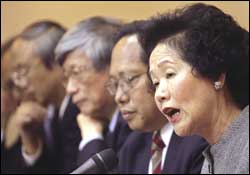 Legislative Council
hopeful Anson Chan Fang On-sang said yesterday the entry of more candidates for
the December 2 by-election would not affect the political showdown between her
and her main rival Regina Ip Lau Suk-yee. "As more and more contenders bid for
the Legco seat, the diversity in their platforms will not dilute my concerns in
this by-election. It is not a war between the democratic and the undemocratic,
it is a matter of addressing wide- ranging issues, such as livelihood issues and
the problematic extension of the political appointment system," the former chief
secretary for administration said. In an attempt to differentiate her policies
from Ip's, Chan declared for the first time she was withdrawing from her earlier
position that a delay in universal suffrage until 2016 and 2017 was acceptable,
as proposed by her core group in March. In unveiling her platform, she was
flanked by her core supporters of barristers and leaders of the Democratic Party
as well as the Civic Party. She also hoisted a banner calling for full democracy
by 2012. "The people of Hong Kong are ready for universal suffrage and I support
its implementation for the two elections in 2012 because the SAR government has
failed to put forward any convincing reason for delaying this step beyond that
date." Chan said while both Ip and she claimed to be democrats, a comparison of
election platforms would show Ip's proposal to be undemocratic, as Ip wants to
set up a screening mechanism for chief executive hopefuls, requiring them to get
10 percent support from each of the nomination committee's four sectors. Chan
said she was disturbed by the widening wealth gap and the growing number of
people living below the poverty line, which now totaled more than 1.1 million.
"Our society has become infatuated with the heated speculation in the stock
market with some people quitting their jobs in search of quick money. In fact
many people are suffering from poverty. The tragic events at Tin Shui Wai are
telling examples. I will pay more visits to slums, single-parent families and
low-income women to discuss their needs," she added. "I was also impressed with
the elderly people and the underprivileged who I recently met. If I were still
the chief secretary, I would visit the various districts weekly, something I did
not do in the past and which I left to my subordinates. It is really important
to reach out to discover the needs of the people," Chan said. Without mentioning
Martin Lee Chu-ming's Beijing Olympic Games saga, Chan tried to smooth over any
impact it may have on her campaign. "Some unrelated events have occurred over
the past few weeks, so I have to explain more about my election platform and
work harder," she said, adding: "The hustings are more demanding than I reckoned
... [but] I am now getting used to this experience." Legislative Council
hopeful Anson Chan Fang On-sang said yesterday the entry of more candidates for
the December 2 by-election would not affect the political showdown between her
and her main rival Regina Ip Lau Suk-yee. "As more and more contenders bid for
the Legco seat, the diversity in their platforms will not dilute my concerns in
this by-election. It is not a war between the democratic and the undemocratic,
it is a matter of addressing wide- ranging issues, such as livelihood issues and
the problematic extension of the political appointment system," the former chief
secretary for administration said. In an attempt to differentiate her policies
from Ip's, Chan declared for the first time she was withdrawing from her earlier
position that a delay in universal suffrage until 2016 and 2017 was acceptable,
as proposed by her core group in March. In unveiling her platform, she was
flanked by her core supporters of barristers and leaders of the Democratic Party
as well as the Civic Party. She also hoisted a banner calling for full democracy
by 2012. "The people of Hong Kong are ready for universal suffrage and I support
its implementation for the two elections in 2012 because the SAR government has
failed to put forward any convincing reason for delaying this step beyond that
date." Chan said while both Ip and she claimed to be democrats, a comparison of
election platforms would show Ip's proposal to be undemocratic, as Ip wants to
set up a screening mechanism for chief executive hopefuls, requiring them to get
10 percent support from each of the nomination committee's four sectors. Chan
said she was disturbed by the widening wealth gap and the growing number of
people living below the poverty line, which now totaled more than 1.1 million.
"Our society has become infatuated with the heated speculation in the stock
market with some people quitting their jobs in search of quick money. In fact
many people are suffering from poverty. The tragic events at Tin Shui Wai are
telling examples. I will pay more visits to slums, single-parent families and
low-income women to discuss their needs," she added. "I was also impressed with
the elderly people and the underprivileged who I recently met. If I were still
the chief secretary, I would visit the various districts weekly, something I did
not do in the past and which I left to my subordinates. It is really important
to reach out to discover the needs of the people," Chan said. Without mentioning
Martin Lee Chu-ming's Beijing Olympic Games saga, Chan tried to smooth over any
impact it may have on her campaign. "Some unrelated events have occurred over
the past few weeks, so I have to explain more about my election platform and
work harder," she said, adding: "The hustings are more demanding than I reckoned
... [but] I am now getting used to this experience."
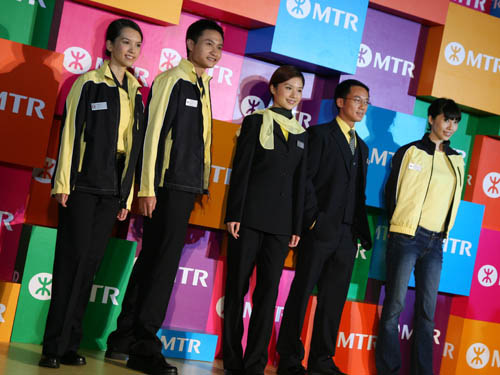 Passengers on the
merged railway being formed by the MTR Corp and the Kowloon-Canton Railway
Corporation will be attended to by staff decked out in new yellow and navy blue
uniforms. About half of the railway's 12,000 staff will don the new gear on the
merger day, December 2, while a further 3,500 will change later. The rest are
not getting new uniforms because they are not on public view. The clothing, the
work of veteran fashion designer William Tang Tat-chi, had a sharp look designed
to stand out on the platform or concourse while creating a customer-friendly
image, the railways said. Tang said travelling on the trains had helped him
choose the colors. "During my journeys, I found yellow is a very sharp color and
it looks more cosmopolitan, while most people accept navy blue, and dirt would
be less obvious." A spokesman said the new name, logo and route map would be
officially announced within weeks. Tang said he was approached last September.
Since then he had had as many as four meetings a month with up to 200 staff
representatives. He said it had been difficult to persuade some staff to accept
his ideas. "The security department wanted their uniform to give them a more
authoritative image, whereas the company wanted it to be customer-friendly. As I
expected, several people disliked the design but the whole process went
smoothly." Station managers, assistants, security guards and receptionists will
wear variations of the yellow-and-blue design. Maintenance staff will wear
khaki. On the rail network, only managers will wear ties with the company logo,
although ties will also be required for property management and shopping centre
staff, who will have an all-blue uniform. Tang said the uniforms would allow
staff to work comfortably and confidently. "I hope they won't think they are
wearing uniforms and won't have to change when going home after work," he said.
Maintenance worker Luk Chun-kit said the zipped pockets were ideal for tools,
while the trousers, made of an elastic fabric, would wear well. The company has
yet to announce its fare table. MTR Corp operations director Andrew McCusker
said it was "a complicated job". "We expect two weeks before December 2, we will
be able to come forward with the new fare table and the new fares," he said. Passengers on the
merged railway being formed by the MTR Corp and the Kowloon-Canton Railway
Corporation will be attended to by staff decked out in new yellow and navy blue
uniforms. About half of the railway's 12,000 staff will don the new gear on the
merger day, December 2, while a further 3,500 will change later. The rest are
not getting new uniforms because they are not on public view. The clothing, the
work of veteran fashion designer William Tang Tat-chi, had a sharp look designed
to stand out on the platform or concourse while creating a customer-friendly
image, the railways said. Tang said travelling on the trains had helped him
choose the colors. "During my journeys, I found yellow is a very sharp color and
it looks more cosmopolitan, while most people accept navy blue, and dirt would
be less obvious." A spokesman said the new name, logo and route map would be
officially announced within weeks. Tang said he was approached last September.
Since then he had had as many as four meetings a month with up to 200 staff
representatives. He said it had been difficult to persuade some staff to accept
his ideas. "The security department wanted their uniform to give them a more
authoritative image, whereas the company wanted it to be customer-friendly. As I
expected, several people disliked the design but the whole process went
smoothly." Station managers, assistants, security guards and receptionists will
wear variations of the yellow-and-blue design. Maintenance staff will wear
khaki. On the rail network, only managers will wear ties with the company logo,
although ties will also be required for property management and shopping centre
staff, who will have an all-blue uniform. Tang said the uniforms would allow
staff to work comfortably and confidently. "I hope they won't think they are
wearing uniforms and won't have to change when going home after work," he said.
Maintenance worker Luk Chun-kit said the zipped pockets were ideal for tools,
while the trousers, made of an elastic fabric, would wear well. The company has
yet to announce its fare table. MTR Corp operations director Andrew McCusker
said it was "a complicated job". "We expect two weeks before December 2, we will
be able to come forward with the new fare table and the new fares," he said.
Average salaries for managers and professionals in Hong
Kong rose 3.4 per cent in June compared with a year earlier, a government survey
released on Tuesday showed.
Corruption in Macau would worsen as triads increasingly
become part of mainstream society there, Asian security expert Steve Vickers
warned on Tuesday.
Mainland internet media firm Sohu.com late on Monday said
quarterly profit soared 47 per cent, boosted by growth in advertising and online
gaming, sending shares up more than 9 per cent in after-hours United States
trade.
China:
China's accommodation and catering retail sales are expected to reach 1.227
trillion yuan (164 billion U.S. dollars) in 2007, up 18.6 percent on last year,
according to statistics released by the Ministry of Commerce on Monday. The
first three quarters saw rapid growth of these sectors, which would maintain the
momentum for the rest of the year as the four-month national overhaul would no
doubt improve food safety and quality of service, said the ministry. The
campaign, launched in August, targeted farm produce, processed food, the
catering sector, drugs, pork, imported and exported goods and products closely
linked to human safety and health. Over the first three quarters, sales were up
18.2 percent on last year to 886 billion yuan, accounting for 13.9 percent of
the total consumer goods retail sales. In September alone, sales reached 11.38
billion yuan, up 19.1 percent. During the nine-month period, foreign investors
set up 683 new accommodation and catering enterprises, down 15.1 percent while
the contractual foreign funds increased by 13.6 percent to 2.42 billion U.S.
dollars, of which 600 million dollars was utilized, up 8.6 percent. (One U.S.
dollar equals 7.47 yuan) .
China and the Association of
Southeast Asian Nations (ASEAN) yesterday released the Nanning Joint Statement
to strengthen collaboration on food safety. The statement was issued at the end
of the two-day China-ASEAN Ministerial Conference on Quality Supervision,
Inspection and Quarantine in the southwestern city. Food safety and product
quality are among the main focuses at the ongoing 4th China-ASEAN Expo and 4th
China-ASEAN Business and Investment Summit. "Quality is a key factor to ensure
healthy and rapid economic development, especially in export-oriented
economies," Li Changjiang, director of China's General Administration of Quality
Supervision, Inspection and Quarantine (AQSIQ), said.
China's military has amended its
aviation code for commercial aircraft to allow more flights in the holding
spaces above airports. Major amendments to the airspace restrictions meant the
vertical bands between flights would be halved, according to the Air Traffic
Control Commission under the Central Military Commission of Communist Party of
China (CPC). The airspace between the altitudes of 8,400 and 12,500 meters,
frequently used by civilian flights, used to be divided into seven vertical
bands, each 600 meters high. Under the amended code, the number increases to 13,
each 300 meters high. Since only one aircraft could fly in each band, more
sections allowed more aircraft to fly at the same time, which would increase the
efficiency of air traffic and ease flight delays, it said. "It is also one of
our efforts to come into line with international practice," the commission said
in a press release. Most nations, except Russia, Mongolia, the Democratic
People's Republic of Korea and some African countries, had adopted similar
restrictions. The amended code issued by the State Council and the CPC Central
Military Commission will take effect on Nov. 22. According to General
Administration of Civil Aviation of China, Chinese airlines operated 1,336
scheduled routes -- 1,068 domestic and 268 international routes -- at the end of
2006 and the number is expected to increase. Chinese airlines are the target of
a rising number of complaints about frequent delays, especially in busy
terminals like Beijing and Shanghai.
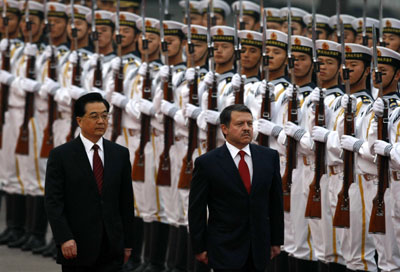 China's President
Hu Jintao (L) and Jordan's King Abdullah view an honor guard during a welcome
ceremony outside the Great Hall of the People in Beijing October 30, 2007. China's President
Hu Jintao (L) and Jordan's King Abdullah view an honor guard during a welcome
ceremony outside the Great Hall of the People in Beijing October 30, 2007.
 Luxury foreign holidays - Chinese tourists spend an average of $3,000 per
overseas trip, a recent survey has found. The total includes money for shopping
sprees abroad, luxurious accommodation and expenses prior to the trip. The
survey, conducted by the Nielsen Company and Pacific Asia Travel Association,
showed travelers to Europe to be the biggest spenders, splashing out an average
of $5,253 per trip. In comparison, those holidaying in Asia spent about $1,900
per person. The exceptions were those traveling to Hong Kong and Macao - the
long-preferred shopping and entertainment destinations for Chinese - whose
average spend was $2,185. Grace Pan, head of travel and leisure research for the
Nielsen Company, China, said: "Asia remains the most popular destination for
Chinese travelers because of the proximity. "However, trips to Europe and
America are becoming increasingly popular, particularly when you add in the
number of business travelers." Affluent market - "We also found that while
mass-market travelers focus on budget travel, there is a fast-emerging affluent
market segment prepared to indulge in luxury travel," Pan said. The survey found
that more than one-third of Chinese overseas travelers choose to stay in
four-star hotels, with a further 10 percent opting for five-star accommodation.
Pan said consumers were also becoming more sophisticated and better prepared
when planning their trips, using all the information available to them on the
Internet. The survey found that nearly seven in 10 leisure travelers accessed
destination websites, and about six in 10 used online travel discussion forums
to source information. The Internet is the most popular source of information
for potential travelers, followed by travel agents and other media such as
newspapers and magazines. While the majority of tourists still uses travel
agents (61 percent), 29 percent prefer online travel services and 16 percent go
via hotel or transport operators' websites. Holiday bookings made via the
Internet are predicted to increase. PATA Strategic Intelligence Center director
John Koldowski said: "Last year, Chinese made 35 million overseas trips, and the
figures are expected to rise dramatically."
Luxury foreign holidays - Chinese tourists spend an average of $3,000 per
overseas trip, a recent survey has found. The total includes money for shopping
sprees abroad, luxurious accommodation and expenses prior to the trip. The
survey, conducted by the Nielsen Company and Pacific Asia Travel Association,
showed travelers to Europe to be the biggest spenders, splashing out an average
of $5,253 per trip. In comparison, those holidaying in Asia spent about $1,900
per person. The exceptions were those traveling to Hong Kong and Macao - the
long-preferred shopping and entertainment destinations for Chinese - whose
average spend was $2,185. Grace Pan, head of travel and leisure research for the
Nielsen Company, China, said: "Asia remains the most popular destination for
Chinese travelers because of the proximity. "However, trips to Europe and
America are becoming increasingly popular, particularly when you add in the
number of business travelers." Affluent market - "We also found that while
mass-market travelers focus on budget travel, there is a fast-emerging affluent
market segment prepared to indulge in luxury travel," Pan said. The survey found
that more than one-third of Chinese overseas travelers choose to stay in
four-star hotels, with a further 10 percent opting for five-star accommodation.
Pan said consumers were also becoming more sophisticated and better prepared
when planning their trips, using all the information available to them on the
Internet. The survey found that nearly seven in 10 leisure travelers accessed
destination websites, and about six in 10 used online travel discussion forums
to source information. The Internet is the most popular source of information
for potential travelers, followed by travel agents and other media such as
newspapers and magazines. While the majority of tourists still uses travel
agents (61 percent), 29 percent prefer online travel services and 16 percent go
via hotel or transport operators' websites. Holiday bookings made via the
Internet are predicted to increase. PATA Strategic Intelligence Center director
John Koldowski said: "Last year, Chinese made 35 million overseas trips, and the
figures are expected to rise dramatically."

*News information are obtained via various
sources deemed reliable, but not guaranteed

|


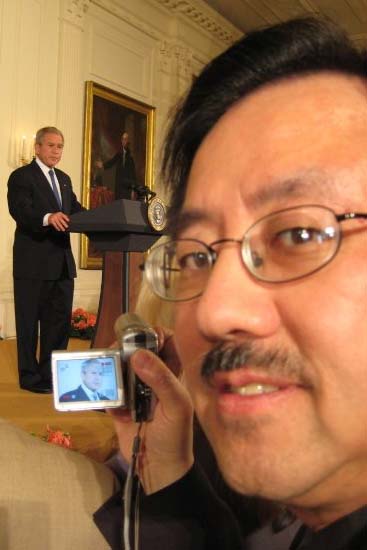
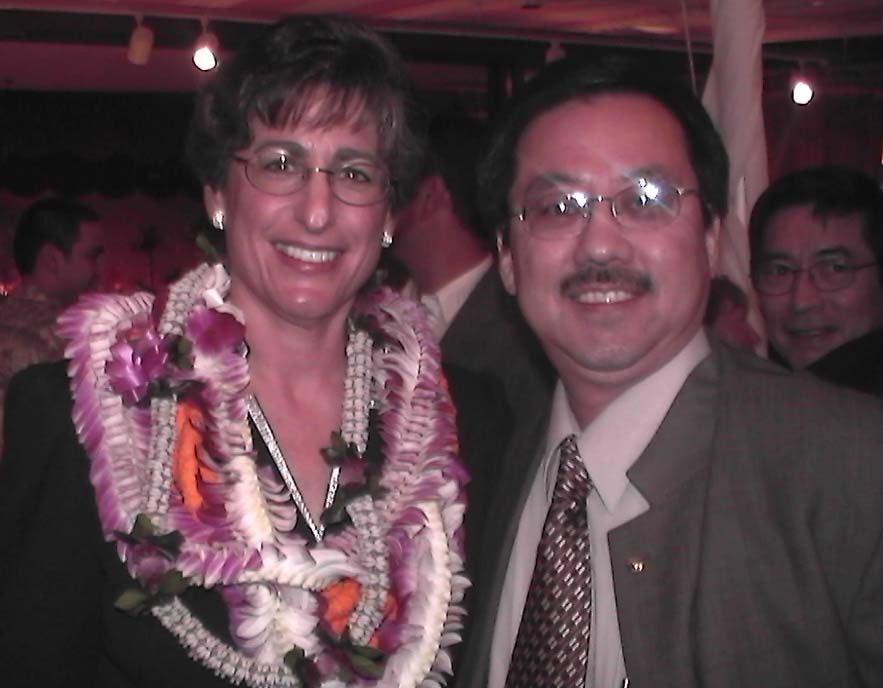


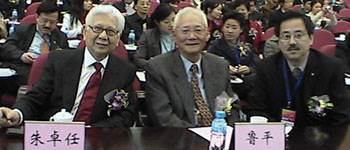




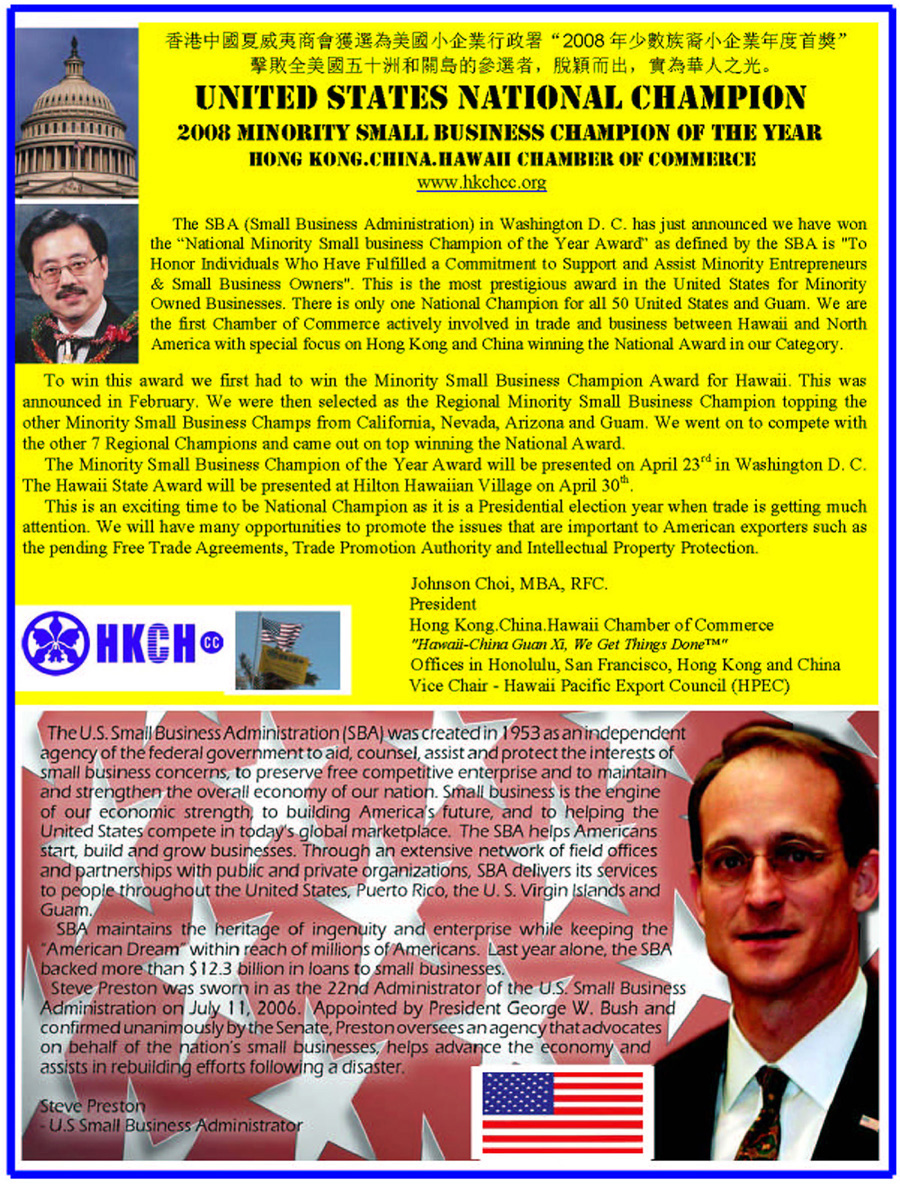 USA Small Business Administration (SBA)
Selected Johnson Choi/HKCHcc
2008 United States
National Champion
USA Small Business Administration (SBA)
Selected Johnson Choi/HKCHcc
2008 United States
National Champion
 and follow us
on
and follow us
on